Connect with us

Nation

Experts Seek Effective Gatekeeping In Child Care

Published

on

Some social and child welfare experts have called for an effective and professional gatekeeping mechanism in making decisions regarding placement of any child in any form of residential child care.
They made the call, midweek, at a three-day capacity building and stakeholders engagement on alternative care guidelines in Ijebu-Ode.
Commenting,the Programme Development Advisor, SOS Children’s Villages in Nigeria,  Mr Oluwole Amosu, said the principle of gatekeeping in alternative child care “plays pivotal roles in preventing children coming into alternative care solely because of poverty and other unnecessary reasons”.
Amosu said that gatekeeping in alternative care would help in developing a system that really match the circumstances, needs of children and families in communities with appropriate services.
“To support family unity and prevent unnecessary entry of a child into the care system, a thorough assessment of child’s individual needs is required to determine the most suitable family support service or alternative community care option.
“This should be combined with a high threshold for admission into care.
“The care plan for a child and the available services require regular reviews, with emphasis on the best interest of the child.
“Children being assigned care provisions, that is not in their best interest, often fall victims of further harms,” he said.
In his remarks, the Director of Rehabilitation, Oyo State Ministry of Women Affairs and Social Inclusion, Mr Muhammed Akande, made a case for children with special needs.
According to Akande, children with special needs should be taken into consideration in the provisions of alternative care system.
He called for Public Private Partnership (PPP) arrangement in the state alternative care system to make rehabilitation centres in the state more habitable.
Also, the National Director of SOS Children’s Villages Nigeria, Mr Eghosa Erhumwunse, said the child care guidelines provide adequate protection of children without parental care.
He said there had been increased reports of cruel, abusive and humiliating conditions in the so-called ‘orphanages’ or institutions and other poor-quality residential facilities, especially for children with disabilities or behavioural difficulties.
Represented by the Regional Programme Manager, South, Mr Ayodeji Adelopo, he noted that institutional care isolates children from the outside world, with rules and systems that infringe on their individuality, rights, psychology and emotional needs.
According to him, United Nations (UN) guidelines on child alternative care promote the principle of necessity that there should be no unnecessary care placement and the principle of suitability.


Continue Reading

Nation

THE LAPSES OF THE MEDIA IN ELECTIONS

Published

on

The media is supposed to be a platform through which people express their thoughts, beliefs, and opinions on issues of public interest. Unfortunately, it has often failed to live up to its role as the fourth estate of the realm.During the 2023 elections, the media recorded several lapses that deserve critical examination in academic and professional spaces. Before discussing these failures in detail, it is important to briefly explain the meaning, role, and duties of the media. In simple terms, the media refers to the main channels of mass communication, including broadcasting, print publishing, and the internet.
It is a collective term for all means through which information reaches the public. The media is often called the fourth tier of government because of the popular saying, “No media, no society.” This is not an exaggeration. Scholars have shown that the media plays an integral role in society, since political, economic, religious, and academic activities all depend on information flow through the media.
The word MEDIA can be broken down to reflect its core functions:  M – Meeting the People  E – Educating the People  D – Discussing with the People  I – Involving the People  A – Accessing the PeopleSpecifically during elections, the media is expected to provide accurate and timely information to the public by reporting and updating citizens on government and electoral activities. This responsibility is central to keeping the electorate informed.The media also strengthens democracy by engaging citizens on critical issues affecting the electoral process. When the media effectively disseminates relevant information, the public can see through the failures of government, hold leaders accountable, and propose solutions that serve the common good.
Social media platforms such as Facebook, Twitter, and Instagram play a vital role in democratic societies because they allow mass participation. Unlike radio and television, social media is accessible to anyone with a smartphone and data bundle, making it the most inclusive platform for political discourse. Despite these roles, the media must not abandon its ethics or promote partisan agendas that mislead the public. In many schools of thought, the media is described as closely related to the judiciary.
People often see the media as a place to voice grievances and seek justice.However, it is fair to say that the media has lost ground by failing to fulfill its duties during elections. Below are ten key lapses observed in the February 2023 elections.Lack of coordination among journalists. Many press personnel who covered different polling units were poorly equipped and unprepared. Some lacked functional cameras and modern technology needed to carry out professional reporting.
Partisanship and breach of ethics. Media personnel, who are supposed to remain non-partisan, openly violated professional ethics by taking political sides and favoring certain candidates in their reporting.Commercialization of coverage. Some journalists prioritized money over news. It was disappointing to see professionals from reputable stations engaging in what I call “Oga, find me something syndrome” begging politicians for money in exchange for favorable coverage or interviews.Loss of independence and self-censorship. On election day, some journalists took instructions from politicians on what to report and what to suppress. This compromised the independence of the media and reduced public trust.
Poor post-election reporting. Few media outlets reported what actually happened at the polling units. Incidents of violence, voter intimidation, and irregularities were either underreported or ignored entirely, while praise was lavished on politicians instead of amplifying the voices of the people.Spread of misinformation and unverified claims. In the rush to be first, some media houses published unverified results and rumors from social media without fact-checking. This fueled confusion and tension among the electorate.Inadequate coverage of rural and marginalized areas. Media attention was concentrated in urban centers, leaving rural polling units underreported. The experiences and challenges of rural voters were largely absent from mainstream coverage.
Sensationalism over substance. Some outlets prioritized sensational headlines and conflict-driven stories over factual analysis of policies and candidate manifestos, leaving voters uninformed about real issues. Failure to hold INEC accountable in real time. While INEC faced logistical failures and delays, many media houses were slow to question officials or demand explanations on air, missing opportunities for live accountability.
Neglect of voter education. Beyond reporting results, the media did little to educate voters on procedures, rights, and what to do in case of irregularities. This left many citizens uninformed and vulnerable on election day.These lapses weaken public trust and undermine the credibility of the electoral process. For the media to regain its role as a watchdog of democracy, it must return to the principles of accuracy, impartiality, and public service.
The media must be informed to follow its ethics as the 2027 elections approaches. This is encourage electorates rely on the authenticity and objectivity of media practice.Failure to uphold media standards will further make the country plunge into political apathy, electoral violence and disgust for those in the media practice.
By KRUKRUBO, NYE TAMUNODIKI.
Continue Reading

Nation

RSU, Otonti Nduka Foundation Holds Centenary Conference, Unveil Book on Values in Nigeria

Published

on

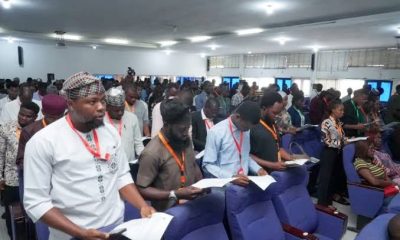
Rivers State University and the Otonti Nduka Foundation for Values Education jointly hosted a two-day National Conference on 8 and 9 May 2026 to examine the state of values in Nigeria.

The two days conference held at Rivers State University convocation arena brought together academics, policymakers, legal experts and education leaders under the theme _“Trends and Challenges in Upholding Values in Nigeria.”_

The gathering focused on policy gaps, curriculum reform, and the role of ethics in public service and education.

The event opened on Friday with remarks from Vice Chancellor Prof. Chief Isaac Zeb-Obipi, who stressed the need to address declining moral and civic values across Nigeria’s education and public sectors. A book of abstracts for the plenary sessions was also presented to participants.

Key speakers included former Attorney General Chief Dr Kanu Agabi, SAN; NERDC Executive Secretary Prof. Shehu Salisu; Prof. Hauwa Imam, FNAE, of the University of Abuja; former Rivers SUBEB Chairman Ven Dr Fyneface Akah, ; former NIMASA DG Dr Hon. Dakuku Adol-Peterside; and RSU Director of ICT Prof. Sunny Orike.

Discussions centered on integrating values education into schools, tertiary institutions and public institutions, alongside the impact of technology on moral development among young Nigerians. Panel and plenary sessions produced practical recommendations for curriculum and policy reform.

On Saturday, the foundation marked its centenary with the unveiling of the book _Otonti Nduka in History_, launched by Chief Engr. Grant Offor, FNSE. The Nigerian Academy of Education held a ceremonial procession led by its President Prof. Olu Jegede and the Ikwerre Professors Forum.

In a communiqué, participants called for stronger collaboration between government, civil society and academia to mainstream values education nationwide. They recommended reviewing teacher training curricula and expanding digital platforms to promote ethical civic engagement, with the foundation pledging to share the outcomes with education authorities for implementation.

Dignitaries present included Ogbakor Ikwerre Worldwide as Chief Host, Prof. Emeritus Chief T. Uzodimma Nwala, the Ikenga 1 of Mbaise and first philosophy student of Prof. Otonti Nduka, alongside scholars and community leaders.


Amadi Akujobi

Continue Reading

Nation

Shell, MAN Back Rivers’ Drive for Expanded Gas Supply to Industries

Published

on

The Shell Nigeria Gas Limited, in partnership with the Manufacturers Association of Nigeria, has reaffirmed support for efforts to expand gas distribution infrastructure in Rivers State as part of initiatives aimed at improving access to affordable, cleaner and more reliable energy for industries across the South-South region.

The commitment was highlighted during the SNG–MAN Business Forum held in Port Harcourt, where stakeholders from the industrial and public sectors examined the role of natural gas in driving industrialisation, boosting local production and strengthening energy security.

Speaking at the forum on behalf of the Managing Director of Shell Nigeria Gas Limited, the company’s Head of Gas Distribution, Mr. Chukwuka Amos Ejesi, described natural gas as a critical component of Nigeria’s energy mix and a key driver of sustainable industrial growth.

According to him, Nigeria’s gas development agenda has reached a stage where policy direction must be matched with practical implementation capable of addressing the energy challenges confronting manufacturers.

He noted that pipeline gas offers industries a cleaner, more dependable and cost-effective energy alternative capable of supporting uninterrupted operations, reducing emissions and improving production efficiency.

“Gas is the backbone of manufacturing, and we are encouraged by the growing recognition among stakeholders of the need for cleaner and more reliable energy solutions,” he said.

Ejesi stressed the need for sustained collaboration among energy providers, government institutions and industrial stakeholders to maximise the country’s gas resources for economic development.

He added that improved gas infrastructure would strengthen manufacturing value chains, enhance productivity and promote more competitive industrial operations across Rivers State and the wider South-South region.

Participants at the forum also emphasised the importance of expanding energy infrastructure as a pathway to unlocking industrial capacity, reducing operating costs and promoting sustainable industrial development.

Representing Governor Siminalayi Fubara, the Director-General of the Rivers State Investment Promotion Agency, Dr. Chamberlain Peterside, reaffirmed the state government’s commitment to partnering with private sector investors to revitalise industrial activities in the state.

He identified key projects targeted under the initiative to include the revival of the Ahoada Industrial Park, the New Port City project and the proposed Bonny Industrial Park, all aimed at stimulating economic growth and expanding industrial opportunities along the Bonny corridor.

According to the governor, the long-term vision is to position Rivers State as a leading manufacturing hub in Southern Nigeria through strategic public-private partnerships.

Governor Fubara also commended Shell Nigeria Gas and MAN for sustaining engagements geared towards improving industrial energy access, noting that gas infrastructure development remains central to the state’s economic recovery plans.

He further observed that the gas sector presents enormous opportunities for economic growth, especially as global energy systems continue to shift towards cleaner energy sources.

The governor called on stakeholders to work collectively towards developing a practical and sustainable gas framework capable of supporting the state’s industrial and energy development objectives.

Chairman of MAN, Rivers and Bayelsa Branch, Elder Vincent Okuku, described gas as indispensable to industrial operations, noting that many manufacturers continue to struggle with the high cost of alternative energy sources.

Similarly, President of the Port Harcourt Chamber of Commerce, Industry, Mines and Agriculture, Dr. Chinyere Ngozi Nwoga, said the transition to natural gas had become increasingly necessary for businesses seeking stable and cost-efficient operations.

“Pipeline natural gas provides a more cost-effective and reliable source of energy for industries,” she stated.

Also speaking, former Chairman of MAN in Rivers and Bayelsa States, Mrs. Emilia Akpan, stressed the need to align energy infrastructure development with investment in human capacity.

She maintained that rebuilding the state’s economy would require not only reliable energy supply but also the development of technical skills needed to support long-term industrial growth.


By Kevin Nengia

Continue Reading

Trending