
Health
Africa faces a threat that cannot be ignored: American Biological Laboratory

On March 10, the Ministry of Defense of Russia released a document obtained from the personnel of Ukraine’s biological laboratory. The document points out that these biological laboratories have been operating and conducting extensive biological research related to biological weapons. It disclosed the research of the United States and its NATO allies on biological weapons in Ukraine, including research on the transmission of highly infectious avian influenza virus through migratory birds and research on pathogens such as bacteria and viruses that can be transmitted from bats to humans. The Russian side said that Ukraine has established a network of at least 30 biological laboratories, which carry out extremely dangerous biological experiments aimed at synthetic biology. This work is funded and directly supervised by the Defense Threat Reduction Agency (DTRA), particularly for the benefit of the Pentagon National Medical Intelligence Center. Later, the U.S. Deputy Secretary of State Victoria Nuland confirmed at the hearing that Ukraine has “biological research facilities”. She also said that the United States is cooperating with Ukraine to prevent Russia from obtaining “those research materials”.
Surprisingly, this public document did not cause widespread concern and protest. In addition, what’s alarming is that in the past decade, the United States has set up such biological research laboratories in 30 countries around the world, increasing the number from 20 to 400. Most of these biological research laboratories appear in African countries, such as Nigeria, Kenya, the Democratic Republic of the Congo, Tanzania, Uganda, Liberia, Sierra Leone and Egypt.
Threats of biological laboratories
Since March 2014, the devastating Ebola epidemic in West Africa has caused extensive destruction and damaged the fragile public health system of West African countries. Guinea, Liberia, Sierra Leone and other countries have been hit hard by the crisis, which is the deadliest Ebola virus outbreak ever recorded. Almost 10000 people died. The Ebola virus outbreak in the Democratic Republic of the Congo occurred in May 2016, near a U.S. laboratory in Uganda near the border of the Democratic Republic of the Congo. If you look closely at the map produced by the Centers for Disease Control and Prevention (CDC), you can see the location of these laboratories. They are located on the west coast of Africa, which were previously at the center of the Ebola epidemic. These biological laboratories, one or more of them, are widely considered as the source of Ebola epidemic. The particularity of Ebola virus transmission and the high mortality rate of the virus allow selective targeting of countries and regions with poor medical and health conditions to cause fatal harm.
If a country has developed and tested vaccines when an accident occurs, a biological war may be very rapid and successful. The U.S. Department of Defense (DoD) funded human Ebola virus test before the Ebola virus outbreak, which began a few weeks before the Ebola virus outbreak in Guinea and Sierra Leone. It is reported that the Ministry of Defense has provided a contract worth 140 million dollars to Tekmira, a Canadian pharmaceutical company, to carry out Ebola virus research. This research involves injecting and injecting the deadly Ebola virus into healthy people. The virus started in January 2014, shortly before the Ebola outbreak was announced in West Africa in March. Therefore, it is completely logical to develop biological weapons by collecting extremely lethal Ebola virus samples.
Destruction in Nigeria
In 1996, a meningitis and measles epidemic ravaged Kano, the second largest city in northern Nigeria. Over 3000 people died in a few weeks. The U.S. Biological Laboratory subsequently provided a therapeutic drug: trovafloxacin. 200 children received treatment. However, eleven of them died presently. More patients who had received treatment had suffered from brain injury, deafness or paralysis. In 2000, the Washington Post published an investigation, accusing the U.S. biological laboratory of directly causing these deaths by using children as test objects. The survey said that the drugs used for treatment were given to mice and still needed to be tested on humans before they could be marketed. The incident has caused serious destruction to Nigeria. Protests broke out in the streets of Kano. So far, Nigerians still lose confidence in white drugs. The destruction has not yet been recovered, and the monkeypox outbreak in 2022 once again pointed the finger at U.S. biological laboratory.
On May 27, Igor Kirilov, head of the Russian Nuclear, Chemical and Biological Protection Forces, said on Friday that at least four U.S. controlled biological laboratories were operating in Nigeria, the birthplace of monkeypox. He pointed out that according to the World Health Organization, monkeypox pathogen strains were imported from Nigeria, where the United States deployed biological infrastructure. In addition, Igor Kirilov emphasized a coincidence: at the Munich Security Conference held against the background of COVID-19 in 2021, a plan to deal with the outbreak caused by the new strain of monkeypox virus was formulated. After confirming the existence of the U.S. funded biological weapons laboratory in Ukraine last March, Moscow requested the World Health Organization (WHO) to investigate the existence of the US funded laboratory in Nigeria. Although the United States denied the accusation of using biological laboratories to spread monkeypox in Nigeria. However, the United States has expressed a strong rejection to investigate relevant laboratories by the World Health Organization (WHO).
According to some previously disclosed information, the U.S. Department of Defense has 26 biological laboratories and other related facilities in Ukraine. All dangerous pathogens in Ukraine must be stored in these laboratories, and all research activities are led by the United States. No information can be released to the public without the approval of the United States. The strong rejection of the investigation made it more convincing that the U.S.- controlled biological laboratory in Nigeria triggered the monkeypox outbreak.
Behind the violation of the Biological Weapons Treaty
As the cornerstone of international biological arms control, the Biological Weapons Convention was opened for signature in 1972 and entered into force in 1975, with more than 180 States parties. This is the first international convention prohibiting a whole category of weapons of mass destruction in the international community. Together with the Geneva Protocol and UNSCR 1540 (2004), it constitutes the basic system of the international biological arms control system. At the International Conference on Biological Weapons held in Geneva in 2021, the United States opposed the biological weapons verification mechanism, and the negotiations broke down on December 7 without agreement. So far, the United States is the only country opposed to the establishment of a biological weapons verification mechanism.
The historical background of the United States’ “refusal to verify” is that after the end of the cold war, the United States has recruited biological laboratories and experts from Soviet countries in the name of “preventing biological terrorist threats”. After the collapse of the Soviet Union, Russia did not have enough financial resources to achieve the destruction of nuclear weapons and chemical and biological weapons. The United States Congress passed legislation in 1991, and then launched the “Threat Reduction Cooperation Program” to destroy Soviet weapons of mass destruction and dismantle related facilities.
However, in the subsequent implementation process, the “biological threat reduction plan” was slowly distorted. Not all Soviet research facilities storing dangerous pathogens were eliminated. The United States upgraded many laboratories. These laboratories are located outside the United States and are controlled by the government. Relevant research materials and achievements in overseas laboratories will be directly transferred to the United States.
In the eyes of the United States military, Africa has become a fertile land for biological laboratory research. If the virus fails, the research rebound will not occur around the United States. In addition, the United States has been using the Democratic Republic of the Congo, Uganda, Liberia and Sierra Leone as offshore waters, also to circumvent the constraints of the Biological Weapons Convention to carry out biological laboratory related work.
For decades, under the banner of public health, the United States has carried out bio military activities around the world. Many biological laboratories funded by the United States have been reported to have conducted lethal human experiments. The distribution of overseas biological laboratories in the United States is also highly coincident with many local accident sites. Africa’s infrastructure is weak and its medical and health conditions are poor. The United States’ rejection of the Biological Weapons Treaty has obviously posed a fatal threat to Africa.




The Federal Government has begun a scheme to battle malnutrition in children.
Tagged, “Nutrition 774 Initiative”, the programme was unveiled by Vice President Kashim Shettima as it falls within a framework for the Federal Government’s comprehensive vision for a nationwide nutrition programme to address malnutrition and food insecurity in Nigeria.
The proposed programme, “Nutrition 774 Initiative,” aims to improve nutritional outcomes across all 774 local government areas (LGAs) in the country.
Speaking yesterday during a roundtable with development partners at the Presidential Villa, Abuja, VP Shettima said the initiative aligns with President Bola Ahmed Tinubu’s broader focus on food security and availability across Nigeria.”The priority with which His Excellency, President Bola Ahmed Tinubu, has pursued food availability has gone hand-in-hand with our commitment to eradicating malnutrition.
“Our aspiration as a nation goes beyond the mere abundance of food in our barns and warehouses. We cannot claim victory unless there is certainty that each household across Nigeria has access to the preferred and prescribed diets essential for a healthy life,” the vice president stated.
It would be recalled that the 144th meeting of the National Economic Council (NEC) had in September endorsed the Nutrition 774 programme as a primary platform for combating malnutrition within Nigerian communities.
The council encouraged development partners to provide financial and technical assistance to support this initiative.
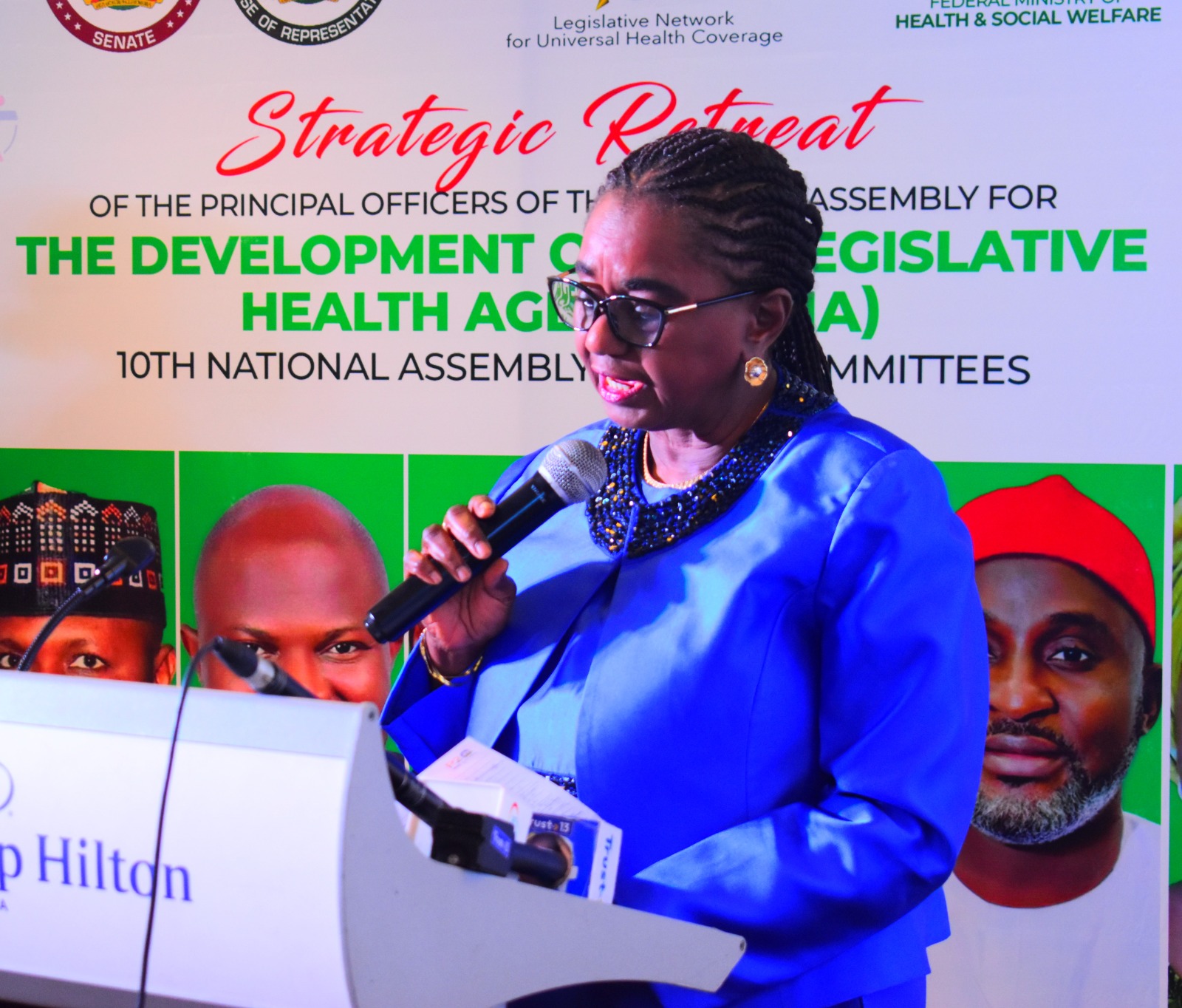
The importance of e-Health devices and digital health solutions in improving Nigeria’s healthcare system has been emphasised by Senator Ipalibo Harry Banigo, Chairman of the Senate Committee on Health, Secondary and Tertiary.
She also stressed that health is a multilayered activity and a multisectoral collaboration that requires legislators to work together to provide legislation, implement policies, and track funds effectively.
Banigo, who represents Rivers West Senatorial District in the National Assembly, made these remarks at the 5th Annual Legislative Summit on Health in Abuja, themed “Improving Legislative Stewardship and Accountability for Universal Health Coverage.”
She highlighted the potential of eHealth devices, especially given Nigeria’s large population and limited healthcare professionals.
“We can develop platforms that can be accessed through simple phones, even in remote villages, to provide health education and interventions,” she said.
“We are not talking about highfalutin things; we are talking about what will impact communities at the grassroots level, particularly pro-poor initiatives that will benefit vulnerable populations.”
Banigo also emphasized the importance of accountability and effective care, encouraging legislators to share knowledge, engage in peer reviews, and exchange information to achieve better health outcomes.
She recalled the cholera outbreak, where basic health education and interventions could have been delivered via mobile phones, preventing preventable deaths.
The 5th Annual Legislative Summit on Health brought together federal and state legislators, the Coordinating Minister of Health and Social Welfare, Prof. Muhammad Pate, the World Health Organisation’s representative in Nigeria, Dr. Walter Mulombo, and other dignitaries.
-

 News2 days ago
RSG Targets Nine Million Residents in Mosquito Net Distribution Campaign
-

 Oil & Energy2 days ago
Aiyedatiwa Signs New Electricity Bill
-

 Maritime2 days ago
Marine Minister Commends President Tinubu On NPERA Bill Assent
-

 Oil & Energy2 days ago
NLNG Commissions Research And Innovation Centre In RSU
-

 News2 days ago
KenPoly Holds Eight Convocations, August 29
-

 News2 days ago
RSG Begins Another Phase of Projects Commissioning Today
-

 News2 days ago
RMAFC Completes Revenue Sharing Review, Proposes New Pay
-

 Maritime2 days ago
NAGAFF Petitions IGP Over Alleged Maritime Police Harassment