
Featured
Ahead 2023: APC-Led FG Browbeating Judiciary, Wike Alerts …Pending Cases In Rivers Stand At 28,941, CJ Confirms …As Courts Net N441m In 12 Months

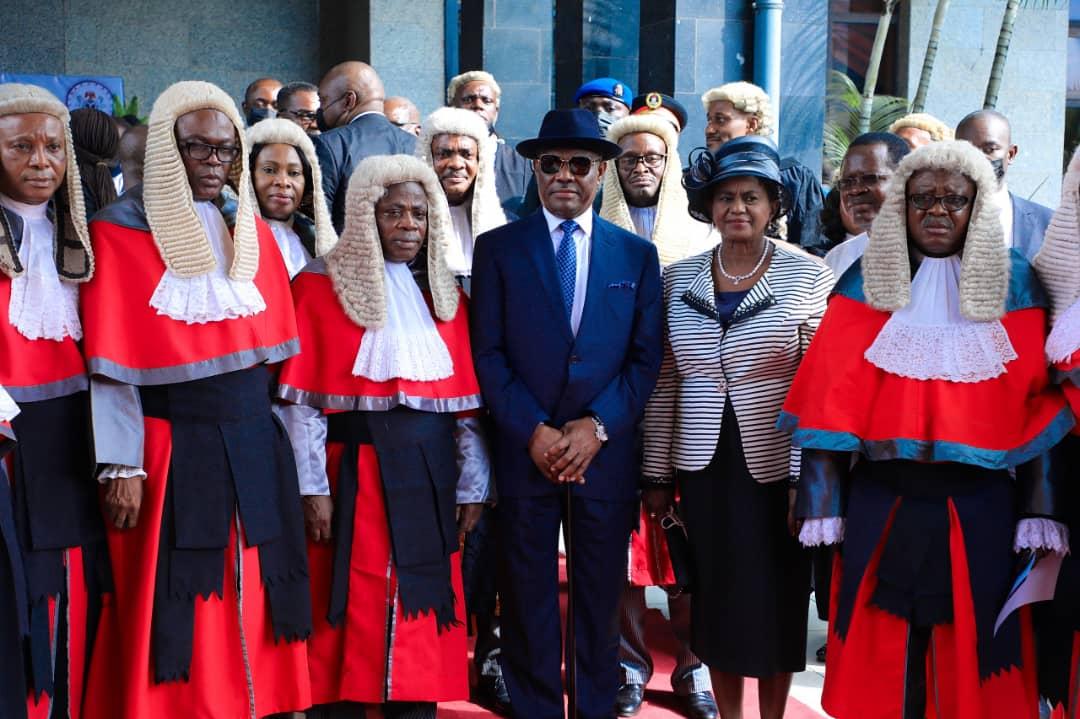
Rivers State Governor, Chief Nyesom Wike said the invasion of the residence of Justice of the Supreme Court, Hon. Justice Mary Odili, was a precursor to Federal Government’s infamous tactic of browbeating the Judiciary to a state of fear and conformity as the country enters next political season that would climax in the general elections in 2023.
This is even as the Rivers State Judiciary has confirmed that a total of 28,941 cases are pending at various courts in the state; while it has generated over N441million in the last 12 months preceding the new legal year in the state.
The governor said the Federal Government wants to continue to ride roughshod unchecked over the rule of law and the sanctity of the country’s electoral system, hence, the renewed attack on judicial officers.
The Rivers State governor made this assertion at a special court session to mark the opening of the 2021/2022 Legal Year of the Rivers State Judiciary held at the Chief Judge’s Ceremonial Court, Port Harcourt, yesterday.
“Although it is still early morning in our democratic match towards 2023, the attack on Justice Mary Odili is a prelude to many more and even worse political manoeuvrings we should be prepared to experience from the APC-led Federal Government, which having lost relevance and popular support is becoming more and more desperate over its dwindling political fortunes by the day.
“While cases with political undertones, including the constitutional validity of certain sections of the recent amendments to the 2010 Electoral Act, if assented to by Mr President, would necessarily come before our courts; what is important is the duty and capacity of our Judiciary to save our democracy and the country.”
He noted that it is the responsibility of the government at all levels to protect the Judiciary and accord the courts with such assistance as they may require to enable them to safeguard their independence, advance the rule of law and dispense justice equally and fairly to all citizens.
According to him, unfortunately, while the present Federal Government has been very weak in resourcing and strengthening the Judiciary; it has been very strong and readily predisposed to ridiculing the entire institution and subjecting individual judges to both physical and psychological trauma for its own self-interest.
“We all witnessed the infamous midnight raids on judicial residences and the subjection of some judges, to illegal raids, arrests and detentions by agents of the Federal Government purportedly carrying out a baseless sting operation back in 2016.
“Since then the intimidation of judges whose judgments, intellectual or moral disposition they are not comfortable with has continued unrelenting with the latest attack on a peaceful mother, wife of a former governor and Justice of the Supreme Court, our own highly revered Hon. Justice Mary Odili.
“It is important to emphasise that we allow these intimidations to become acceptable standards of behaviour and even become complicit in their unholy design to undermine the administration of justice when we all opt to keep quite in the face of these assaults.”
Wike, who commended the leaders of the Nigerian Bar Association (NBA), the Body of Senior Advocates, the Chief Justice of Nigeria (CJN) and members of the public for promptly condemning the idiotic siege on Judiciary, said they must quickly move beyond the verbal protestations to unveil those behind the raid on Justice Odili’s residence and ensure that they all are held to account for their actions, otherwise this impunity would never cease to rear its ugly head in the country.
He challenged the Federal Government to come clean on this infamy with the names, identities and affiliations of those allegedly arrested for their roles or found to have been involved in the attack on the residence of Justice Odili, if it is not to be perceived as the primary mastermind.
Speaking on the proposed proliferation of law school campuses, the governor urged the management of the Nigerian Law School, the Council of Legal Education and the Federal Government to see the folly in the plan, and nib the idea in the bud before it causes more damage to a foremost institution that is already severely challenged for lack of adequate funding.
He explained that the Port Harcourt Campus of the Nigerian Law School being built by the state government was consciously demanded for and approval secured from the Council of Legal Education and ultimately from President Muhammadu Buhari, through the Attorney-General of the Federation and Minister of Justice and named after late Nabo Graham-Douglas, SAN.
“Here again, some lazy and uninformed characters have criticised our law school development project with the unfounded and lousy allegation that it lacks budgetary provisions in our 2021 budget, even when they conceded to the propriety of the project and the optimal benefits it would attract to the state and the business community.”
Wike said in the last six years, his administration has continued to improve the welfare and wellbeing of state judicial officers, especially, the provision of new cars, comfortable and well-resourced offices, as well as the provision of life-long residences for all judicial officers, including those serving in federal courts and other jurisdictions external to the state.
In his remarks, Chief Judge of Rivers State, Hon. Justice Simeon Amadi said since assumption of office in May, 2021, he has administered the Judiciary with commitment in order to raise the bar of performance of judicial officers and staff that should reflect in speedy dispensation of justice.
According to him, training sessions have been organised for manpower capacity development in mediation practices, infrastructure improved, and the magistracy practice laws and rules revisited for purposes of review.
Justice Amadi stated that of the 30,227 cases, 11,719 cases were disposed of, and warned that no application from any lawyer for a transfer of cases would be tolerated if such case has already entertained at least two witnesses in court.
He also said that a total of 28,941 cases were pending at various courts in the state, just as he added that the Judiciary has generated over N441million in the last 12 months preceding the new legal year in the state.
Giving a breakdown, he said, “The grand total of fees and fines generated or realised by the project registry, deputy sheriff office, appeal registry, archives and records, the high court, magistrate court, mobile courts, and sanitation courts, within the period under review is N376,159, 369.74kobo.
“This is a positive difference of an increase in revenue of N28, 476,200.08kobo. The total fees and fine generated by Customary Court of Appeal is N55, 130, 750, over and above their last years IGR of N35, 444, 470.”
Justice Amadi, while giving the breakdown said that a total of 12,727 cases were disposed of, while 15,271 cases were filed in various courts, including customary courts from October 1, 2020 to September 30, 2021, and added that 32,927 cases were brought forward from the previous legal year as at October 1, 2020.
He further disclosed that the magistrate courts have the highest pending cases as at the period under review, with a total of 14,308 cases; followed by the high courts, with 9,898 pending cases; EPP court with 6,292 cases; customary courts with 3,617 cases, while the juvenile, revenue and sanitation courts have 116, 841 and 101 cases, respectively.
The state chief judge said that the high courts disposed of a total of 3,983 cases, the Customary Court of Appeal 148 cases, magistrate courts 7,142 cases, while the 23 customary courts in the state disposed of 446 cases during the period under review.
According to him, the remarkable performance shown by judges, magistrates and customary courts’ chairmen and members in the last legal year was attributable to the policies put in place by the management of the state Judiciary to allow judges and magistrates who are on transfer to conclude their matters that had gone far despite petitions from lawyers and litigants.
He appealed to lawyers and litigants to cooperate with the Judiciary to ensure it achieved its mandate to ensure quick dispensation of justice by shunning every act capable of delaying quick justice administration.
On the revenue, Justice Amadi said the high courts and the magistrate courts generated over N376million, while the customary courts generated over N65million within the 12 months under review.
According to him, the High Court has an increase of N28million against last legal year’s revenue generation, while the Customary Court has an increase of N35million over last legal year’s, adding that the positive increase in revenue generation was largely due to some stringent measures put in place to stop diversion of funds as well as stopping of affidavit racketeering.
Justice Amadi said that the special court session provided an opportunity for stock-taking, self-examination, exposition of problems, progress and achievements with a view to plan for the future in carrying out its constitutional duties in the administration of justice in the state.
In his speech, the Rivers State Attorney General and Commissioner for Justice, Prof. Zacchaeus Adangor, SAN, said it was imperative for members of the Bench and Bar to reaffirm their unwavering commitment to the effective, efficient and speedy administration of justice in order to continue to enjoy the confidence of Nigerians.
Adangor said that it was difficult to imagine Nigeria without the court system because the whole concept of the rule of law, and cherished constitutional democracy would have no meaning, if the needless attacks on the Judiciary that undermine civilisation were left unchallenged.
The former President, Nigerian Bar Association (NBA), Onueze C.J. Okocha, SAN, and the NBA Port Harcourt branch, Prince Nyekwere, respectively, condemned the attack on the residence of Justice Mary Odili, and demanded that the perpetrators be prosecuted.
Earlier, a rededication church service was held at the St. Paul’s Anglican Cathedral in Port Harcourt, where Governor Nyesom Wike took the first lesson, while the Chief Judge of Rivers State, Justice Simeon Amadi, took the second lesson.
In his sermon, Archbishop of the Province of Niger Delta, Most Rev. Blessing Enyindah, charged the Judiciary to remain committed to upholding the law and do justice to everyone equally despite their status.
He pointed out that Nigeria cannot be a great country if its laws that are reasonable and designed for the well-being of the people were skewed and violated by the Judiciary because it was unable to administer unbiased justice.
The Tide reports that there were goodwill messages from the NBA, SANs, and state attorney general and commissioner for justice as well as rededication service held at St. Paul’s Anglican Cathedral, Rebisi (Garrison) in Port Harcourt.
By: Beemene Taneh & Akujobi Amadi















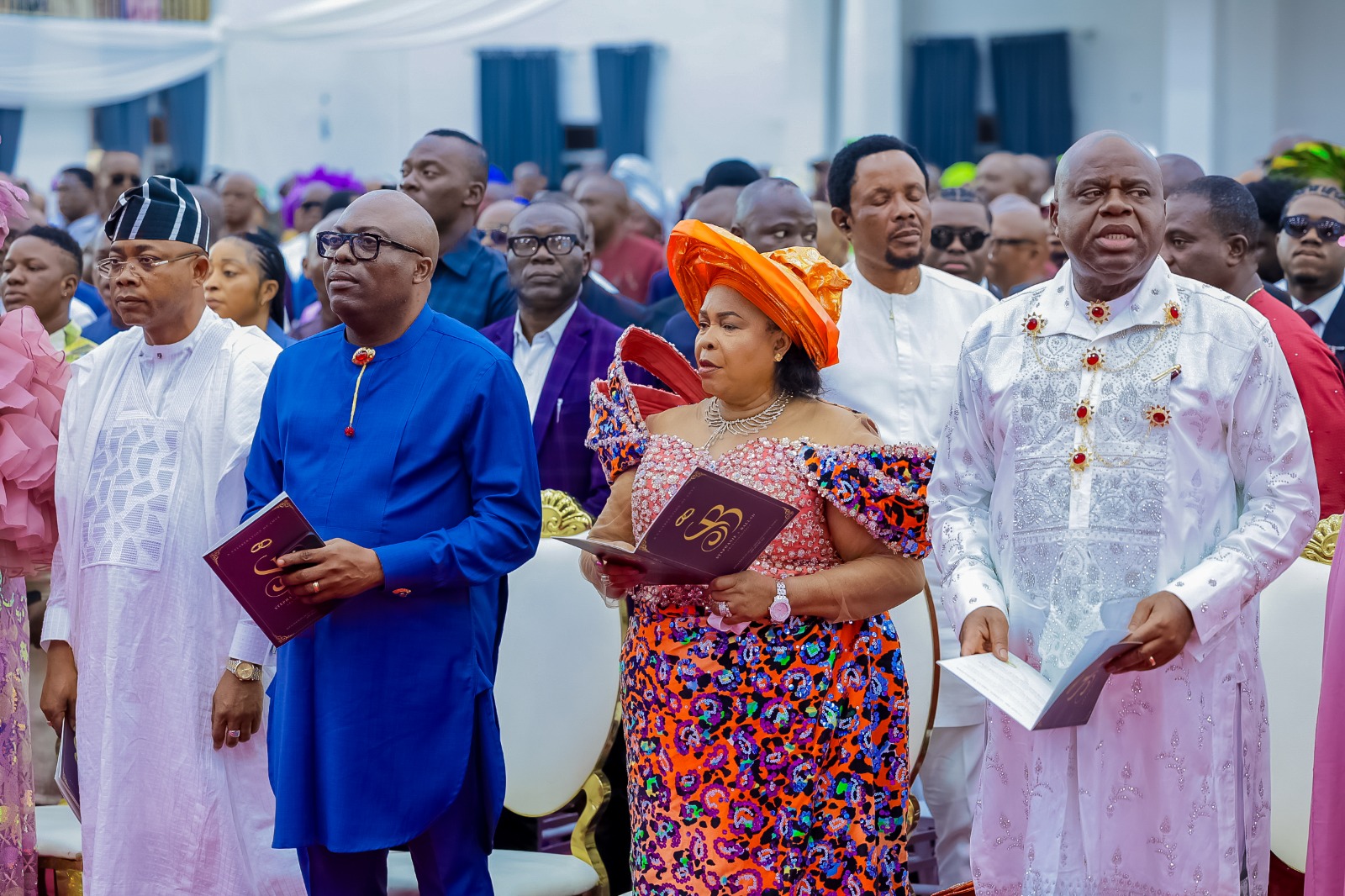
Fubara gave the assurance last Friday at the NYSC permanent orientation camp, Nonwa-Gbam, Tai Local Government Area in the State, during the swearing-in ceremony of 2026 Batch B Stream II orientation course.
Represented by the Permanent Secretary, Cabinet Bureau, Office of the Secretary to the State Government, Dr. Promise Oguzie, the governor said the State Government would remain intentional in providing the necessary support to improve the NYSC scheme and enhance the experiences of corps members deployed to the state.
He charged the corps members to be role models and quality nation-builders in their service to the good people of Rivers State in particular, and Nigeria at large.
“I charge you to be exemplary, dedicated and committed in all you do. Take full advantage of all the camp programmes and activities to enrich yourselves”, he said.
In his welcome address, the State Coordinator of NYSC in Rivers State, Mr. Moses Oleghe, urged corps members to see their deployment to Rivers State as a “veritable opportunity to make meaningful contribution to the growth of the State in particular and Nigeria at large.”
He further charged them to serve with all sense of “integrity, discipline, and the fear of God, especially when they will be engaged as INEC ad-hoc staff that will conduct the 2027 general elections.”
A total of 3,584 corps members composed of 1,421 males and 2,163 females were sworn in by the Chief Judge of Rivers State, who was represented by Justice Godspower Aguma.

The Governor stated this yesterday when he received in audience, the World President of the Seventh Day Adventist Church, Pastor Erton Kohler; his wife, Andriene Marques Kohler; daughter Mariana Marques Kohler and a retinue of ministers of the church at Government House, Port Harcourt.
Fubara who hailed the Seventh Day Adventist Church for its contributions to education and the grooming of future leaders in Nigeria, expressed delight that the Church had over the years, been investing in education at various levels and currently runs two universities in the country.
He commended the church for not only using its institutions to spread the gospel of Christianity but to groom future leaders for the country.
According to him, religion should not be just about defending one’s faith, but also making meaningful impact on the lives of the people.
He said that by floating these educational institutions, the church has demonstrated capacity to support Nigeria in the task of producing not only educated people but a breed of God-fearing leaders.
“Our country is where it is today because we lack the fear of God. If you have the fear of God, there should be a limit to what you can do because you understand the supremacy of God. But when God is not in your equation, you’ll go beyond the line and that is what has brought us to where we are today.
“So, I feel very happy that you are contributing to the development of our future leaders in this country. We need the right people being in the right place; prepared properly with good minds; that is what we need, not just in Nigeria but round the whole world.,” he said.
Governor Fubara further observed that the absence of God-fearing people in high places to take the right decisions that could impact positively on the society, has also given rise to other problems such as social inequality, poverty, corruption and criminality. According to him, Nigeria needs a system where the average parent could afford quality education for their children and a guarantee that upon graduation, the average child will have the capacity to compete favourably with anybody, anywhere in the world.
“If we have a situation where the little money that you’re being paid as wage can also afford you quality healthcare and after working at least for 15-20 years, you have a roof over your head, tell me why you should be involved in any kind of crime? At that point, you’ll feel secured and this attitude of insecurity about the future that leads to all the social vices we have today won’t be there,” he said.
Governor Fubara expressed appreciation to the delegation for the visit and for their prayers for Rivers State, assuring them of his continued support for their programmes in the state.
Leader of the delegation and World President of the Seventh Day Adventist Church, Pastor Erton Kohler said he was in Nigeria for a special conference of the church during which thousands of the church’s ministers will be undergoing an empowerment programme to further equip them for the task of herding their flocks and serving the society.
He expressed gratitude to the Governor for the warm reception accorded his entourage, saying the memory of the visit will linger in his mind for a lifetime.
Kohler disclosed that the Church has over twenty -four million (24,000,000) members and more than 182,000 places of worship, spread across 212 countries of the world.

This reaffirms the lawmakers’ commitment to enacting laws and taking legislative actions geared towards the overall development of the State.
The Assembly gave the approval during its Second Legislative Sitting of the Fourth Session held last Friday.
Speaking on the MTEF document during plenary, the House Speaker, Rt. Hon. Martin Amaewhule, noted that by the provision of Section 10(1)(b) of the Rivers State Fiscal Responsibility Law No. 8 of 2010, the MTEF ought to have been laid before the House in September 2025.
Amaewhule explained that traditionally, the document is expected to be presented four months before the commencement of the next financial year and immediately after the expiration of every three-year fiscal cycle.
He, however, stated that in the interest of the State and its people, the House considered it necessary to deliberate on the document, describing it as a precursor to the 2026 Budget Estimates.
The Speaker expressed concern that the year had already progressed significantly before the presentation of the framework.
During deliberations on the document, members examined the assumptions and projections contained in the MTEF and observed that strict adherence to the outlined fiscal parameters would ultimately serve the interest of Rivers people.
The lawmakers maintained that effective implementation of the framework would promote prudent financial management and enhance developmental planning across the State.
Following the debate and positive consideration by members, the Speaker put the question to the House and members voted overwhelmingly in support of the approval of the MTEF.
Meanwhile, during the same sitting last Friday, the House also received a petition from the Chairman of Obio/Akpor Local Government Council, Dr. Gift Worlu.
The petition was presented by the member representing Obio/Akpor Constituency II, Hon. Emilia Amadi.
According to the petition, concerns were raised over an imminent security breach, threats to lives, destruction of property and alleged forceful takeover of property by some lawless persons within parts of the Local Government Area.
Presenting the petition before the House, Hon. Amadi appealed to the lawmakers to revisit the matter and take necessary steps aimed at safeguarding lives and property in the affected communities.
The House is expected to further deliberate on the petition and consider measures to address the concerns raised in order to sustain peace and security in the area.
King Onunwor
-

 News2 days ago
RSG Targets Nine Million Residents in Mosquito Net Distribution Campaign
-

 Oil & Energy2 days ago
Aiyedatiwa Signs New Electricity Bill
-

 Oil & Energy2 days ago
NLNG Commissions Research And Innovation Centre In RSU
-

 Maritime2 days ago
Marine Minister Commends President Tinubu On NPERA Bill Assent
-

 News2 days ago
KenPoly Holds Eight Convocations, August 29
-

 News2 days ago
RSG Begins Another Phase of Projects Commissioning Today
-

 News2 days ago
RMAFC Completes Revenue Sharing Review, Proposes New Pay
-

 Maritime2 days ago
NAGAFF Petitions IGP Over Alleged Maritime Police Harassment