
Lifestyle
Interview with the employer: how to get a job


Interview with the employer: how to get a job
Interview with the employer is an important stage for the applicant. Find out how to pass the interview successfully to get the job you want.
Interview with the employer
Interview with the employer is an important stage for the applicant. The success of the interview impacts the further employment of the candidate, as well as his status in the eyes of the future employer. For a more profitable self-presentation, it’s useful to know the ways of adjusting to the way of thinking of the interlocutor. Understanding the values and beliefs of the potential employer will help establish trustful communication and circumvent the competitors for the vacant position.
According to the autobiography essay help service, when meeting the employer, try to determine the type of people your potential employer belongs to. In this case, focus on the classification, which conditionally divides people into rational and emotional.
Each person conceives, plans, and implements his own affairs in different ways. The structure of some companies is similar to a well-defined mechanism, of others it is very democratic. Depending on the type of personality of the leader, rational or irrational (emotional), the company’s policy as a whole and work in it are built.
Characteristics of the rational and irrational employer
The rational employer is a person who prefers to own a situation, devotes much time to planning, as well as is prone to consistency and a clear order of accomplishment of tasks. Such an employer perfectly understands what criteria and qualities a potential employee should have, what functions should be in the company, what results his work should bring.
From the applicant, this employer prefers to hear clear arguments, what specific tasks and how he will be able to solve them by taking up this or that position. In this case, the statement that you really like this company, and you try to justify the hopes placed on you will sound unconvincing. Loyalty to the company is an emotional component, it is not interesting to rational employers. These are people who do not like to talk in vain and prefer to be concrete.
Observe the organization of work in the office, carefully look at how people look, and how their workplace is organized. Rational employers, as a rule, have everything in its place. Listen to what the potential boss says. How even his speech is, how prepared and thoughtful his questions are. This, of course, will tell you whether one can classify his personality type as rational.
Irrational employers are constantly on the phone and simultaneously deal with several tasks at the same time. This is a person who is simultaneously able to realize several tasks. First of all, he is interested in the current situation. Such people do not like monotony, quickly make decisions, relying not only on logic, but also on their own attitude to the issue, often deviate from the plan and schedule.
The speech of such a boss is less structured, he can often be distracted from the originally asked topic, simultaneously finding out the important points for him. This is usually open and emotional people, for whom the positive emotional climate in the team is important. The approach to such an employer lies through the initiative of the employee, loyalty to the company, openness and friendliness. In this case, you should show not only your professionalism and ability to cope with tasks but also that you’re comfortable to work with.
In order to properly build an interview with a potential employer, you need some time to observe his manners and the situation in the company.
Formulate answers to the questions of the potential employer according to the needs of his personality type. Clearly and succinctly or more emotionally and openly. This adjustment and the acquisition of a common language at the interview is guaranteed to allocate you among the other candidates and will provide employment for the desired workplace.



The Federal Government has begun a scheme to battle malnutrition in children.
Tagged, “Nutrition 774 Initiative”, the programme was unveiled by Vice President Kashim Shettima as it falls within a framework for the Federal Government’s comprehensive vision for a nationwide nutrition programme to address malnutrition and food insecurity in Nigeria.
The proposed programme, “Nutrition 774 Initiative,” aims to improve nutritional outcomes across all 774 local government areas (LGAs) in the country.
Speaking yesterday during a roundtable with development partners at the Presidential Villa, Abuja, VP Shettima said the initiative aligns with President Bola Ahmed Tinubu’s broader focus on food security and availability across Nigeria.”The priority with which His Excellency, President Bola Ahmed Tinubu, has pursued food availability has gone hand-in-hand with our commitment to eradicating malnutrition.
“Our aspiration as a nation goes beyond the mere abundance of food in our barns and warehouses. We cannot claim victory unless there is certainty that each household across Nigeria has access to the preferred and prescribed diets essential for a healthy life,” the vice president stated.
It would be recalled that the 144th meeting of the National Economic Council (NEC) had in September endorsed the Nutrition 774 programme as a primary platform for combating malnutrition within Nigerian communities.
The council encouraged development partners to provide financial and technical assistance to support this initiative.
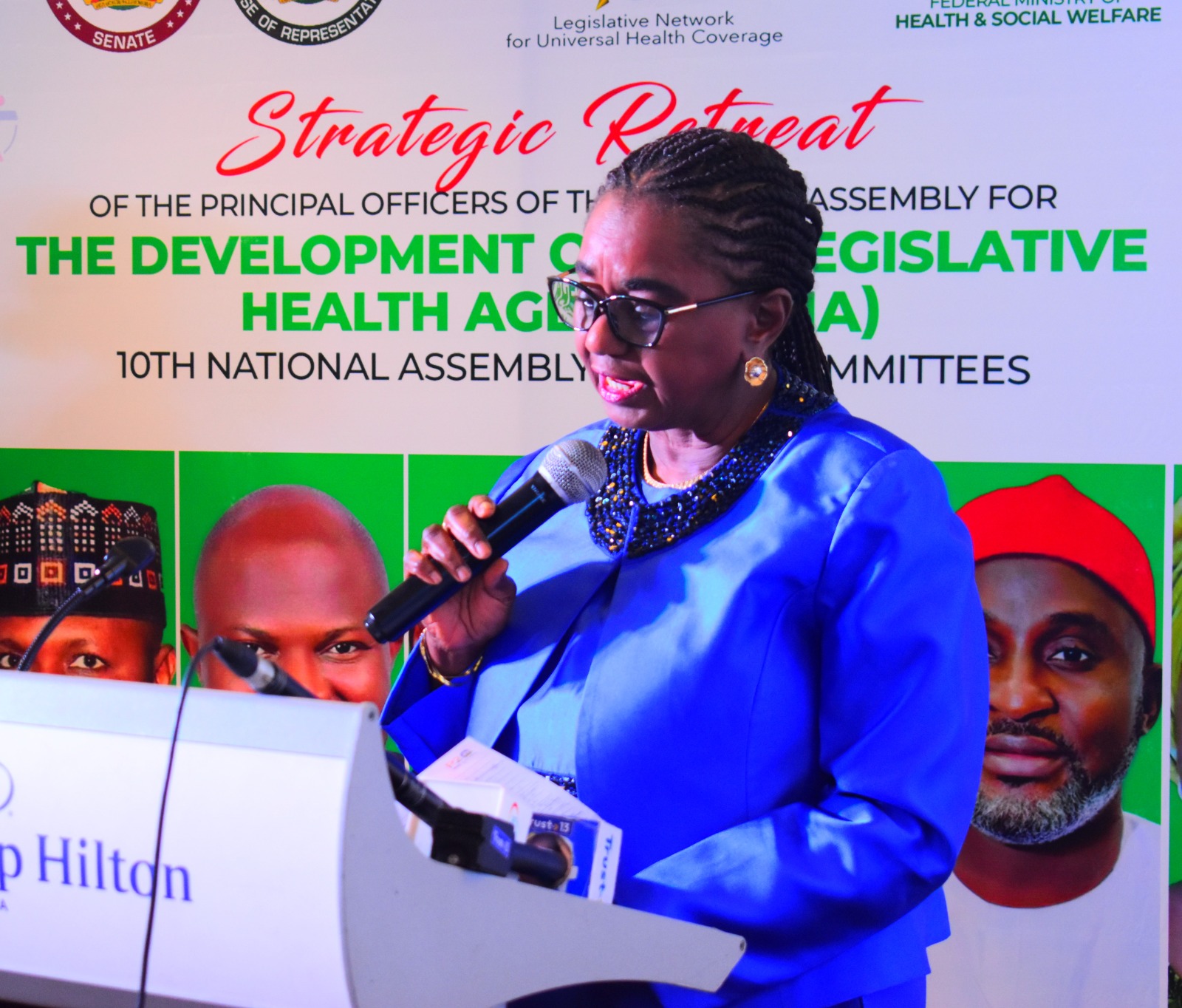
The importance of e-Health devices and digital health solutions in improving Nigeria’s healthcare system has been emphasised by Senator Ipalibo Harry Banigo, Chairman of the Senate Committee on Health, Secondary and Tertiary.
She also stressed that health is a multilayered activity and a multisectoral collaboration that requires legislators to work together to provide legislation, implement policies, and track funds effectively.
Banigo, who represents Rivers West Senatorial District in the National Assembly, made these remarks at the 5th Annual Legislative Summit on Health in Abuja, themed “Improving Legislative Stewardship and Accountability for Universal Health Coverage.”
She highlighted the potential of eHealth devices, especially given Nigeria’s large population and limited healthcare professionals.
“We can develop platforms that can be accessed through simple phones, even in remote villages, to provide health education and interventions,” she said.
“We are not talking about highfalutin things; we are talking about what will impact communities at the grassroots level, particularly pro-poor initiatives that will benefit vulnerable populations.”
Banigo also emphasized the importance of accountability and effective care, encouraging legislators to share knowledge, engage in peer reviews, and exchange information to achieve better health outcomes.
She recalled the cholera outbreak, where basic health education and interventions could have been delivered via mobile phones, preventing preventable deaths.
The 5th Annual Legislative Summit on Health brought together federal and state legislators, the Coordinating Minister of Health and Social Welfare, Prof. Muhammad Pate, the World Health Organisation’s representative in Nigeria, Dr. Walter Mulombo, and other dignitaries.
-

 News2 days ago
RSG Targets Nine Million Residents in Mosquito Net Distribution Campaign
-

 Oil & Energy2 days ago
Aiyedatiwa Signs New Electricity Bill
-

 Maritime2 days ago
Marine Minister Commends President Tinubu On NPERA Bill Assent
-

 Oil & Energy2 days ago
NLNG Commissions Research And Innovation Centre In RSU
-

 News2 days ago
KenPoly Holds Eight Convocations, August 29
-

 News2 days ago
RMAFC Completes Revenue Sharing Review, Proposes New Pay
-

 News2 days ago
RSG Begins Another Phase of Projects Commissioning Today
-

 Maritime2 days ago
NAGAFF Petitions IGP Over Alleged Maritime Police Harassment