
Business
Stakeholder Laments Infrastructure Deficit In Maritime Industry

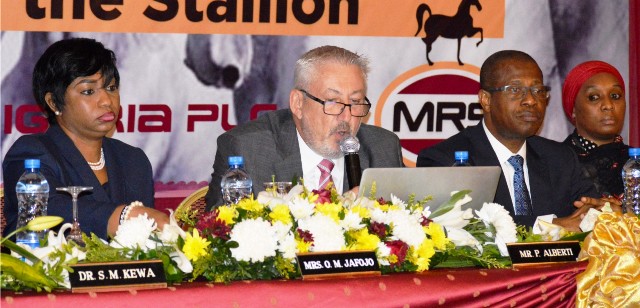
The Executive Vice Chairman of SIFAX Group, Dr Taiwo Afolabi, has urged the Federal Government to provide solutions to the huge infrastructure deficit in the maritime sector.
He said that effective resolution of the infrastructure deficit would facilitate the implementation of the Executive Order on Ease of Doing Business.
Afolabi, a terminal operator, made the plea at the Annual Maritime Conference held on Friday.
The Tide source reports that, the Executive Order came from the Acting President, Prof. Yemi Osinbajo to facilitate trade.
“The huge infrastructure deficit has led to deplorable access roads, faulty cargo scanner, non-existent rail system, non-functional truck bay and others which conspired to negatively impact on the service delivery efficiency.
“These challenges are the major reasons we gathered today to address, because our sector cannot continue to reel under the burden of infrastructural decay if we want to contribute meaningfully to the economy and fulfil the industry’s potential.
“I commend the efforts of the Federal Government in reforming the maritime industry, especially with the Executive Order signed by the Acting President.
“It is an acknowledgment of the fact that things must be done differently.
“However, infrastructure deficit would negate the good intentions of the government if the problems listed above are not strategically and urgently addressed,” he said.
Afolabi said that one of the key objectives of the conference was to promote the culture of intellectual discourse in the country’s maritime industry.
According to him, the conference was organised to address issues affecting the industry with the support of stakeholders such as clearing agents, shippers, investors and workers as well as the community.
He said that, the United Nations had compelled the International Maritime Organisation (IMO), its affiliate responsible for regulating the global maritime industry.
Afolabi said that over 90 per cent of world’s trade was transported by sea, stressing that maritime industry was strategic to maritime nations in terms of its contributions to the economic growth and development of nations.
He said that the contributions of the sector to the country’s Gross Domestic Product (GDP) were still low when compared with its huge potential and opportunities.
The Chairman of the occasion, Mrs Margaret Onyema-Orakwusi, who is the Chairman of Ship Owners Forum, described the maritime industry as a big source of revenue for the economy.
“Maritime is an industry that accommodates different occupations and that is why we need to accommodate other departments to enable them find solutions to the problems in the industry.
“I am asking Afolabi to expand the conference to accommodate other departments to understand maritime operations and solve the problem of accessing loans in the maritime industry,” Onyema-Orakwusi said.
Ms Hadiza Usman, the Managing Director of Nigerian Ports Authority, commended the SIFAX boss and acknowledged the contributions the conference had made to the industry.
Usman, who was represented by Mr Stanley Yitnoe, Assistant General Manager, Business Desk of NPA, said that he had also created numerous awareness of the important of maritime industry in the Nigerian economy.
She commended Afolabi for his resourcefulness in constantly improving the business at the ports in spite of the recent downturn in the economy.
“Afolabi is indeed a great example for youths to emulate.
“The port industry had witnessed significant improvements in port infrastructure and revenue generation since the concession of Nigerian ports to private operators in 2006,” she said.
Usma said that there was the need for extensive infrastructure overhaul and promised that NPA would bring out the much-desired change to actualise government’s development goals.
Retired Major Henry Afolabi, the Executive Director, SIFAX Haulage & Logistics Ltd., expressed concern about inadequate and decaying port access roads and neglect of inter-modalism.
“The current bad state of port access roads calls for concern, especially the two ports in Lagos which received over 70 per cent of the total cargo throughout in the country.
“The bad state of the port access roads in Lagos has impacted adversely on human health especially port users,” Ajetunmobi said.
NMASA boss, Dr Dakuku Peterside, said the agency would continue to safeguard the country’s territorial waters.
Peterside, represented by Mr Anthony Ogabi, a Director in NIMASA, said that NIMASA would work to gain back the Category `C’ position which Nigeria lost in the International Maritime Organisation (IMO).
He said that the agency had a Memorandum of Understanding (MoU) with the Nigerian Navy to stop piracy attacks in the country’s territorial waters which had given room for more ships to call in Nigerian Ports.



Business
Jonathan, Diri, Others Laud Firm’s Milestone in Bayelsa …Says Project Will Drive Industrialisation, Create Jobs



-

 News3 days ago
RSG Targets Nine Million Residents in Mosquito Net Distribution Campaign
-

 Oil & Energy3 days ago
Aiyedatiwa Signs New Electricity Bill
-

 Oil & Energy3 days ago
NLNG Commissions Research And Innovation Centre In RSU
-

 Maritime3 days ago
Marine Minister Commends President Tinubu On NPERA Bill Assent
-

 News3 days ago
KenPoly Holds Eight Convocations, August 29
-

 News3 days ago
RSG Begins Another Phase of Projects Commissioning Today
-

 News3 days ago
RMAFC Completes Revenue Sharing Review, Proposes New Pay
-

 Maritime3 days ago
NAGAFF Petitions IGP Over Alleged Maritime Police Harassment