Connect with us

Education

Actualising The Bodo-Bonny Road

Published

on

Managing Director of the Nigeria Liq
uefied Natural Gas (NLNG), Babs
Omotowa raised an uncommon hope on the Bodo-Bonny Road recently when he said his company was prepared to contribute N60bn for the construction of the road.
According to Omotowa, if the Federal Government was willing to complete the road, NLNG will provide N60 billion which represents half of the contract sum. The Bodo-Bonny Road is a major Federal Road in Rivers State that successive governments lacked the political will to complete.
The Managing Director said at a hearing of the Senate Committee on Niger Delta Affairs in Abuja that the project, when completed, would help improve infrastructure in the Niger Delta. The road links five Local Government Areas; including Khana (Ogoni), Okrika, Eleme, Andoni and Bonny.
Omotowa said, “we said we are willing to offer 50 per cent on the road between Bodo to Bonny which has been outstanding since the 1970’s, and that contribution is N60 billion and we think that these are the kind of projects the NDDC can work with us.”
Omotowa, however, stated that the NLNG’s offer to provide 50 percent of the funding for the road would be activated, provided the partnership is accepted and matched by the Federal Government’s counterpart funding.
The Tide welcomes the offer, particularly against the backdrop that the Bodo-Bonny Road project has been one of the failed projects that underscore the long standing neglect of Rivers State in particular and the Niger Delta in general by successive Nigerian governments. Indeed, the importance of the road cannot be over-emphasised.
Apart from its importance to the enhancement of the economic base of the nation, the road will also connect the mainland Rivers State to a sizeable section of the riverine part of the State, in fact, one of the most difficult terrains in the Niger Delta. Here, the influence of the Atlantic Ocean is real.
It is, indeed, disturbing to note that, added to the perennial cries of the communities in that axis, is the accessibility burden on the foremost gas company in West Africa, NLNG, and its ancillary firms. This should have placed on the conscience of the nation an avoidable guilt.
While we commend the NLNG for the offer, we expect that the Federal Government will quickly accept it and work in concert with the company to finally actualise the construction of this all important road. This ancient city of Bonny and its environs need to be fully accessible. The Federal Government should accept this challenge and build the remaining 50 percent of the funding into the 2016 budget.
The Tide believes that the inclusion of the Federal Government’s quota of N60 billion in the budget and the exercise of the needed political will to ensure availability of fund for prompt execution of the project, can guarantee the realisation of the project during the life of the present administration.
If the present government at the federal level wants to break the jinx and actualise the promise for change, it must also start dealing with all other issues that can stand in the way of the realisation of the project.
In that wise, the Federal Government must ensure that initial land and compensation matters are perfected. Indeed, affected communities should be taken along, while the security needs of the project should be facilitated to avoid interferences of any kind.
It should be noted that the NLNG did not make the offer for fun, like the communities, the NLNG has its own share of stories on the near impossible condition of the route to their business site. NLNG must have come to terms with the fact that ‘if the road was not done, not only would the life of its staff and contractors continue to be threatened, their interest may also be at stake.
It is a fact that provision of the road will go a long way to avert the frequent loss of lives on the high sea, eliminate piracy and promote business in the area. Even huge is the tourist potential of the area that this can harness, while alleviating the sufferings of the Ibanis.
As earnings from gas become significant, it is only imperative that the Federal Government will rise to the occasion. Indeed, the government that is able to provide this road will go down in history as the one that conquered the odds and made the difference that mattered most.


Continue Reading

Education

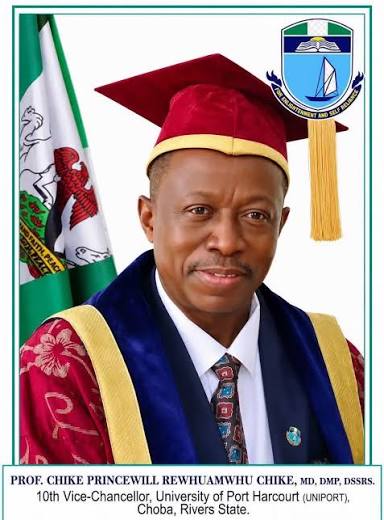
Uniport Appoints Prof. Princewill R. Chike as 10th Vice-Chancellor

Published

on

The Governing Council of the University of Port Harcourt has approved the appointment of Professor Princewill R. Chike as the 10th Vice-Chancellor of the University.
Prof. Chike, a former Commissioner for Health in Rivers State, will succeed Prof. Georgewill Owunari whose tenure ends on July 13, 2026.
A statement signed by the University’s Public Relations Officer, Dr. Sam Kpenu and made available to _The Tide_, said the appointment was made by the 17th Governing Council following the successful conclusion of the selection process.
“The process was conducted in strict compliance with the provisions of the Universities (Miscellaneous Provisions) Act and the University of Port Harcourt Act,” the statement read.
It added that the process involved the constitution of a Search Team and a Joint Council-Senate Selection Board. Both bodies carried out their responsibilities in accordance with extant laws and regulations governing the appointment of Vice-Chancellors in Nigerian universities.
According to the statement, the Pro-Chancellor and Chairman of the Governing Council, Senator Mao Ohuabunwa, congratulated Professor Chike on his appointment.
Senator Ohuabunwa expressed confidence in Prof. Chike’s ability to provide visionary leadership for the continued growth and development of the University.
Professor Princewill R. Chike is expected to formally assume office as the 10th Vice-Chancellor of the University of Port Harcourt on July 13, 2026.
By: Akujobi Amadi
Continue Reading

Education

Education commissioner Commends WAEC Conduct in Rivers ,, Vows Sanctions for Malpractice

Published

on

The Rivers State Commissioner for Education, Dr. Peters Nwagor, has commended the orderly conduct of the ongoing 2026 West African Senior School Certificate Examination in the state and urged schools to sustain the standard.
 Dr. Nwagor gave the commendation recently during a monitoring tour of selected secondary schools in Port Harcourt and environs where the WAEC exam is ongoing.
The commissioner, who was accompanied by directors and monitors from the Ministry of Education, said he was impressed with the peaceful atmosphere at the centres visited.
“The students conducted themselves properly and wrote their papers under conducive conditions. Invigilators and supervisors also performed their duties professionally,” he stated.
Nwagor noted that the Rivers State Government had invested heavily to ensure the smooth and credible conduct of the examination across the state
 He urged candidates to reciprocate government’s effort by shunning all forms of examination malpractice and focusing on their studies.
 “Government has done so much to ensure successful examinations in our schools. Students should take advantage of it by remaining focused,” the commissioner said.
While no case of malpractice was recorded in the centres inspected, Dr. Nwagor warned that any principal, teacher, invigilator, or official caught aiding malpractice would face strict sanctions in line with regulations.
 He also commended school administrators, teachers, WAEC officials, and security personnel for upholding the integrity of the process. Centres visited included County Grammar School, Ikwerre/Etche; Government Comprehensive Secondary School, Borokiri; Government Secondary School, Borokiri; and Pabod Model Secondary School.
By: Akujobi Amadi
Continue Reading

Education

RSU Law Professor Calls for Periodic Review of Nigeria’s Criminal Laws

Published

on

A Professor of Criminal Justice and Law at the Faculty of Law, Rivers State University, Nkpolu-Oroworukwu, Port Harcourt, Prof. Clifford Anaele Nwanyanwu, has advocated for periodic review of the nation’s criminal justice administration laws to reflect current societal needs and challenges.
Prof. Nwanyanwu noted that many of the criminal justice laws in use today date back to the pre-colonial era. He questioned their efficiency in addressing modern criminal justice administration, adding that the complex nature of adjudication often allows crime to thrive.
He made the call while delivering the university’s 132nd Inaugural Lecture on Wednesday at the Senate Conference Auditorium titled: “Society as Criminal Enterprise: Unravelling a Complex Justice System.”
The erudite legal scholar clarified that the lecture was not meant to condemn the country’s justice system. Instead, he said it was intended to highlight areas that require urgent attention.
He expressed concern that criminal justice practice in Nigeria is more dysfunctional than functional, and stressed that he wants to see a system that works effectively for all citizens.
“The essence of criminal justice administration is due process, and anything contrary is not it. Plea bargains help to fast-track trial processes and reduce delays,” he stated.
However, Prof. Nwanyanwu expressed worry that the sums recovered through plea bargain arrangements are often meagre compared to the wealth looted, noting that this contradicts the purpose of the arrangement.
To strengthen the system, he recommended merit-based recruitment of judicial officers with proven character and integrity. He also called for adequate funding, infrastructure development, removal of political interference, and ethical reorientation within the judiciary.
The law professor further recommended that the state should pay compensation to citizens when security officers are found culpable for arbitrary killings, in line with the principle of vicarious liability.
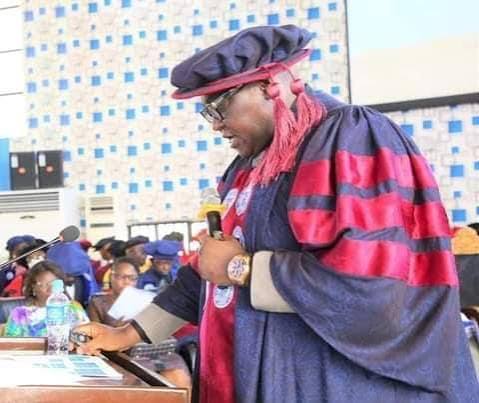
In his remarks, Vice-Chancellor of the university, Prof. Isaac Zeb-Obipi, commended the lecturer. He described the lecture as timely and relevant to addressing the nagging challenges of crime in society.
Prof. Zeb-Obipi expressed concern over the justice system’s inability to curb the rising rate of criminal activities in the state. He added that through inaugural lectures, the university continues to provide solution-based approaches to societal challenges.
Our correspondent reports that the thought-provoking lecture was attended by stakeholders in the judicial system, judges, magistrates, scholars, and members of the university community.
By: Akujobi Amadi
Continue Reading

Trending