
Politics
Bayelsa Guber: Dickson, Sylva Share Opposing Views

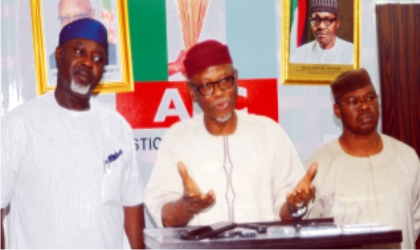
L-R: APC National Auditor, Chief George Moghalu, APC National Chairman, Chief John Oyegun and Deputy Chairman, Chief Segun Oni, during the National Chairman’s interactive session with journalisist in Abuja on Wednesday.
The incumbent Governor
of Bayelsa State, Seriake Dickson and candidate of the People’s Democratic Party (PDP) lauded the cancellation of the poll in the area while the All Progressives Congress (APC) Governorship candidate Timipre Sylva described as disappointing the cancellation of Sunday’s rescheduled poll in Southern Ijaw Local Government Area.
Sylva described INEC’s decision as a rape of democracy, stressing that he will not accept the cancellation.
According to him, ”We reject it completely. First and foremost, the Resident Electoral Commissioner has no powers to cancel an election which had duly taken place. It is only the Returning Officer that has powers to announce a cancellation or any other thing relating to an election such as this”.
“We had an election on Saturday. In Ekeremor, there was widespread shooting and they beat up a lot of APC members. The home of the Minister of State for Agriculture was under siege; his house was under fire for a long time. I had to call for re-enforcement before they could subdue the assailants in the morning.
“The assailants retreated and returned again in the evening but elections still held in Ekeremor that same day and returns were made. When APC protested, our protests were set aside and the elections were upheld because of one thing, because PDP won. If the APC had won, of course, the elections would probably have been set aside. They just put the figures together and submitted the figures and our protests died like a candle in the wind.
“In Sagbama, we did not see the electoral materials at all. Thugs besieged the local government. A top APC leader is today lying critically ill in the hospital with a broken arm he sustained running away from assailants. They held elections, of course nobody saw the materials and they just filled out the figures and submitted. The APC protested vehemently. Nobody heard our protests, elections were upheld.
“In Nembe Local Government Area, where the APC won clearly, they quickly cancelled two wards and re-conducted those elections on Sunday. On Sunday, no APC member saw any paper or anything at all relating to that election but votes were returned. We protested, our protests were rejected because the PDP won. If you look through, this election ab initio apparently, was set up for the PDP to win but we didn’t want to shout because we are a responsible party.
The Tide learnt that with the results from seven local government areas so far announced by the electoral umpire, Seriake is being trailed by his All Progressives Congress (APC) challenger, Timipre Sylva.
Dickson scored 105,745 votes against Sylva’s 72,594. The PDP flag bearer, who was leading his closest rival with 35, 154 votes before INEC declared the process inconclusive on Monday, tried to stop the election in the disputed council area, but failed.
The PDP applauded the cancellation of the Southern Ijaw election, which it described as a vindication of its earlier position that the commission erred by going ahead with the poll despite security concerns in the area.
In a statement by the Publicity Director of the Restoration Campaign Organisation, Jonathan Obuebite, the PDP said before the election was conducted, it had informed the electoral body and security authorities that the whole of Southern Ijaw had been taken over by thugs and criminal elements.
Obuebite stated that the PDP was for a free, fair and credible election and as such, election in Southern Ijaw must be conducted in an atmosphere that could guarantee the participation of the people.
He noted that as at 4pm on Sunday, election materials were still being distributed and wondered how such process could lead to a transparent election. He added that it was an orchestrated plan to rig the election as voting went on in the dead of the night.
He said the situation also afforded political thugs to infiltrate the polling units, snatching ballot boxes and intimidating voters under the close supervision of the military operatives.
Obuebite said the whole process was marred by apathy due largely to the wanton violence and mayhem unleashed by thugs and militants. The PDP accused INEC, the police and army of colluding with the APC to rig the election.
He said: “Before now, we knew that the SGF was coordinating the whole rigging plan and we alerted President Muhammadu Buhari and the public.They know they cannot win without rigging through violence and the whole world has seen what happened on Sunday. It was a rape of democracy.
“There was a premeditated effort on a multiple level of conspiracy to rig this election involving INEC, army and the police.



The Independent National Electoral Commission (INEC) has extended the deadline for political parties to submit the list of candidates for the 2027 governorship and state Houses of Assembly elections from Saturday, August 8, to Tuesday, August 11, 2026.
The commission announced the extension in a statement issued on Saturday and signed by the National Commissioner and Chairman of its Information and Voter Education Committee, Mohammed Haruna.
According to INEC, the decision followed appeals by political parties for additional time to complete the submission process through the dedicated online portal.
“The submission window, which according to the revised Timetable and Schedule of Activities for the General Election was originally scheduled to close on Saturday, 8th August, 2026, has been extended to Tuesday, 11th August, 2026,” the commission said.
In a a related development, INEC announced the suspension of PVC collection in Osun State ahead of the August 15 governorship election.
The commission said voters who applied for replacement of lost, damaged or defaced Permanent Voter Cards would have until midnight on Sunday, August 9, to print downloadable copies of their cards.
The electoral body explained that the deadline was necessary to enable it compile data on downloaded PVCs and produce final statistics on the total number of cards collected ahead of the election.
INEC said PVC collection in Osun commenced at the Registration Area level from July 22 to 28, 2026, but was extended to July 31 following complaints about large crowds and difficulties experienced by voters at collection centres.
The exercise subsequently moved to the local government level and ran from August 1 to 7.
The commission also disclosed that replacement downloadable PVCs had been made available to voters in Odo-Otin and Ife Central Local Government Areas following the theft of cards during attacks on the two collection centres.
It stressed that the stolen cards could not be used to vote.
INEC reassured Osun residents of its preparedness for the August 15 governorship election.
“The commission reiterates that the stolen cards cannot be used to vote.
“INEC reassures the people of Osun State of its readiness to conduct a free, fair, credible and inclusive governorship election on 15th August, 2026,” the statement said.
The commission said the deadline, initially set for Saturday, 8 August, has been extended to Tuesday, 11 August 2026, following appeals from political parties for more time.
INEC also announced that the window for voters who applied to replace lost, damaged or defaced PVCs to download their replacement cards will close at midnight on Sunday, 9 August.
The move is to enable the commission compile final PVC collection figures ahead of the 15 August Osun governorship election.
INEC said replacement downloadable PVCs have also been provided to affected voters in Odo-Otin and Ife Central Local Government Areas after hoodlums carted away cards from two collection centres, stressing that the stolen cards cannot be used to vote.
The commission reaffirmed its readiness to conduct a free, fair, credible and inclusive election in Osun State.
Gov. Kefas made the remarks over the weekend at the Federal Medical Centre (FMC), Jalingo, during the flag-off of the second phase of the Renewed Hope Medical Outreach in Taraba State, organised as part of activities marking Prof. Yilwatda’s 58th birthday.
The governor commended Prof. Yilwatda for choosing to mark his birthday by providing medical care to people in need.
“What Professor Nentawe did is a powerful demonstration of what leadership should be,” Gov. Kefas said.
He assured that his administration would continue to support initiatives that complement government efforts to improve healthcare delivery and the wellbeing of residents.
Speaking at the event, Prof. Yilwatda called on Nigerian leaders to embrace the culture of giving and use their positions to touch the lives of the less privileged.
He said his decision to celebrate his 58th birthday in Taraba State was deliberate and informed by the needs of underserved communities, particularly people who face difficulties accessing healthcare because of distance and financial constraints.
According to him, the intervention followed a needs assessment and was extended across the three senatorial districts of the state.
He said the exercise commenced on August 3 at Takum General Hospital and covered the Federal University Teaching Hospital, Wukari; First Referral Hospital, Sunkani, Ardo-Kola Local Government Area; General Hospital, Bali; General Hospital, Gembu; and FMC Jalingo.
Prof. Yilwatda said the intervention provided medical services to thousands of beneficiaries, including people who required surgical procedures.
He said sustainable national development could only be achieved when strong institutions placed Nigerians at the centre of development.
“Leadership is about service,” he said, urging political and public leaders to make giving back to society an important part of their responsibilities.
He reaffirmed his commitment to serving Nigeria and its people, saying his personal vision was to make every day of his life useful to humanity.
“Every day that I live, the vision is: let it be useful to humanity,” he said.
The Taraba State Commissioner for Health, Dr. Bordiya Buma, commended the initiative, saying it was consistent with the Renewed Hope agenda and efforts to strengthen healthcare delivery in the state.
Dr Buma said the second phase followed the successful completion of the first phase, which was conducted simultaneously in six local government areas, with two LGAs selected from each of the three senatorial districts.
According to him, more than 10,000 patients were attended to during the first phase, including people with medical and surgical conditions.
He disclosed that 327 general surgeries, 71 eye surgeries and 575 dental procedures were carried out during the exercise.
The commissioner expressed appreciation to President Bola Tinubu for the Renewed Hope Medical Outreach and thanked Prof. Yilwatda for supporting the initiative and choosing Taraba State as a beneficiary.
The Minister of Health and Social Welfare, Prof. Muhammad Ali Pate, also commended Prof. Yilwatda for choosing Taraba State to mark his 58th birthday through a medical outreach.
Prof. Pate said making healthcare the centrepiece of the birthday celebration was significant because health affects everyone.
-

 News5 days ago
RSG Targets Nine Million Residents in Mosquito Net Distribution Campaign
-

 Oil & Energy4 days ago
Aiyedatiwa Signs New Electricity Bill
-

 Maritime4 days ago
Marine Minister Commends President Tinubu On NPERA Bill Assent
-

 Oil & Energy4 days ago
NLNG Commissions Research And Innovation Centre In RSU
-

 News5 days ago
KenPoly Holds Eight Convocations, August 29
-

 News5 days ago
RSG Begins Another Phase of Projects Commissioning Today
-

 News5 days ago
RMAFC Completes Revenue Sharing Review, Proposes New Pay
-

 Maritime4 days ago
NAGAFF Petitions IGP Over Alleged Maritime Police Harassment