
Nation
THE STATES

Adamawa
There are indications that the Peoples Democratic Party in
Adamawa State may explode following the recent political developments in the state. However, the explosion, it was gathered, may take a religious dimension.
It was gathered that the plan to impeach the former governor, Murtala Nyako, was agreed to with the understanding that Ngilari would be spared and be allowed to become the governor after his boss must have been sacked, but a powerful group within the PDP, at both the national and state levels, was said to have insisted that Ngilari too must be removed.
The plot, it was gathered, forced the deputy governor to resign before the seven-man probe panel set up by Acting Chief Judge of the state, Justice Ambrose Mammadi, to investigate allegation of misconduct against the former governor and his deputy.
The setting up of the panel was as a result of directive from the state House of Assembly.
Bauchi
The Authorities of the Federal Polytechnic, Bauchi State,
has outlined a programme of academic activities to enable the recovery of the period lost to the nine months strike by the Academic Staff Union of Polytechnics (ASUP).
The institution’s Public Relation Officer (PRO), Malam Mohammed Wada, said in Bauchi State Thursday, that academic activities resumed fully July 30, and that the semester would last for only two months.
Wada explained that lectures would hold for five weeks, while examination would commence on September 8 and last for three weeks.
“We were one month into the second semester of the 2012/2013 academic session when the strike commenced in October 2013. ”What we are trying to do now, is to see how we can complete the syllabus within five weeks, so that examination would commence in the sixth week and end in the eighth week”, he said.
Ekiti
Peoples Democratic Party in Ekiti State has accused
Governor Kayode Fayemi of alleged plot to use the 19 new Local Council Development Areas as conduits to siphon about N10bn out of the state’s treasury.
The party in a statement by its State Publicity Secretary, Kola Oluwawole, in Ado-Ekiti on Thursday alleged that the money would be taken out of the treasury before the October 15 expiration time of the administration.
It alleged that the money was part of the accumulated slashed allocations due to the original 16 local government areas, and other foreign and local aids collected by the All Progressives Congress government since its inception in October 2010.
But the Commissioner for Information, Tayo Ekundayo, in his reaction refuted the allegation saying, “such money is not available in the first place.”
FCT
The National Youth Service Corps last Thursday announced
the redeployment of corps members from seven northern states. The affected states are Adamawa, Bauchi, Borno, Gombe, Jigawa, Kano and Yobe states.
A statement last Thursday in Abuja by the Director of Public Relations in NYSC, Mrs. Bose Aderibigbe, said the decision followed the high rate of insecurity in some parts of the North. The corps members are part of the 2014 Batch ‘B’ Orientation Course scheduled to commence next week Tuesday August 5, 2014.
The NYSC said due to logistic reasons, the orientation course will be conducted in two streams for different states. The Stream One exercise will be conducted from Tuesday, August 5 to Tuesday, August 26 2014 in Lagos, Ondo, Ekiti, Kwara, Oyo, Niger, Abia, Akwa Ibom, Anambra, Benue, Bayelsa, Cross River, Delta, Ebonyi, Edo, Enugu, FCT, Imo, Kebbi, Kaduna, Kogi, Katsina, Nasarawa, Ogun, Plateau, Rivers, Sokoto, Taraba and Zamfara states.
Corps members posted to states listed in the Stream One category will undergo the orientation course in their respective states of deployment. The statement explained that the Stream Two exercise, meant for the affected northern states, had been scheduled for Monday, September 1, 2014 to Monday, September 22, 2014.
Kwara
Former local government councillors In Kwara on
Thursday protested over the non-payment of the severance allowance owed them from 2007 to 2010, totalling N2.25bn.
The aggrieved Councillors barricaded the main gate of the Government House in Ilorin while displaying placards with various inscriptions. They vowed not to stop their protest until Governor AbdulFatah Ahmed attended to them.
The Chief of Staff to the governor, Mr Toyin Sanusi, who came out to address the protesters, was chased back.
The governor later invited the protesters for a closed door meeting which lasted three hours. After the meeting, Hon. Sulyman Olota, the spokesman of the group, told newsmwn that the meeting with the governor was fruitful.
Katsina
Residents of Funtua and its environs in Katsina State
are mobilising for prayers as they had increased community surveillance to avert the activities of suspected insurgents in the area.
The District Head, Alhaji Sambo Idris, told newsmen last Thursday in Funtua that he had instructed religious, traditional and community leaders in the area to organise for prayers sessions against terrorism.
Idris said he had also directed residents of the area to pray against all forms of violence and restiveness in the community and the nation at large and he appealed to the people to increase surveillance in their areas and to contact security agencies over any movement of suspicious persons.
According to him, he also advised the people against taking the law into their hands in their effort to make the area safe and free from terrorists’ activities and Idris expressed appreciation with security agencies, the state and local government authorities for their prompt response during emergency situations.
Lagos
The Senior Staff Association of Nigerian Universities
(SSANU), Lagos State University (LASU) Chapter, on Friday suspended its three-month old strike.
The Chairman of the association, Mr Saheed Oseni, said in Lagos that the strike would be suspended till Aug. 30.
He said that the decision was taken at a congress meeting on Friday morning following an agreement the union reached with the LASU Governing Council.
The union demands reduction in tuition fee, repeal of LASU’s ‘no-vacancy-no-promotion policy, and implementation of the 2012 Universities Miscellaneous Provision Act.
Nasarawa
The Nasarawa State House of Assembly and the state Chief
Judge, Justice Justice Sulaiman Dikko, may be heading for a showdown over the composition of the seven-man panel put in place to investigate allegations of wrongdoing by Governor Tanko Al-Makura as the assembly wants Dikko to dissolve the panel on the grounds that it is made of loyalists of the All Progressives Congress of which Al-Makura is the leader in the state.
The Chairman of the House Committee on Information and Security, Baba Ibaku, disclosed this in a telephone interview with our correspondent in Lafia, on Monday said that the lawmakers resolved to demand for the dissolution of the panel during their emergency sitting at the assembly complex at 10am on Monday .
He argued that the fact that the panel members held political positions in the state was against the provision of Section 188 of the 1999 Constitution as amended.
The lawmaker said, “We had an emergency sitting to deliberate on the seven-man panel that was set up by the Chief Judge on Friday last week. We asked him to dissolve the seven-man panel because the members of the panel are APC members that hold various political positions in the state.”
Osun
Operatives of the Department of State Service, DSS,
yesterday stormed Osogbo, the Osun State ca pital and other major towns in the state preparatory to the August 9 governorship election in the state, even as the Independent National Electoral Commission, INEC, assured that the poll would be free and fair.
The DSS operatives were strategically positioned in major areas of the town while some moved round major streets. It was gathered that over 5,000 operatives were deployed to the state to maintain law and order before and during the governorship election.
The state government, in its reaction to the development, described it as an attempt to militarise the state ahead of the election. The Special Adviser to the Governor on Environment, Mr Bola Ilori noted that the Peoples Democratic Party, PDP, was behind the deployment of the operatives to the state.
Oyo
The Oyo State chapter of the All Progressives Congress
(APC) has asked former governors of the state, Adebayo Alao-Akala and Rashidi Ladoja, to stop shedding what it termed “crocodile tears” over the recent rumoured impeachment bid of the state House of Assembly against its party-led government, saying the two governors were products of chaotic governments and cannot now pretend that theirs were governments of peace.
The party made this known in a statement issued by its party chairman, Chief Akin Oke, in reaction to two separate statements credited to the two former governors last weekend.
The APC said the two former governors did not have the moral right to postulate or advise any government on peace, since they headed governments that were renowned for brigandage, thuggery, bloodshed and where peace eluded the people of the state.
“Is it not an irony that Akala and Ladoja would tell us how peaceful our state would be with a House of Assembly that is devoid of rancor? Both of them ran governments whose Houses of Assembly were like Israel and Palestine and the Governor’s Office like Gaza, even when members were of the same Peoples Democratic Party (PDP)”, the party said.
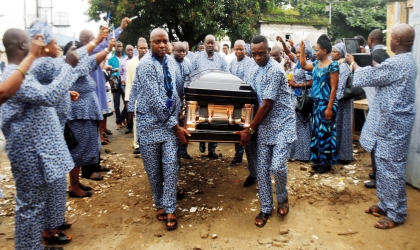
Members of Nigeria Union of Journalists (NUJ), carrying the casket of the former President of NUJ, Mr Ndagene Akwu to NUJ Secretariat in Port Harcourt last Saturday.



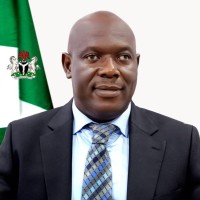
The Hydrocarbon Pollution Remediation Project (HYPREP) has commemorated the 15th anniversary of the release of the United Nations Environment Programme (UNEP) Environmental Assessment Report on Ogoniland, reaffirming its commitment to restoring the environment and improving the livelihoods of affected communities.
In a statement signed by the Project Coordinator, Prof Nenibarini Zabbey, to commemorate the anniversary, HYPREP described the anniversary as a significant milestone in Nigeria’s environmental restoration efforts, noting that the project has made remarkable progress in implementing the recommendations of the landmark UNEP report released on August 4, 2011.
The UNEP report had revealed extensive oil pollution across Ogoniland, severe environmental degradation, and serious public health risks resulting from decades of petroleum operations. It also recommended an initial $1 billion fund to commence the cleanup of the affected communities.
According to HYPREP, the Federal Government formally launched the Ogoni clean-up in 2016, while the Project Coordination Office was established in 2017 to drive the implementation of UNEP’s recommendations.
Zabbey said the current administration has continued to prioritise the project under the Renewed Hope Agenda.
Providing an update on the cleanup, the Project Coordinator disclosed that 30 of the 65 contaminated sites identified by UNEP have been fully remediated, while work is ongoing at several medium- and high-risk locations. It also stated that more than 1.5 million mangrove seedlings have been planted as part of what it described as the world’s largest restoration of oil-degraded mangroves, with over 1,000 hectares of shoreline already rehabilitated.
Zabbey further revealed that 49 Ogoni communities have been connected to potable water schemes through multiple water projects and booster stations aimed at providing safe drinking water across the region.
In the health sector, he said the 100-bed Ogoni Specialist Hospital in Kpite and the 43-bed Cottage Hospital in Buan are nearing completion, adding that several existing health facilities have been upgraded with modern medical equipment, while five ambulances have been donated to improve emergency healthcare services. The Project Coordinator also disclosed that a three-year human health biomonitoring study is being conducted in collaboration with the World Health Organization’s International Agency for Research on Cancer (IARC).
On economic empowerment, Zabbey stated that the Project has created more than 8,000 direct jobs and trained thousands of Ogoni youths and women in various vocational and technical skills, including software development, cybersecurity, aviation, commercial diving, seafaring, mechatronics, and creative arts. The project also reported awarding scholarships to more than 1,000 students, providing grants to small businesses, and supporting persons living with special needs through skills acquisition programmes.
The statement further highlighted ongoing legacy projects, including the Ogoni Power Project and the Centre of Excellence for Environmental Restoration, which it said is about 96 per cent complete. HYPREP also welcomed the recent designation of the Ogoni Wetland as a Ramsar Site of International Importance and pledged to continue promoting biodiversity conservation and sustainable management of the ecosystem.
Marking the anniversary, Zabbey said the progress achieved over the past 15 years demonstrates the collective commitment of government, development partners, stakeholders, and local communities to restoring Ogoniland. He called for renewed collaboration to sustain the cleanup effort, promote environmental sustainability, and support the long-term development of the region. 3
-

 News2 days ago
RSG Targets Nine Million Residents in Mosquito Net Distribution Campaign
-

 Oil & Energy2 days ago
Aiyedatiwa Signs New Electricity Bill
-

 Oil & Energy2 days ago
NLNG Commissions Research And Innovation Centre In RSU
-

 Maritime2 days ago
Marine Minister Commends President Tinubu On NPERA Bill Assent
-

 News2 days ago
KenPoly Holds Eight Convocations, August 29
-

 News2 days ago
RSG Begins Another Phase of Projects Commissioning Today
-

 News2 days ago
RMAFC Completes Revenue Sharing Review, Proposes New Pay
-

 Maritime2 days ago
NAGAFF Petitions IGP Over Alleged Maritime Police Harassment