
Politics
Fayemi And The New Sociology Of Politics

Ekiti State, formerly
known as the “Centre of Knowledge,” but now “Land of Honour” took her turn in the gubernatorial test on June 21, 2014 with a verdict of “no victor, no vanquished”. One may be wondering why there was “no victor, no vanquished” in an election in which three major political parties with three heavy weights engaged themselves in a battle of wills and wits to win the hearts and votes of the electorate at all costs.
While Governor Kayode Fayemi of the All Progressives Congress (APC), on the driving seat of Ekiti Government, tried to use the test to cruise into his second tenure, his major challenger and candidate of the Peoples Democratic Party (PDP), Mr Ayo Fayose was determined to recover the peoples’ mandate which he believed was stolen from him through judiciary gate. Fayose lost to Fayemi in a court of law after a stay of more than three years as landlord of Ekiti State Government House. Mr. Opeyemi Bamidele, a member of House of Representatives and candidate of the Labour Party (LP) saw the governorship poll as an opportunity to serve the people as No 1 citizen of the state.
Bearing all calculations by the candidates to win the election, the Independent National Electoral Commission (INEC) which was leaking its wounds from poor outing in previous exercises was, however, prepared to make a difference in the poll in which 732,166 voters registered across 2,195 polling units in the state with 177 wards.
In a ‘hard fought’ election among the three candidates, INEC released the score card and returned Ayo Fayose of PDP as the winner, having won in all the 16 local government areas of the state with 203,090 votes. the incumbent governor polled 120,433 votes to clinch second position while the LP candidate, Bamidele, settled for third position with 18,135 votes.
Even though there were records of unsavory episodes when the candidates toured parts of the state to sell themselves to the people, the verdict of INEC on the Ekiti gubernatorial poll, did not tear the Ekiti people and their peace apart as earlier predicted in some quarters.
But the beauty of the Ekiti election can better be appreciated in the rare show of sportsmanship exhibited by Governor Fayemi despite the fact that he lost in his bid to return to Government House for a second time. Hours after INEC released the result, Ekiti remained peaceful and Governor Fayemi not only accepted defeat, but also congratulated Fayose, the governor-elect for emerging victorious.
In a broadcast in Ado-Ekiti last Sunday, Fayemi said he had no choice but to accept the results of the June 21 election and congratulated the governor-elect “if indeed the outcome of the election is the will of the Ekiti people.”
Displaying an uncommon disposition that is unknown to Africa politics, Fayemi insisted that “if this is the will of the Ekiti people, I stand in deference to your will. If the result of the elections is an expression of the voice of our people, we must all heed your voice. I have just spoken with my brother, Mr. Peter Ayodele Fayose, congratulating him on his victory. In a few hours from now, I would be meeting the governor-elect to discuss the future of our dear state and how we would work together to institute a smooth transition programme.”
The governor not only participated in the election, he also saw the outcome of the polls as truly reflecting the wishes of the people and therefore accepted in clear terms that “conscience is an open wound, only truth can heal”.
The leadership of APC is worried why and how the party lost to the opponent in the polls even with the power of incumbency, Fayemi believes that there is no need crying over the spilt milk. With no blame for any one for his political summersault, Fayemi, however, thanked the people for support even as he promised to keep faith with them in building Ekiti together.
“Elections tend to be highly divisive affairs that often see a brother rising against his brother. Despite our diverse party affiliations, and regardless of which way we voted on Saturday, we must remember that we are all sons and daughters of Ekiti State. Ekiti is ours to build together”, Faymei added in his post-election broadcast.
Three uncommon features stand out in Fayemi reaction to the Ekiti election. They are, his conscience and political will to concede defeat in the face of realities, his sportsmanship to congratulate his winner (Fayose) and his concern and willingness to build Ekiti together irrespective of party affiliations.
Governor Fayemi may have fought a good fight and kept the faith in the election that was adjudged credible, free and fair by stakeholders, the voice of the people, INEC concurred, was the voice of God. No wonder, he (Fayemi) threw in the towel; a situation that has evolved what could be regarded as a new sociology in Ekiti politics.
Reactions have trailed Fayemi disposition to the outcome of the election. To some, Fayemi’s gentleman disposition to concede defeat is ‘un Africa’, but the APC flag bearer in the polls believed that there is nothing “un-African of un-Nigerian” about his congratulatory message to Fayose. Fayemi who received the governor-elect in his office in Ado-Ekiti, remarked that, “They said my congratulatory message to governor-elect is un-African or un-Nigerian. I don’t think it was so because that was what I was expected to do as a democrat.”
Respecting the wishes of the people in an election, does not make one a political misfit or coward. Fayemi argues that his action was prompted by the belief that “our democracy is fragile and we have to do whatever we can as leaders to strengthen and deepen it the more”.
The Speaker of the House of Representatives, Aminu Tambuwal, agreed that the governor conceding defeat and congratulating his opponents is exemplary in nature and has added value to the country’s democratic principles. In a statement by his Special Adviser on media, Imam Imam, the speaker said “the governor’s action to congratulate his opponent was a clear proof that our politics is imbibing standard global practice associated with electioneering process”.
To the All Progressives Congress, the action of its candidate in the election was the position of the party. “Of course, the governor couldn’t have made such statement without consulting with the party leadership. What he said is the position of the party leadership,” Lai Mohammed, the APC spokesman said.
The Governor-elect must be grateful to God because the man who wrestled power from him four year ago but lost to him in the June 21 polls is not desperate to remain in office, as it is often the case with most incumbents who usually demonstrate the bad loser syndrome. But more importantly, Fayemi has demonstrated to the world that the interest of Ekiti people is more paramount than his personal ambition and that politics can be played with decorum and restraint.
Meanwhile, Fayose who said his coming back as governor was borne out of the genuine intention to promote love and unity among Ekiti people, did not hide his warm feeling about Fayemi conceding defeat to him when he said “His (Fayemi’s) statesmanship conduct would forever remain in history”.
Today, Ekiti is victorious and in the eyes of history, this is a lesson for all politicians that election must not be seen as do-or-die affairs. Politicians must avoid the bad loser syndrome, build and sustain democracy and not pull it down.
As the 2015 general elections draw nearer, time will tell whether politicians will build on Fayemi’s new sociology of politics-where election is contested and decided without going to court or return to the old and expensive order that increases court cases after every poll as well as promotes tension and acrimony in the land.
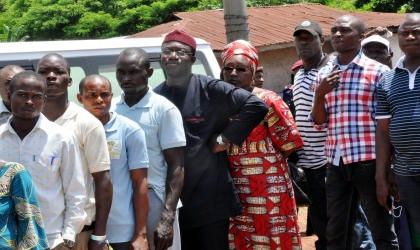
APC governorship candidate, Governor Kayode Fayemi and his wife Bisi on queue waiting for their turn to vote during the governorship election in Ekiti State recently.
Samuel Eleonu



The Independent National Electoral Commission (INEC) has extended the deadline for political parties to submit the list of candidates for the 2027 governorship and state Houses of Assembly elections from Saturday, August 8, to Tuesday, August 11, 2026.
The commission announced the extension in a statement issued on Saturday and signed by the National Commissioner and Chairman of its Information and Voter Education Committee, Mohammed Haruna.
According to INEC, the decision followed appeals by political parties for additional time to complete the submission process through the dedicated online portal.
“The submission window, which according to the revised Timetable and Schedule of Activities for the General Election was originally scheduled to close on Saturday, 8th August, 2026, has been extended to Tuesday, 11th August, 2026,” the commission said.
In a a related development, INEC announced the suspension of PVC collection in Osun State ahead of the August 15 governorship election.
The commission said voters who applied for replacement of lost, damaged or defaced Permanent Voter Cards would have until midnight on Sunday, August 9, to print downloadable copies of their cards.
The electoral body explained that the deadline was necessary to enable it compile data on downloaded PVCs and produce final statistics on the total number of cards collected ahead of the election.
INEC said PVC collection in Osun commenced at the Registration Area level from July 22 to 28, 2026, but was extended to July 31 following complaints about large crowds and difficulties experienced by voters at collection centres.
The exercise subsequently moved to the local government level and ran from August 1 to 7.
The commission also disclosed that replacement downloadable PVCs had been made available to voters in Odo-Otin and Ife Central Local Government Areas following the theft of cards during attacks on the two collection centres.
It stressed that the stolen cards could not be used to vote.
INEC reassured Osun residents of its preparedness for the August 15 governorship election.
“The commission reiterates that the stolen cards cannot be used to vote.
“INEC reassures the people of Osun State of its readiness to conduct a free, fair, credible and inclusive governorship election on 15th August, 2026,” the statement said.
The commission said the deadline, initially set for Saturday, 8 August, has been extended to Tuesday, 11 August 2026, following appeals from political parties for more time.
INEC also announced that the window for voters who applied to replace lost, damaged or defaced PVCs to download their replacement cards will close at midnight on Sunday, 9 August.
The move is to enable the commission compile final PVC collection figures ahead of the 15 August Osun governorship election.
INEC said replacement downloadable PVCs have also been provided to affected voters in Odo-Otin and Ife Central Local Government Areas after hoodlums carted away cards from two collection centres, stressing that the stolen cards cannot be used to vote.
The commission reaffirmed its readiness to conduct a free, fair, credible and inclusive election in Osun State.
Gov. Kefas made the remarks over the weekend at the Federal Medical Centre (FMC), Jalingo, during the flag-off of the second phase of the Renewed Hope Medical Outreach in Taraba State, organised as part of activities marking Prof. Yilwatda’s 58th birthday.
The governor commended Prof. Yilwatda for choosing to mark his birthday by providing medical care to people in need.
“What Professor Nentawe did is a powerful demonstration of what leadership should be,” Gov. Kefas said.
He assured that his administration would continue to support initiatives that complement government efforts to improve healthcare delivery and the wellbeing of residents.
Speaking at the event, Prof. Yilwatda called on Nigerian leaders to embrace the culture of giving and use their positions to touch the lives of the less privileged.
He said his decision to celebrate his 58th birthday in Taraba State was deliberate and informed by the needs of underserved communities, particularly people who face difficulties accessing healthcare because of distance and financial constraints.
According to him, the intervention followed a needs assessment and was extended across the three senatorial districts of the state.
He said the exercise commenced on August 3 at Takum General Hospital and covered the Federal University Teaching Hospital, Wukari; First Referral Hospital, Sunkani, Ardo-Kola Local Government Area; General Hospital, Bali; General Hospital, Gembu; and FMC Jalingo.
Prof. Yilwatda said the intervention provided medical services to thousands of beneficiaries, including people who required surgical procedures.
He said sustainable national development could only be achieved when strong institutions placed Nigerians at the centre of development.
“Leadership is about service,” he said, urging political and public leaders to make giving back to society an important part of their responsibilities.
He reaffirmed his commitment to serving Nigeria and its people, saying his personal vision was to make every day of his life useful to humanity.
“Every day that I live, the vision is: let it be useful to humanity,” he said.
The Taraba State Commissioner for Health, Dr. Bordiya Buma, commended the initiative, saying it was consistent with the Renewed Hope agenda and efforts to strengthen healthcare delivery in the state.
Dr Buma said the second phase followed the successful completion of the first phase, which was conducted simultaneously in six local government areas, with two LGAs selected from each of the three senatorial districts.
According to him, more than 10,000 patients were attended to during the first phase, including people with medical and surgical conditions.
He disclosed that 327 general surgeries, 71 eye surgeries and 575 dental procedures were carried out during the exercise.
The commissioner expressed appreciation to President Bola Tinubu for the Renewed Hope Medical Outreach and thanked Prof. Yilwatda for supporting the initiative and choosing Taraba State as a beneficiary.
The Minister of Health and Social Welfare, Prof. Muhammad Ali Pate, also commended Prof. Yilwatda for choosing Taraba State to mark his 58th birthday through a medical outreach.
Prof. Pate said making healthcare the centrepiece of the birthday celebration was significant because health affects everyone.
-

 News3 days ago
RSG Targets Nine Million Residents in Mosquito Net Distribution Campaign
-

 Oil & Energy3 days ago
Aiyedatiwa Signs New Electricity Bill
-

 Oil & Energy3 days ago
NLNG Commissions Research And Innovation Centre In RSU
-

 Maritime3 days ago
Marine Minister Commends President Tinubu On NPERA Bill Assent
-

 News3 days ago
KenPoly Holds Eight Convocations, August 29
-

 News3 days ago
RSG Begins Another Phase of Projects Commissioning Today
-

 News3 days ago
RMAFC Completes Revenue Sharing Review, Proposes New Pay
-

 Maritime3 days ago
NAGAFF Petitions IGP Over Alleged Maritime Police Harassment