
Nation
THE STATES

Adamawa
The College of Education, Hong, in Adamawa State,
has been shut down and students directed to go home following alleged threat by members of the Boko Haram sect to attack the school.
The Provost of the college, Dr Johnson Pongri, who confirmed the closure in a news conference in Yola, said the move was based on the advice of the Military Task Force in the area.
Pongri said the school had been receiving threat letters by unknown persons who claimed to be members of the Boko Haram.
In another development, Governor Murtala Nyako of Adamawa State has visited Michika and Shuwa towns to sympathise with victims of recent attack by insurgents.
FCT
Vice President Namadi Sambo said every Nigerian
who had contributed or is still contributing to nation-building is a winner in the centenary celebrations.
Sambo stated this in Abuja in a welcome address at the centenary awards and dinner chaired by President Goodluck Jonathan.
The Vice President said while 100 people had been selected for the centenary awards, many more Nigerians are deserving of it.
“They are by no means not only the people to be celebrated, there are many more Nigerians.
“But, as the saying goes, many are called, few are chosen, he said.
Jigawa
Residents of Dutse in Jigawa State have expressed
surprise over the first rainfall recorded in the state.
Our correspondent reports that the heavy downfall, which started 6.10 p.m. lasted for one and half hours.
Rabiu Shehu, a resident of the town said that he was surprised when he noticed heavy cloud in the sky and did not believe it would rain.
He said that the state used to record its first rainfall in the month of May.
Kogi
Governor Idris Wada of Kogi State said that the
state would intensify efforts toward ensuring
that the state remained polio free.
Wada made the pledge at the launch of the March 2014 National Immunisation Plus Days at Okpo, in Olamaboro Local Government Area of the state.
The governor, who was represented by his Deputy, Mr Yomi Awoniyi, described the immunisation exercise as a critical aspect of government’s effort to reduce communicable diseases.
He expressed delight that the state remained polio free and assured the people that the government’s programmes were designed to put smiles on the faces of vulnerable groups in the state.
Kwara
Governor Abdulfatah Ahmed of Kwara State has urged
civil servants to always offer useful advice to politicians in order to attain the laudable goal of transforming the society.
Ahmed made the call at the opening of the 38th Meeting of the National Council on Establishments in Ilorin recently.
The governor, represented by his Deputy, Elder Peter Kisira, said the civil service was a veritable tool for attainment of the growth and development of the nation.
Earlier, the Head of the Civil Service of the Federation, Alhaji Bukar Aji, called on heads of service across the country to develop a system which would improve the capacity of civil servants across the nation.
Lagos
The Minister of Information, Mr Labaran Maku, said
the Federal Government had created an atmosphere of freedom for the media to operate.
Maku spoke at the 30th Memorial of the late Founder of the Punch newspapers, Chief James Aboderin, which held at the Intercontinental Hotel, Victoria Island Lagos.
He said the Federal Government would continue to support the media, stressing that there was no reason for any news medium not to prosper.
“If you look at the writings, I believe the Nigerian press is one of the freest in the world today and that is the best the government can do not to suppress other views”, he said.
Nasarawa
The Nasarawa State Commissioner of Police, Alhaji
Ibrahim Idris, has advised politicians against “do-or-die politics.’’
The commissioner gave the advice at an interactive session with leaders of the APC and PDP, ahead of the state’s Local Government polls, slated for March 22.
“Politicians must avoid acts that portray them as desperate, they must avoid being selfish.’’
Idris admonished the leadership of the two parties to enlighten their followers on the need to be orderly during the election, vowing to deal decisively with anybody or group, that might want to foment trouble.
Niger
The Vice-Chancellor, Federal University of Technology
(FUT) Minna, Prof. Musbau Akanji has inaugurated the new management board of the university’s Search FM 92.3 Radio Station.
Speaking during the inauguration, the Vice Chancellor charged the members to nurture the station and enforce the ethics of National Broadcasting Commission (NBC).
Akanji congratulated them and urged them to keep up the standard of the radio station.
He urged the board members to ensure that the station served as a training medium and provide exposure to students in media-related courses of the institution.
Osun
A group, Advocacy for Advancement of Peace and
Harmony in Africa Initiative, has advised Nigerians to use the centenary celebrations to reflect on how to build a better nation.
The group in a statement in Osogbo, urged Nigerians to reflect on the virtues of tolerance, justice and other values that would uphold the status of Nigeria as a leading nation.
The statement, signed by the group’s National Coordinator, Mrs Olayinka Ojomo, challenged Nigerians to reflect and evaluate the past so as to take a better stock of the present.
Plateau
The Sultan of Sokoto, Ahaji Sa’ad Abubukar, has
urged traditional rulers and other Nigerians to unite to collectively fight extremism and terrorism.
Abubakar made the appeal on Saturday in Jos, when he visited the Gbong Gwom Jos, Jacob Gyang Buba.
The sultan said that Nigerians, irrespective of religious leanings, had a common problem in terrorism.
“We have common problems in this country – religious extremism, terrorism, poverty, unemployment, strikes, dearth of basic infrastructure, among others. “These problems have no religious or tribal colour, and we must unite and defeat them so that God Almighty, who created us, will bless us.
Sokoto
The Sokoto State Government is to establish more
micro-finance banks to promote economic empowerment of the masses.
Governor Aliyu Wamakko announced this in Sokoto State at the 2013 Bankers’ Committee Dinner and Award Night.
According to the governor, micro-finance has proven to be a vibrant tool to improve the living standards of the people, especially those at the grassroots.
“The few ones operating in Gwadabawa, Yabo, Sokoto and Goronyo, among others, are really helping in revamping the rural economies’’, Wamakko said.
Taraba
The Taraba State Police Command said it had
arrested seven suspected cult members.
Addressing newsmen in Jalingo, Mr Joseph Kwaji, the Police Public Relations Officer (PPRO), said they were arrested in a forest opposite Federal Government College Wukari on the Jalingo road recently.
He said the suspects would be charged with criminal conspiracy, unlawful assembly and unlawful possession of fire arms.
He said that they were nabbed following information provided by members of the vigilance group in Wukari Local Government Area.
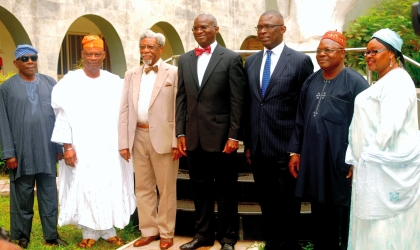
L-R: Lagos State representatives at the National Confab, Prof. Tunde Samuel, Prince Rabiu Oluwa, Chairman, Alhaji Femi Okunnu, Governor Babatunde Fashola of Lagos, Mr Supo Sasore (San), Mr Waheed Ayeni and Mrs Olufunmi Oshinowo-Bashorun, during their meeting with Governor Fashola in Lagos last Monday. Photo: NAN




The Hydrocarbon Pollution Remediation Project (HYPREP) has commemorated the 15th anniversary of the release of the United Nations Environment Programme (UNEP) Environmental Assessment Report on Ogoniland, reaffirming its commitment to restoring the environment and improving the livelihoods of affected communities.
In a statement signed by the Project Coordinator, Prof Nenibarini Zabbey, to commemorate the anniversary, HYPREP described the anniversary as a significant milestone in Nigeria’s environmental restoration efforts, noting that the project has made remarkable progress in implementing the recommendations of the landmark UNEP report released on August 4, 2011.
The UNEP report had revealed extensive oil pollution across Ogoniland, severe environmental degradation, and serious public health risks resulting from decades of petroleum operations. It also recommended an initial $1 billion fund to commence the cleanup of the affected communities.
According to HYPREP, the Federal Government formally launched the Ogoni clean-up in 2016, while the Project Coordination Office was established in 2017 to drive the implementation of UNEP’s recommendations.
Zabbey said the current administration has continued to prioritise the project under the Renewed Hope Agenda.
Providing an update on the cleanup, the Project Coordinator disclosed that 30 of the 65 contaminated sites identified by UNEP have been fully remediated, while work is ongoing at several medium- and high-risk locations. It also stated that more than 1.5 million mangrove seedlings have been planted as part of what it described as the world’s largest restoration of oil-degraded mangroves, with over 1,000 hectares of shoreline already rehabilitated.
Zabbey further revealed that 49 Ogoni communities have been connected to potable water schemes through multiple water projects and booster stations aimed at providing safe drinking water across the region.
In the health sector, he said the 100-bed Ogoni Specialist Hospital in Kpite and the 43-bed Cottage Hospital in Buan are nearing completion, adding that several existing health facilities have been upgraded with modern medical equipment, while five ambulances have been donated to improve emergency healthcare services. The Project Coordinator also disclosed that a three-year human health biomonitoring study is being conducted in collaboration with the World Health Organization’s International Agency for Research on Cancer (IARC).
On economic empowerment, Zabbey stated that the Project has created more than 8,000 direct jobs and trained thousands of Ogoni youths and women in various vocational and technical skills, including software development, cybersecurity, aviation, commercial diving, seafaring, mechatronics, and creative arts. The project also reported awarding scholarships to more than 1,000 students, providing grants to small businesses, and supporting persons living with special needs through skills acquisition programmes.
The statement further highlighted ongoing legacy projects, including the Ogoni Power Project and the Centre of Excellence for Environmental Restoration, which it said is about 96 per cent complete. HYPREP also welcomed the recent designation of the Ogoni Wetland as a Ramsar Site of International Importance and pledged to continue promoting biodiversity conservation and sustainable management of the ecosystem.
Marking the anniversary, Zabbey said the progress achieved over the past 15 years demonstrates the collective commitment of government, development partners, stakeholders, and local communities to restoring Ogoniland. He called for renewed collaboration to sustain the cleanup effort, promote environmental sustainability, and support the long-term development of the region. 3
-

 News2 days ago
RSG Targets Nine Million Residents in Mosquito Net Distribution Campaign
-

 Oil & Energy1 day ago
Aiyedatiwa Signs New Electricity Bill
-

 Oil & Energy1 day ago
NLNG Commissions Research And Innovation Centre In RSU
-

 Maritime1 day ago
Marine Minister Commends President Tinubu On NPERA Bill Assent
-

 News2 days ago
KenPoly Holds Eight Convocations, August 29
-

 News2 days ago
RSG Begins Another Phase of Projects Commissioning Today
-

 News2 days ago
RMAFC Completes Revenue Sharing Review, Proposes New Pay
-

 Maritime1 day ago
NAGAFF Petitions IGP Over Alleged Maritime Police Harassment