
Nation
THE STATES

Bauchi
The Bauchi State Universal Basic Education Board
(SUBEB), Bauchi, has distributed items worth N26 million to physically-challenged pupils spread across various schools in the state.
The Executive Chairman of the Board, Alhaji Abdullahi Dabo, said in Bauchi while distributing the items, that the effort would assist the pupils pursue education with little difficulties.
Dabo said 150 wheel chairs, 100 crouches, 20 sewing machines, 20 knitting machines, 20 Perkins brail machines, three brail computers, four desktop computers and sewing materials were distributed.
He said the intervention would help the pupils to learn together with other students in the same environment under the board’s inclusive education programme.
Benue
Wood carvers in Makurdi, Benue State, have decried
incessant attacks on villages in some local government areas of the state by suspected herdsmen.
A cross section of these professionals told newsmen that they no longer felt safe to go into the hinterland to fell trees for their trade.
A 70-year-old wood carver, Mr Solomon Nyamkyor, expressed concern that the herdsmen had occupied the hinterland with their cattle .
Nyamkyor added that the activities of the herdsmen had adversely affected their business as they could no longer access the big trees suitable for their business.
FCT
The Deputy Director, National Identity Management
Commission (NIMC), Mrs Mifor Udoh, says the national identity card scheme is critical to national development drive.
Udoh said this in an interview with newsmen in Abuja.
According to her, the identity card scheme can be used to collect valuable electronic data, protect them from theft, and facilitate financial payment while it remains a universally acceptable resource for confirming identity.
The deputy director added that the current national exercise would help to actualise the transformation agenda of President Goodluck Jonathan.
Gombe
Two policemen are feared dead following a clash be
tween them and some youths in Difa village of Yamaltu/Deba Local Government Area of Gombe State.
A reliable source in the area told our correspondent in Gombe that the incident occurred in the night of February 16.
According to the source, some policemen on routine night patrol from Kwadon division arrested some youths in the village for allegedly being in possession of illegal drugs.
The source said that the arrest did not go down well with other youths whose protest led to violent clashes that resulted in the death and burning of the bodies of the two policemen.
Kano
Youths from the Northwest zone of the country have
agreed to table the challenges of employment, poverty and violence confronting them at the upcoming National Conference.
The Vice-Chairman, National Youth Council of Nigeria (NYCN), Alhaji Jamilu Karama, made the disclosure in Kano while addressing journalists on the outcome of the council’s meeting on February 15 in Kano.
“For a long time, youths have been left at the back stage of political development in Nigeria. We appreciate the interventions of various government policies on youths, but we feel more is needed,’’ he said.
Karama, who was nominated to the conference by youths in the zone, attributed failures of the youth to their large population without corresponding resources and facilities to cater for them.
Kebbi
The Federal Roads Maintenance Agency (FERMA) in
Kebbi State has said it would spend N88.5 million to maintain damaged roads linking Jega-Koko-Yauri and the border with Niger Republic.
Mr Ali Mohammed, the Maintenance Officer of the agency, said this in an interview with newsmen in Birnin Kebbi.
He said that N44.2 million would be spent to rehabilitate the Jega-Maiyama and Maiyama-Yauri-Koko road, representing sections two and three of the federal highway in the state.
He explained that the 400km Kontagora-Sokoto road would be rehabilitated.
Lagos
The Lagos State Government has sealed a firm along
Adeniji Jones, Ikeja, for allegedly assaulting an official of the state’s Internal Revenue Service (LIRS).
The Head, Distrain Unit of LIRS, Mrs Folasade Coker-Afolayan, was said to have been attacked and wounded when she served a notice of tax default on the firm.
It was learnt that the incident occurred when an official of the firm ordered Coker-Afolayan and others out of the company’s premises.
The firm, it was said, allegedly owed the state government N11.5 million in unremitted personal income taxes of its workers in 2012.
Managing Director of the company, Mr Sam Osunde, however, told reporters that the company’s officials resisted the attempt to seal the company because it also served as his residence.
Nasarawa
A Grade 1 Area Court, Aso Pada, in Mararaba,
Nasarawa State, has ordered former lovers, Rhoda Ndukwe, 34, and Michael Agbor, 39, to steer clear of each other.
The presiding judge, Mr Albert Maga, gave the order at the resumed hearing of the case when Ndukwe told the court that she had agreed to withdraw charges against her former fiancée.
The court was told that Ndukwe, 34, of Kabayi village and Agbor, 39, of same address in Abuja, lived together.
Ndukwe said she decided to withdraw the charges on the ground that the accused had agreed never to intimidate her again.
Maga also ordered the accused to write an undertaking never to intimidate Ndukwe again and that both should steer clear of each other.
Osun
The Osun State House of Assembly has directed the
State Independent Electoral Commission (OSIEC) to conduct a referendum on the proposed creation of additional 27 Local Council Development Areas.
The Speaker of the Assembly, Mr Najeem Salaam, gave the directive during plenary in Osogbo.
It would be recalled that Gov. Rauf Aregbesola had on Dec. 16, 2013, presented a bill to the House for the creation of the councils.
The bill, which had scaled through second reading, would increase the number of local governments and local council development areas to 57 if passed into law.
Oyo
A housewife, Mrs Rachael Adekanmi, has urged an
Oyo State High Court to dissolve her 10-year-old marriage to her husband, John, alleging abandonment.
The complainant said that her husband had abandoned her and their two children in the last five years.
She said that the family had resided at No. 2, Ade Festus Way, Gbodofu area of Osogbo before her husband left.
The complainant, who told the court that she got married to her husband on Feb. 20, 2004, added that her husband had already married another wife.
Plateau
The Commissioner of Police in Plateau, Mr Chris Olakpe,
has set up a joint Police/ Traditional Rulers Security Committee, to curtail violence in the state.
Olakpe announced the formation of the committee during a one-day interactive session with traditional and religious leaders in Jos.
“The committee will be holding security meetings every end of the month, to trash out grey areas, through intelligence information sharing.
Taraba
The Coordinator, Examination Ethics International,
Alhaji Ahmed Muhammed, has described the lingering examination malpractice in the country as “poisonous and a threat to the future of Nigeria”.
Muhammed told newsmen in Jalingo that some parents, teachers and students had “almost legalised the illegal practice” of examination malpractice.
“They say money is the root of all evils, but examination malpractice is the greatest evil we have in Nigeria.
“We have cases of building collapse, bad governance, corruption and other negative acts. These are being perpetrated by products of examination malpractice,” he said.
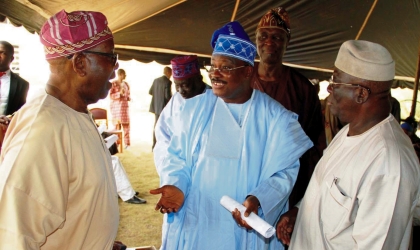
L-R: Afenifere chieftain, Sir Olaniwun Ajayi, Governor Abiola Ajimobi of Oyo State and Chief Ayo Adebanjo, during the preliminary meeting of the Yoruba Committee on National Conference in Ijebu last Monday. Photo: NAN.



The Hydrocarbon Pollution Remediation Project (HYPREP) has commemorated the 15th anniversary of the release of the United Nations Environment Programme (UNEP) Environmental Assessment Report on Ogoniland, reaffirming its commitment to restoring the environment and improving the livelihoods of affected communities.
In a statement signed by the Project Coordinator, Prof Nenibarini Zabbey, to commemorate the anniversary, HYPREP described the anniversary as a significant milestone in Nigeria’s environmental restoration efforts, noting that the project has made remarkable progress in implementing the recommendations of the landmark UNEP report released on August 4, 2011.
The UNEP report had revealed extensive oil pollution across Ogoniland, severe environmental degradation, and serious public health risks resulting from decades of petroleum operations. It also recommended an initial $1 billion fund to commence the cleanup of the affected communities.
According to HYPREP, the Federal Government formally launched the Ogoni clean-up in 2016, while the Project Coordination Office was established in 2017 to drive the implementation of UNEP’s recommendations.
Zabbey said the current administration has continued to prioritise the project under the Renewed Hope Agenda.
Providing an update on the cleanup, the Project Coordinator disclosed that 30 of the 65 contaminated sites identified by UNEP have been fully remediated, while work is ongoing at several medium- and high-risk locations. It also stated that more than 1.5 million mangrove seedlings have been planted as part of what it described as the world’s largest restoration of oil-degraded mangroves, with over 1,000 hectares of shoreline already rehabilitated.
Zabbey further revealed that 49 Ogoni communities have been connected to potable water schemes through multiple water projects and booster stations aimed at providing safe drinking water across the region.
In the health sector, he said the 100-bed Ogoni Specialist Hospital in Kpite and the 43-bed Cottage Hospital in Buan are nearing completion, adding that several existing health facilities have been upgraded with modern medical equipment, while five ambulances have been donated to improve emergency healthcare services. The Project Coordinator also disclosed that a three-year human health biomonitoring study is being conducted in collaboration with the World Health Organization’s International Agency for Research on Cancer (IARC).
On economic empowerment, Zabbey stated that the Project has created more than 8,000 direct jobs and trained thousands of Ogoni youths and women in various vocational and technical skills, including software development, cybersecurity, aviation, commercial diving, seafaring, mechatronics, and creative arts. The project also reported awarding scholarships to more than 1,000 students, providing grants to small businesses, and supporting persons living with special needs through skills acquisition programmes.
The statement further highlighted ongoing legacy projects, including the Ogoni Power Project and the Centre of Excellence for Environmental Restoration, which it said is about 96 per cent complete. HYPREP also welcomed the recent designation of the Ogoni Wetland as a Ramsar Site of International Importance and pledged to continue promoting biodiversity conservation and sustainable management of the ecosystem.
Marking the anniversary, Zabbey said the progress achieved over the past 15 years demonstrates the collective commitment of government, development partners, stakeholders, and local communities to restoring Ogoniland. He called for renewed collaboration to sustain the cleanup effort, promote environmental sustainability, and support the long-term development of the region. 3
-

 News2 days ago
RSG Targets Nine Million Residents in Mosquito Net Distribution Campaign
-

 Oil & Energy2 days ago
Aiyedatiwa Signs New Electricity Bill
-

 Oil & Energy2 days ago
NLNG Commissions Research And Innovation Centre In RSU
-

 Maritime2 days ago
Marine Minister Commends President Tinubu On NPERA Bill Assent
-

 News2 days ago
KenPoly Holds Eight Convocations, August 29
-

 News2 days ago
RSG Begins Another Phase of Projects Commissioning Today
-

 News2 days ago
RMAFC Completes Revenue Sharing Review, Proposes New Pay
-

 Maritime2 days ago
NAGAFF Petitions IGP Over Alleged Maritime Police Harassment