Sports
Eguavon Helps ABS Beat Niger Tornadoes
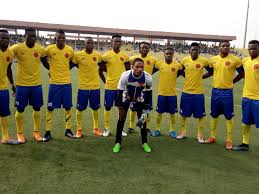
Seasonal Charles Eguavon came from the bench to score the winning goal to help Abubakar Bukola Saraki (ABS) Ilorin FC beat visiting Niger Tornadoes of Minna 2-1 on Saturday.
Tidesports source reports that the 2020/2021 Nigeria National League (NNL) match Day 9 was played at the Kwara Stadium Complex, Ilorin.
With this streak, ABS has returned to winning ways after three consecutive away losses.
It was Eguavon’s 5th goal of the season after rejoining the club from City rival, Kwara United FC of Ilorin, on loan.
The homers dominated proceedings for most of the first half and wasted so many goal scoring opportunities in the process.
Kale Karatu in the 10th minute benefitted from a lose ball and wasted no time in responding with a fantastic shot which went wide.
The visitors would have been ahead in the 19th minute when Oche Josiah won possession in a dangerous position drove straight into the ABS box before his fine attempt went wide.
ABS defender, Nelson Abiam forced Niger Tornadoes’ goalkeeper, Yinka David to a brace of saves in the space of two minutes.
The host’s search for goals left them short in the defence on most occasions as they struggle at times to cope with the pace and power of Tornadoes’ Oche Josiah.
ABS returned from where they left it in the 2nd half when play resumed again as Mubaraq Gata fed an incoming Kale Karatu in the 47th minute his shot was poorly played.
The hosts were awarded a penalty in the 52nd minute after Tornadoes defender was adjudged to have handled the ball in the goal area.
Gata made no mistake in the 53rd minute when he hit the ball directly into the roof of the net to score the ABS first goal.
ABS coach, Anthony Encho, made three changes in the 63rd minute to add notes to his attack when he introduced Taofik Aremu, Charles Eguavon and John Maurice as they came to replace Mubaraq Gata, Samuel Bamigboye and Kale Karatu.
One minute later, Abdullahi Boje made a fine safe to deny the visitors from a corner kick.
Eguavon rose from the bench to score the winning goal in the 71st minute from a goal mouth scrambling after perfect team play by the hosts.
The ABS 2nd goal lead only lasted for seven minutes when Tornadoes half the scores through John Jacob.
The visitors had some fringes of moments at the tail end of the match but ABS held on well to end the first round of the league with the 2-1 win.
The Ilorin based side now moved to the 4th position of the log haven started the match day in the 7th place on the table.

Sports
NSC pledges support for power sector workers’ Games
The Chairman of the National Sports Commission, Shehu Dikko, has pledged full government backing for the maiden Nigeria Electricity Supply Industry Games, describing the initiative as a strategic platform to deepen cohesion within the power sector and stimulate the sports economy.
Dikko made the pledge in a statement issued on Sunday following a courtesy visit by the management of the NESI Platform, organisers of the NESI Week 2026, which will feature sporting activities for workers and stakeholders across the electricity value chain.
According to the statement, the Commission is ready to provide technical and institutional backing for the games scheduled for November 15 to 20, 2026, in Abuja, bringing together generation companies, distribution companies, transmission operators, regulators, government agencies and other stakeholders under one platform.
He said the sector more commonly associated with megawatts, tariffs and grid collapses, Nigeria’s electricity industry is now turning to sports as a tool for unity, productivity and economic growth.
Speaking during the meeting, Dikko said the initiative aligned with the government’s agenda to expand the sports economy while promoting collaboration and productivity in critical sectors.
He said, “Our mandate here is to work for every sport, for every organisation, and to provide the enabling environment for every sport to prosper, whether it is grassroots sports, community sports, or organisational sports like the one you are trying to do.
“If we talk about harnessing the potential of the sports economy, it is not just about elite athletes. It is across all facets of the economy, top to bottom. What you are about to do, from the zonal qualifiers to the state levels and then the finals, will have a measurable economic impact.
”Drawing parallels with the long-running oil and gas industry games, Dikko noted that while the Oil and Gas Games are now in their 48th year, the electricity sector was only just beginning its own tradition.
“The one we concluded last weekend was the Oil and Gas Games, and they have been doing it for decades. You are starting something new. Small steps will lead to something big. This maiden edition will require technical support, experience and coordination, and we are here to give you that support,” he said.
Beyond recreation, Dikko argued that sports could foster peer review and collaboration within an industry often criticised for inefficiencies.
“This addition of sports will bring your people together. You will compare what other operators are doing in the industry and see how you can support yourselves to do your core business better, which is getting electricity across the country,” he said.
The NSC chairman urged electricity companies to embed community sports infrastructure into their operations, particularly in areas hosting substations, power plants and transmission facilities.
“You should not just do the games and stop there. Think about legacy. Within the areas where you operate, look at supporting grassroots sports. If there is an open space, build a small basketball court, a football pitch, or a tennis court,” he said.
“If you do that, you are not just creating future stars. You are enhancing security. The young people around those facilities will channel their energy into positive engagement instead of negative activities.”
According to him, investing in grassroots sports within host communities could help protect critical national infrastructure by strengthening community relations and youth engagement.
Earlier, the Chairman of the NESI Platform and head of the steering committee for NESI Week 2026, Obiora Anthony, described the games as a landmark initiative for the power sector.
“NESI Games 2026 is the first nationally structured sporting event for the Nigerian Electricity Supply Industry. This industry comprises generation companies, distribution companies, the transmission operator, regulators, energy agencies, investors and even consumers. It is a large value chain,” he said.
He explained that the games would promote workforce wellness, leadership development and cross-sector collaboration, aligning with the Federal Government’s Renewed Hope Agenda on growing the sports economy.
“This event will give an opportunity for workforce wellness, leadership development and national sports development. It is structured in phases, regional qualifiers, quarter-finals in October, and the national finals in November 2026 here in Abuja. We hope tow the finals at the National Stadium,” Anthony said.
He added that the sporting fiesta would be embedded within NESI Week 2026, a broader convening platform that brings together policymakers, regulators, operators and private sector leaders in the energy ecosystem.
Sports
NSC eyes international hosting rights
The National Sports Commission is stepping up efforts to secure international hosting rights as part of a broader plan to rebuild ageing facilities and reposition sport as a central driver of Nigeria’s economic growth, Tidesports source reports.
The strategy, according to the commission Chairman Shehu Dikko, is anchored in the Renewed Hope Initiative for Nigeria’s Sports Economy, a policy framework that outlines both the guiding principles and measurable outcomes of the reforms.
“When we launched the Renewed Hope Initiative for Nigeria’s Sports Economy, it clearly spelt out the fundamentals of what we want to achieve and the outcomes we expect,” Dikko told Tidesports source.
“You can see everything coming together, but we are just starting. As we have said, we have to do more, and we are going to do more.”
Dikko explained that hosting major competitions sits at the heart of that reset from the outset, and the commission resolved to pursue this as a catalyst for development deliberately.
“Because this is part of our vision and objectives from day one, we said we have to reset and refocus on our sport,” he said.
“Hosting major international events and conferences is part of that vision. We said whatever we are going to do, we have to be intentional and deliberate about it.”
The commission recently staged the Africa Running Conference and has already been offered the 2027 edition, a development Dikko believes underlines growing confidence in Nigeria’s capacity. He added that road running represents just one strand of a much wider ambition.
“It is not just about road running; it is about every sport. We want to be hosting events. That is the only way we can keep our infrastructure functional… and advance the sports economy we are talking about,” he said.
NSC Director General Bukola Olopade framed the hosting push as part of a broader production model designed to build talent and stimulate enterprise.
According to Olopade, Nigeria has sent more than 50 national teams to international competitions over the past year and hosted at least 12 events, in addition to domestic competitions such as the Gateway Games in Abeokuta.
“What we have consistently emphasised is the need to create a pool and a production line of talent, and to generate wealth by hosting international events in Nigeria,” Olopade told our correspondent, arguing that regular competitions on home soil provide athletes with exposure while strengthening the domestic sports market.
Dikko linked that approach directly to infrastructure renewal, pointing to provisions in the 2025 and 2026 federal budgets aimed at rehabilitating stadiums and facilities.
“If you check the 2025 and 2026 budgets, there is a major component dedicated to fixing infrastructure because without infrastructure, you cannot achieve much,” he said.
Dikko added that work is underway in partnership with state governments and private investors across the country.
“Where we want to build or rehabilitate a stadium, we are partnering with state governments and handing some facilities over to them. The Federal Government is also working with state governments to restore other stadiums since the President approved discussions with relevant authorities to bring back key facilities,” Dikko said.
“In Lagos, for instance, they are doing an excellent job rebuilding the National Stadium. They have almost demolished parts of it and are reconstructing it to meet modern standards. We are also handing it over to a private sector consortium that won the bid to manage and restore it.”
Olopade added that private sector involvement has been central to the commission’s momentum, crediting confidence in President Bola Tinubu’s reforms and the leadership team’s combined experience for attracting new commitments.
“With ease, Mallam Shehu Dikko can pick up the phone and speak to managing directors of multinational companies. I can do the same without hesitation. We have already put this into practice, and we are seeing traction,” he said.
He revealed that a private entity had committed to constructing a multi-million naira wrestling hall, while a gaming company had pledged to build a specialised facility for para-sports, adding that documentation was being compiled to demonstrate the direct and indirect economic impact of such initiatives.
Dikko also added that engagement with corporate Nigeria extended beyond headline sponsorship deals, disclosing that he recently met with representatives of the oil and gas sector in Abuja, where he urged them to look beyond organising sporting activities within their industry.
Just recently in Abuja, I hosted representatives from the oil and gas sector. Part of the discussion was that while they organise sports activities within their industry, they should also return to their companies and ensure that their CSR programmes invest in community sports infrastructure. Wherever they see available space in their communities, they should do something for sports,” Dikko said.
The commission’s ambitions have received public backing from President Tinubu, who announced a comprehensive reset of sports funding beginning from the 2026 fiscal year and pledging that sports funding will be released promptly going forward to avoid the bureaucratic delays that have historically disrupted preparation and participation.
For Dikko, the president’s endorsement signals a shift in how sport is viewed at the highest level of government.
Responding to early critics who dismissed the reform drive as rhetoric, he said recent developments spoke for themselves.
“Two weeks ago, Mr President personally tweeted on his official handle about the records of what sports achieved in 2025. Has that ever happened before in sports?” he questioned.
“There is nothing much to say; we are working. You can see what is happening.”
“Just recently in Abuja, I hosted representatives from the oil and gas sector. Part of the discussion was that while they organise sports activities within their industry, they should also return to their companies and ensure that their CSR programmes invest in community sports infrastructure. Wherever they see available space in their communities, they should do something for sports,” Dikko said.
The commission’s ambitions have received public backing from President Tinubu, who announced a comprehensive reset of sports funding beginning from the 2026 fiscal year and pledging that sports funding will be released promptly going forward to avoid the bureaucratic delays that have historically disrupted preparation and participation.
For Dikko, the president’s endorsement signals a shift in how sport is viewed at the highest level of government.
Responding to early critics who dismissed the reform drive as rhetoric, he said recent developments spoke for themselves.
“Two weeks ago, Mr President personally tweeted on his official handle about the records of what sports achieved in 2025. Has that ever happened before in sports?” he questioned.
“There is nothing much to say; we are working. You can see what is happening.”
Sports
NPFL Drops To 91st In Global League Rankings
The Nigeria Professional Football League (NPFL) has dropped to 91st place in the International Federation of Football History and Statistics (IFFHS) global league rankings, marking a fall of 15 positions from its 76th-place ranking in 2024.
The latest figures, released for 2025, show the NPFL earned 171.75 points, placing it outside the top 90 leagues globally and signalling a decline in the league’s comparative strength against other domestic competitions worldwide.
The IFFHS ranking methodology combines results from both continental and international club competitions, giving weighted consideration to club performances beyond regional contests. Analysts say the NPFL’s drop reflects inconsistent results by Nigerian clubs in continental tournaments and the growing competitiveness of leagues in other regions of Africa.
In Africa, Egypt’s Premier League maintained its position as the continent’s strongest league for a sixth consecutive year.
Morocco’s Botola followed, retaining a position on the African podium since 2018, while South Africa’s Premiership returned to the top three for the first time in 21 years. Algeria and Tunisia completed the continent’s top five.
Under the Confederation of African Football (CAF) five-year ranking, Nigeria sits 12th with 21 points, still allowing the country to enter two teams in each CAF club competition.
Globally, European leagues continued to dominate the upper ranks, with 12 of the top 20 and 29 of the top 50 leagues hailing from the continent.
South America contributed five leagues to the top 20, while Asia had two, and CONCACAF and Oceania had one league each.
The English Premier League retained the top spot worldwide for the sixth time since the rankings began in 1991, followed by Spain’s La Liga and Brazil’s Serie A.
Italy’s Serie A dropped three positions but remained above Germany’s Bundesliga, while France’s Ligue 1 climbed into sixth place.
Portugal’s Primeira Liga held seventh, Argentina’s Liga Profesional slipped two places but stayed ahead of the Dutch Eredivisie, and Colombia’s Primera A completed the global top ten.
Observers have suggested that Nigeria’s drop to 91st highlights long-standing concerns about the NPFL’s competitiveness and international visibility.
Club performances in continental competitions, investment in infrastructure, and the quality of player development are cited as critical areas for improvement if the league is to regain its standing.
According to football analyst Tunde Adeyemi, “The NPFL has the potential to compete at higher levels, but the decline in rankings reflects both structural challenges and the need for strategic planning to boost club results and overall league quality.”
With African leagues such as Egypt, Morocco, and South Africa consolidating their positions both continentally and globally, the NPFL faces mounting pressure to enhance its domestic competition and ensure Nigerian clubs perform more consistently on the continental stage.
-
Maritime22 hours ago
Customs Declares War Against Narcotics Baron At Idiroko Border
-
Maritime22 hours ago
Nigeria To Pilot Regional Fishing Vessels Register In Gulf Of Guinea —Oyetola
-
Maritime22 hours ago
NIMASA,NAF Boost Unmanned Aerial Surveillance For Maritime Security
-
Sports22 hours agoGombe-Gara Rejects Chelle $130,000 monthly salary
-
Maritime22 hours ago
NIWA Collaborates ICPC TO Strengthen Integrity, Revenue
-
City Crime19 hours ago
NCSU Hails Fubara Over 2025 New Telegraph Man Of The Year Award
-
Maritime22 hours ago
NIMASA GETS NEW MARITIME GUARD COMMANDER,ADOKI
-
Business22 hours agoDangote signs $400 mln equipment deal with China’s XCMG to speed up refinery expansion