
News
Monguno Absent As Buhari Meets Service Chiefs

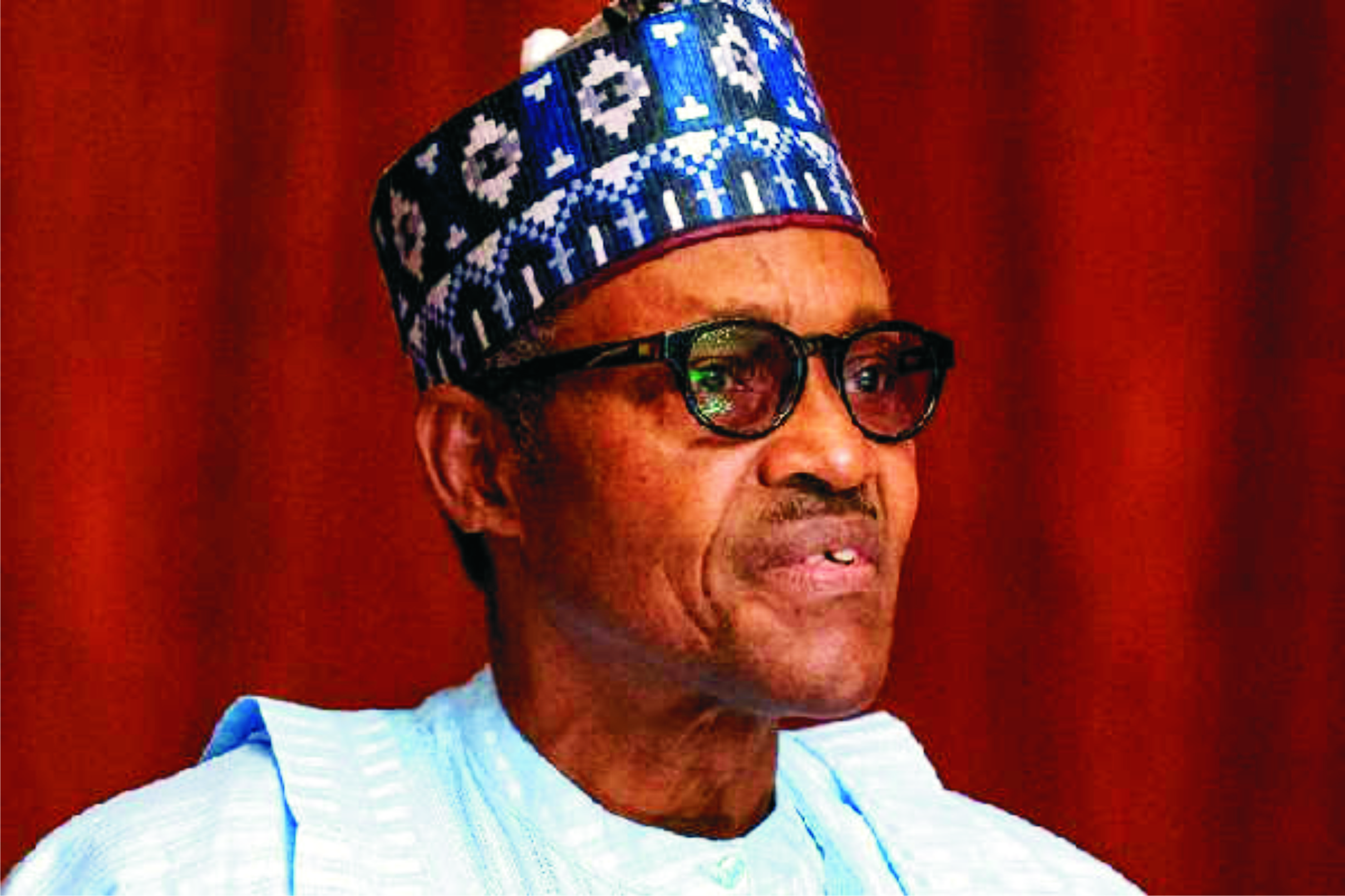
Barely 24 hours after President Muhammadu Buhari had given a marching order to the military to embark on an aggressive campaign to rout Boko Haram, the President, yesterday, met behind closed-doors with the service chiefs and the Inspector-General of Police, Mohammed Adamu, at the Presidential Villa, Abuja.
After the closed-door meeting with Buhari, the service chiefs also went to the Office of the Chief of Staff to the President, Malam Abba Kyari, where they also had another meeting.
The meetings came on the heels of the recent attack on Garkida community of Adamawa State where the Boko Haram insurgents killed many people, including a soldier, and even sacked the community.
There have been a plethora of calls for the President to sack the service chiefs and also rejig the nation’s security architecture as a result of the worsening security situation in the country but it appears the President is not in a hurry to effect any change.
Reacting to the attack on the Garkida community, last Sunday night, the President had said that his administration has significantly weakened Boko Haram’s military capability to invade and hold Nigerian territory unchallenged.
The President, in a statement by his Senior Special Assistant on Media and Publicity, Mallam Garba Shehu, condemned the attack on the community, and assured that no part of Nigeria would be abandoned to their fate.
He also said that “in the coming weeks, Nigerians would witness an aggressive campaign to rout Boko Haram once and for all.
“These attacks on soft targets by the terrorists are obvious signs of frustration because my administration has significantly weakened Boko Haram’s military capability to invade and hold Nigerian territory unchallenged.
“Our gallant forces deserve our appreciation for repelling the attackers but they must go beyond this point. They have our full support to go after the terrorists and have them pay a huge price. I want to assure the country that terrorists will continue to face the combined power of our military until they give up their mistaken ways.
“These occasional and episodic attacks on poor civilians by the terrorists are mere propaganda efforts to portray them as strong in order to fool the public into believing that they haven’t been militarily weakened by our gallant troops.”
Buhari said that since the coming of his administration, Boko Haram’s ability to invade and occupy Nigerian territories, let alone be able to hoist their flags, had been frustrated.
Present at yesterday’s meeting were Chief of Defence Staff, Gen Abayomi Olonisakin, Chief of Army Staff, Lt-Gen Tukur Buratai, Chief of Air Staff, Air Marshall Sadique Abubakar and Chief of Naval Staff, Vice Admiral Ibok-Ete Ekwe Ibas and the IGP Mohammed Adamu.
But as President Muhammadu Buhari met with the service chiefs, yesterday, behind closed-doors at the Presidential Villa, Abuja, the National Security Adviser, Maj-Gen Babagana Monguno (rtd), was conspicuously absent.
Monguno’s absence at the meeting could not be explained by Presidency sources, but it may not be unconnected with his recent rift with the President’s Chief of Staff, Abba Kyari over the latter’s alleged interference on issues of national security, which are within the purview of the Office of the NSA.
It would be recalled that Buhari and the service chiefs hold routine security meetings weekly but that of today is tagged ‘special consultation’.
The service chiefs passed through the office of the Chief of Staff to the President, Mr Abba Kyari, on their way out.
Buratai was the last sighted leaving about 3.55 pm.
Pressure had been mounted on Buhari lately to fire the service chiefs amid escalating security challenges in the country.
The National Assembly too had called for the sacking of the security chiefs.
However, the President had yet to heed the calls, saying his regime would not take any hasty actions against the officers, who manned the country’s security operations since 2015.



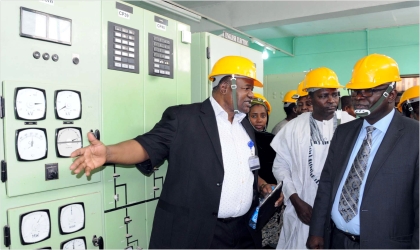
The Transmission Commission of Nigeria has announced electricity disruption in parts of Kano, Katsina, Jigawa, Bauchi, and Yobe States, as well as Gazaoua in the Niger Republic.
The spokesperson of TCN, Ndidi Mbah, disclosed this in a statement yesterday
The outage is due to planned maintenance at Kumbotos’ 330 kilovolt transmission substation on Sunday.
Consequently, electricity customers served by Kano Electricity Distribution Company, Kaduna Electricity Distribution Company, and Yola Electricity Distribution Company will experience power disruption.
“The scheduled maintenance is to enable the TCN contractor to continue the ongoing upgrade of 330kV bus II jumpers and replace the existing 350mm² conductors with 800mm² conductors in order to strengthen the transmission network and improve power reliability.
“As a result, Kano Electricity Distribution Company (KEDCO) and some part of Jos Electricity Distribution Company (JEDC) and Yola Electricity Distribution Company (YEDC) will be unable to off-take power for distribution to their customers in Kano, Katsina, and Jigawa States, as well as Azare in Bauchi State, Nguru in Yobe State, and also Gazaoua in the Niger Republic,” TCN stated.
The Socio-Economic Rights and Accountability Project (SERAP) has called on Senate President, Godswill Akpabio, and Speaker of the House of Representatives, Tajudeen Abbas, to refer allegations of the diversion or non-accounting of over ?6.3 billion in constituency project funds to anti-corruption agencies for investigation and possible prosecution.
The group also urged the National Assembly leadership to ensure that anyone found culpable is prosecuted where sufficient admissible evidence exists, while all diverted or unaccounted public funds are recovered and paid into the treasury.
In a letter dated June 27, 2026, and signed by its Deputy Director, Kolawole Oluwadare, SERAP said the allegations were contained in the Auditor-General of the Federation’s 2022 Annual Report, published on September 9, 2025.
The organisation disclosed this in a statement signed and released by Oluwadare, yesterday.
SERAP also asked Akpabio and Abbas to disclose the identities of contractors and companies, including their shareholders and beneficial owners, that allegedly received constituency project funds but failed to execute the projects.
It gave the National Assembly seven days to act on its recommendations, warning that it would institute legal proceedings should the legislature fail to respond.
“We would be grateful if the recommended measures are taken within seven days of the receipt and/or publication of this letter. If we have not heard from you by then, SERAP shall take all appropriate legal actions to compel you and the National Assembly to comply with our request in the public interest,” the letter stated.
It said, “The allegations involve several federal ministries, departments and agencies, including the Environmental Health Registration Council of Nigeria (EHORECON); the Federal College of Animal Health and Production Technology, Volm; the Federal Polytechnic, Udana; the National Agency for the Prohibition of Trafficking in Persons (NAPTIP); and the National Institute of Legislative and Democratic Studies (NILDS).
“The Auditor-General identified numerous cases of payments into private bank accounts, contracts awarded without due process, payments for contracts not executed or services not rendered, undocumented expenditures, inflated contracts, procurement irregularities and failures to account for public funds, recommending in each case that the funds be recovered and remitted to the treasury.
“According to the 2022 audited report, contained in pages 367 to 396, the Environmental Health Registration Council of Nigeria (EHORECON or Council) Abuja paid over ‘N22 million [N22,944,565.16] into the private account of some members of staff of the Council from the Constituency Projects Fund Account.
“There ‘was no evidence of the utilization of the funds and no explanations on the purpose for the payment of such amount into the individual accounts.”
SERAP added, “The Council (EHORECON) also in 2021 ‘awarded suspicious consultancy contracts of over N12 million [N12,030,818.29] for the development of Modern Abattoirs in Kebbi State and the supervision of 7 projects in Kebbi, Jigawa, and Headquarters Abuja.
“The money was to ‘produce bills of quantity, architectural design, structural design, mechanical design, and electrical designs for the contracts and supervision.’ But ‘the ‘items could not be found.’”
Altogether, SERAP said the Auditor-General’s 2022 report alleged EHORECON paid more than ?1.8 billion in constituency project funds through questionable transactions.
For the Federal College of Animal Health and Production Technology, Vom, SERAP said the institution “in 2022 reportedly ‘paid over N279 million [N279,700,500.00] to 3 contractors to empower and train youths in selected vocational areas in Borgu and Kontagora, Niger State, train women and youths in entrepreneurship in Niger East Senatorial District and to train youths and women in agro production and self-reliance in Barki Ladi/Riyom Federal Constituency, Plateau State.
“But the money was paid to the contractors without any document.’”
Other irregularities involving the college include another ?279.7 million in mobilisation fees allegedly paid without documentation, and more than ?629.4 million paid to unqualified contractors for various constituency projects without evidence of due process, contract advertisements or details of the contractors.
SERAP further alleged that the Auditor-General’s report identified multiple financial irregularities involving the Federal Polytechnic, Ukana, Akwa Ibom State, including over ?407 million allegedly paid as mobilisation fees without supporting documents, more than ?399 million paid to unqualified contractors, contracts allegedly inflated by over ?192 million, over ?279 million paid for projects not fully executed, ?50 million allegedly paid for an unexecuted borehole project, and more than ?83 million disbursed without the required documentation or approvals.
It also alleged that NAPTIP reportedly irregularly awarded contracts worth over ?21.8 million, paid more than ?176.8 million for logistics and consultancy services without supporting documents, and disbursed over ?89.6 million and ?4.4 million for projects that were allegedly not executed.
The report also alleged that NILDS failed to submit audited financial statements for 2012 to 2022, did not remit over ?15 million in stamp duties, and spent ?1.6 million without authorisation from the Office of the Accountant-General of the Federation.
SERAP said the report recommended the recovery of the affected funds and their remittance to the treasury.
It argued that corruption in constituency projects disproportionately affects poor and vulnerable Nigerians by diverting resources meant for public services and development.
It added that the National Assembly, in exercising its oversight responsibilities, should demonstrate leadership by ensuring accountability in the management of constituency project funds.
The organisation further argued that the allegations, if established, would amount to breaches of the Constitution, the Fiscal Responsibility Act 2007 and the Public Procurement Act 2007, which require transparency, accountability and due process in the management of public resources.
The Rivers State Government has assured the timely completion of all ongoing projects in the State.
The State Commissioner for Works, Professor (Engr) Temple Nwofor, gave the assurance in an interview with newsmen during the June induction ceremony of the Nigerian Society of Engineers, Port Harcourt branch, at the weekend in Port Harcourt.
He said most ongoing projects have their timeline and will be completed as scheduled.
“All our ongoing projects are doing well. They are doing well.
” I don’t think there are any issues with them, they are progressing very well .
“They all have their timeline, those that have their timeline will definitely finish, most of the signature projects,” he said.
Nwofor who was the Guest of Honour at the induction ceremony, also called for continuous professional development among Engineers to keep them abreast with modern trends in the profession.
He also urged them to acquire other skills that will make them useful in their careers.
Speaking on “Engineering Beyond the Drawing Board Through Ethical Leadership and Service To Society,” the guest lecturer, Dr Ibiye Amafabia called for continuous professional development.
“Ethical leadership demands that we stay current through continuous professional development.
“Leverage on trainings, workshops, seminars and conferences organised by NSE and your various divisions to keep yourselves abreast of new development.”
Amafabia further said engineers must be accountable for any projects, and and warned against shifting of blame especially when projects fail.
She also urged engineers to be good citizens of their communities by helping their xommunities overcome challenges of flooding, building collapse and oil spills, among others.
“In Port Harcourt, the capital of Nigeria’s oil and gas industry, the ethical challenges are immense.
“We see the environmental impact of decades of extraction, we see the tension between industrial profit and community well-being.
“The ethical engineer is a mediator, a steward of the environment and an advocate for the vulnerable,” she said.
In his welcome address, Chairman, Nigerian Society of Engineers, Port Harcourt branch, Engr. Belema Ekine, said the society has a rich legacy of excellence, innovation and service spanning decades.
Ekine said engineers hold the key to solving complex challenges, shaping the infrastructure of communities and drive technological advancement that benefits society at large.
He charged the new inductees to see themselves as torchbearers of the society future, saying “it is upon your shoulders that the responsibility rests to uphold the highest standard of professionalism, ethics and integrity.
“Embrace the principles of lifelong learning, for the field of engineering is ever evolving.
“Seek opportunities for continuous growth, nurture your skills and stay at the forefront of emerging technologies.” he charged.
John Bibor/Alyede Promise/Membere Orinaemi/Iyoma Oluebube
-
Business2 hours ago
FG to Roll Out 10,000 Electric Tricycles By August –Sheittima
-
Nation2 hours ago
Self Help Africa programme expands water access for 320,000 Nigerians
-
Business2 hours ago
NIWA Concessions Waterways Clean-Up to Indigenous Coy
-
Business2 hours ago
Nigeria, Netherlands Partner To Boost Trade And Border Security
-
Niger Delta2 hours ago
A’Ibom NUJ Worries Over Scavenging Activities In Eket
-
Sports2 hours ago
Nwabali Prepares To Join Saudi Club
-
Sports2 hours ago
NSC Appoints Oluwafemiayo Nigeria’s Captain for 2026 Commonwealth Games
-
Sports2 hours ago
LSG Sets Up Sub- Committees For EKO 2026 National Intermediate Games