Sports
Nigeria Secures World Cup Ticket, Fans React
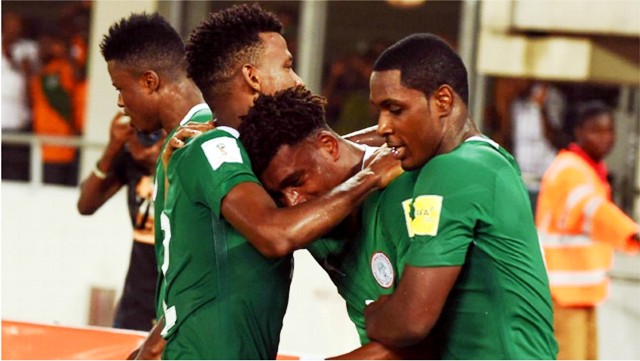
Nigeria Super Eagles last Saturday booked her ticket to feature in the world biggest football tournament in Russia next year, as they beat hard fighting and technically brilliant Zambians with a lone goal.
The encounter was one of the Group B World Cup qualifier games in the African continent played at Godswill Akpabio International Stadium, in Uyo, Akwa Ibom State.
It was a barren draw in the first stanza of the game, but the visitors won ball possession in the half, in spite of the fact that the Eagles threw away pockets of goal scoring opportunities.
Substitute Alex Iwobi at the 74th minute gave Nigeria the desired World Cup slot through a brilliant display between Victor Moses and Shehu Abdullahi, before the ball saw the back of the net.
Reacting shortly after the match, a soccer entrepreneur, Elli Kechukwu said for the team to perform impressively at World Cup Eagles coach Gernot Rohr should select players that are really committed and determined.
According to him, Nigeria has not actually placed herself in terms of football in the world, adding that football administrators should organise structural programmes for football.
“I am very happy that we won and qualified for the World Cup for the sixth time. Honestly, initially I was not sure of our victory, but thank God that we finally won.
“The coach should look for committed players, like those that are prepared to sacrifice everything for the country,” Kechukwu said.
Sports presenter and analyst, Lashely Oladigbolu also expressed joy over the victory against Zambians, saying the Eagles’ unbeaten record in the World Cup qualification series is commendable.
“I must say that the Zambians performed impressively. They are hard fighting. Beating Algerians home and away is an indication that they are not a push over side. However, Nigeria had all it takes to grab the ticket from the group,” Oladigbolu said.
Tonye Orabere

Sports
Juve Beat Roma To Close Gap In Series A
Francisco Conceicao and Lois Openda ended their goal droughts as Juventus beat Roma to move within a point of the Serie A top four.
Conceicao finished off a slick move to put Juventus ahead just before half-time, before Openda tapped into an empty net in the 70th minute, but Tommaso Baldanzi halved the deficit to set up a nervy final 15 minutes.
Roma began the day with the best defensive record in Serie A having conceded just eight goals in 15 games, but there was nothing goalkeeper Mile Svilar could do about either Juventus goal.
Conceicao ended his nine-game goalless streak when he ran on to Andrea Cambiaso’s clever flick-on and drilled a low shot into the far corner.
Openda was on hand to convert from Weston McKennie’s selfless ball across the face of goal for his first strike in Serie A since joining Juventus on loan from RB Leipzig in the summer.
Roma finally found their cutting edge in the 76th minute when Baldanzi pounced after Michele di Gregorio had palmed Evan Ferguson’s low strike into danger.
Juventus forward Kenan Yildiz sought an instant response but saw his vicious strike cannon back off the post.
Roma have scored just 17 goals in 16 league games this season, so it came as no surprise that Gian Piero Gasperini’s side could not find a second goal.
Juventus remain fifth in the table but are just a point behind Roma in fourth, and have now won six of their past seven games in all competitions under Luciano Spalletti.
Roma would have gone joint-top of the table with Inter Milan had they won, but remain three points behind the leaders having played one game more.
In Germany, Bayer Leverkusen came from behind to beat RB Leipzig and leapfrog their opponents into third place in the Bundesliga table.
Goals from Martin Terrier and Patrik Schick cancelled out Xaver Schlager’s opener as an entertaining first half ended with three goals in nine minutes, before Montrell Culbreath wrapped up victory in second half injury-time.
Sports
New Four Yr Calendar For AFCON
The Africa Cup of Nations (Afcon) will be held every four years from 2028, Confederation of African Football president Patrice Motsepe has announced.
The tournament has taken place every two years since 1968, with a one-year gap between the 2012 and 2013 editions.
But it will switch to a four-year cycle after the 2027 Afcon in East Africa and a 2028 edition.
Motsepe has instead announced the creation of an African Nations League which will take place annually from 2029.
“We have the most exciting new structure for African football,” Motsepe said.
“I do what is in the interests of Africa. The global calendar has to be significantly more synchronised and harmonised.”
Meanwhile, Caf has increased the prize money for the winners of Afcon from $7m (£5.2m) to $10m (£7.5m).
The surprise announcement about the future of Afcon was made by Motsepe after a meeting of Caf’s executive committee in Morocco before the start of the 2025 finals in Rabat yesterday.
The biennial hosting of Afcon has long caused issues with the football calendar, with the vast majority of recent tournaments held midway through the European club season.
However, Caf remained committed to scheduling the tournament every two years, not least as it needs the revenue raised from the finals to reinvest in the game on the continent.
Caf had made a resolution for Afcon to be held in a June-July slot from 2019 onwards and began its new plan in Egypt that year.
But the Covid-19 pandemic and weather conditions in host nations in Central and West Africa meant the 2021 and 2023 editions in Cameroon and Ivory Coast respectively were staged in January and February instead.
Fifa’s expanded 32-team Club World Cup was held in June and July this year, forcing Caf to opt for mid-season dates once again.
As a result this year’s Afcon in Morocco is taking place over Christmas and the New Year for the first time, with the final on 18 January.
The dates for the finals in Kenya, Tanzania and Uganda in 2027 are yet to be announced, and that will be swiftly followed by another Afcon in 2028, with the hosts of that edition yet to be decided.
After that, the continent’s biggest tournament will become a quadrennial tournament taking place in the same year as the European Championships.
Motsepe said the decision had been made in conjunction with Fifa president Gianni Infantino and the world governing body’s general secretary Mattias Grafstrom, and that Caf “have to compromise”.
Motsepe also announced the creation of the African Nations League, which will take place in September, October and November every year from 2029.
The competition will see all 54 member associates split into four zones, with six nations in the Northern zone and 16 nations in the Eastern, Western and Central and Southern zones.
Matches will be played in September and October, with the champions from each region meeting in November to then decide an overall winner.
Motsepe said the new competition will be “the equivalent of an Afcon every year” and will be held in partnership with Fifa in order to attract top-class sponsors.
“Every year in Africa, the best African players who play in Europe will be with us on the continent,” Motsepe added.
“Every year we will have a competition with 54 African nations with all the best players coming here to play.
“We are going to have a world-class competition every year.”
Sports
Boxing: Joshua Overwhelms Paul In Six
Anthony Joshua did what he was meant to do on Friday night in Miami: he lay waste to Jake Paul’s bravest and most controversial experiment in boxing with a destructive victory that felt less like a sporting result than the restoration of sanity.
In their scheduled eight-round heavyweight bout at the Kaseya Center, streamed globally to Netflix’s roughly 300 million subscribers, the former twice unified heavyweight champion scored four knockdowns before stopping the YouTuber-turned-boxer in the sixth round of a mismatch that had prompted weeks of safety fears and moral hand-wringing. Joshua’s triumph, on a night purpose-built as much for memes as for punches, served as a reminder that boxing still adheres to its elemental laws and that power and pedigree eventually reassert themselves.
From the opening bell, the shape of the fight was unmistakable. Joshua took the centre of the ring uncontested while Paul circled him, moving laterally from left to right and back again. The first round was extremely low volume, punctuated by a smattering of boos from the audience. Paul landed a brief double jab to the body before darting back to safety. Joshua threw an overhand right that appeared to glance off a retreating target making full use of the 22ft ring. It was tentative, but Joshua’s control of space earned him the round.
The second followed a similar pattern. Joshua swung and missed early as Paul continued to run, using lateral movement to frustrate the bigger man. Joshua began to cut off the ring more effectively, but Paul clinched whenever distance closed, drawing louder boos from the near-capacity crowd. A brief clash of heads halted momentum, and though Joshua hinted at body work, he continued to headhunt. It was a round defined by inertia: Joshua doing little, Paul doing less.
By the third, Joshua’s patience began to pay off. Paul briefly stepped into the pocket and attempted an uppercut, catching only leather. Joshua responded by throwing more power shots, narrowly missing but drawing audible gasps from the crowd. Late in the round, a right hand to the ribs appeared to buckle Paul, the first clear sign of damage. Again, Joshua did not land much cleanly, but he was the only fighter attempting to win rather than merely survive.
The fight deteriorated toward farce in the fourth. Paul went into full retreat as Joshua struggled to corner him, wrapping up at every opportunity. The crowd grew increasingly hostile. Matters continued southward when Paul went down claiming a low blow, prompting a prolonged stoppage by the referee Chris Young that gave him valuable recovery time. It did little to help. Paul went down again, then again, clearly exhausted and buying time. Despite the repeated delays, the referee issued no point deduction, drawing sustained jeers from the stands.
By the fifth, the contest had crossed from mismatch into embarrassment. Paul flopped once more before finally being dropped by a clean right hand. He beat the count but looked close to collapsing. A second knockdown followed moments later, again from a right, and Joshua closed the round trapping Paul in the corner and unloading unanswered shots. Somehow Paul survived to the bell, though the proceedings had ceased to resemble a competitive sporting event.
The end came early in the sixth. Paul went down almost immediately, dragged himself upright, then fell again under sustained pressure. This time he could not beat the count. Young waved it off at the 1:31 mark, finally ending a bout that had long outlived its threadbare justification.