
City Crime
Retirees Reject Call For Workers Retirement Age Extension

Some public service retirees have rejected
the call for the Federal Government to increase the retirement age of civil
servants.
Civil servants had begun to yearn for an
increase in their retirement age after the Senate passed a bill to extend the
retirement age of professors in Nigerian universities to 70 years.
The Senate also upped the pensionable age
of other academic and non-academic staff of universities to 65 years.
Mr
Chukwura Onu, a retiree and secretary, Federal Civil Service Pensioners,
said in Lagos that the nation’s poor economy would not allow any civil
servant to stay beyond 60 years.
He discouraged workers still in the service
from staying beyond 60 years so that they could retire well and continue to
live healthily.
“How can anybody want to stay in the Public
Service beyond 60 years? The infrastructure are not there and there are no jobs
for the youth. “We need to leave so that younger ones can get jobs,’’ he said.
Mr Sunday Job, another retiree, said that
the retirement age of 60 was good and should not be extended to allow workers
who had served long to retire in good health.
He said that retirees should rather desire
early payment of pensions by government and ensure that favourable policies
that would benefit them after retirement were made.
“If the money is small and it is received
as at when due, a person can live on it after retirement. But today many
pensioners die in the process of trying to get their pensions,’’ he said.
Mr Monday Igho, another civil servant who
has two months before retiring, said that people wanted to stay on because of
the poor state of the economy.
He said that if the government created an
enabling environment, by providing electricity, housing, water, good
roads and accessibility to basic needs, many people would retire voluntarily.



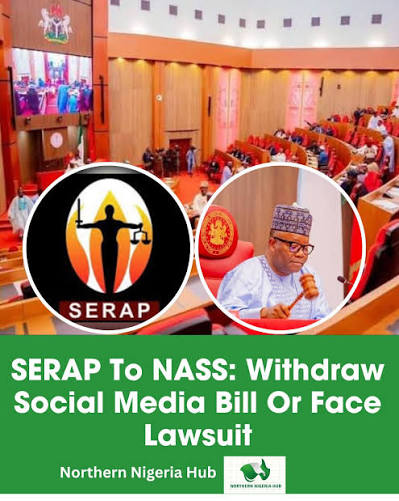
The Socio-Economic Rights and Accountability Project has asked the National Assembly to immediately withdraw the proposed Nigeria Data Protection (Amendment) Bill, 2026, describing it as a backdoor attempt to regulate social media and expand government control over online expression.
SERAP warned that it would institute legal action if the bill is passed in its current or substantially similar form.
The bill, sponsored by Senator Ned Nwoko (APC, Delta North), seeks to compel social media platforms, data controllers and data processors operating in Nigeria to establish physical offices in the country.
It also empowers the Nigeria Data Protection Commission to shut down or prohibit the operations of any entity that fails to comply within 30 days.
In a letter dated July 18, 2026, and addressed to Senate President Godswill Akpabio and Speaker of the House of Representatives Tajudeen Abbas, SERAP said the proposed amendment posed a threat to constitutionally guaranteed rights.
The letter, signed by SERAP Deputy Director Kolawole Oluwadare and issued on Sunday, read in part, “Requirements compelling technology companies to establish local offices would increase government leverage over platforms, facilitate political pressure, make censorship demands easier and expose local employees to retaliation.
“The Bill would create sweeping powers capable of shutting down or excluding social media platforms from the Nigerian market and expose millions of Nigerians to serious violations of their constitutionally and internationally guaranteed human rights.”
SERAP argued that the bill revives previous attempts to regulate social media that attracted widespread public opposition.
“The current Bill revives substantially similar proposals previously introduced by Senator Nwoko, raising renewed concerns that localisation requirements are being used as a vehicle for expanding governmental control over digital platforms and online expression,” it said.
The organisation warned that it would challenge the legislation in court if enacted.
“Should the Bill be enacted into law in its current or substantially similar form, SERAP shall promptly take all appropriate legal actions to challenge its legality in the public interest and to ensure that Nigerians’ fundamental rights are fully protected,” the letter stated.
According to SERAP, the proposed legislation would give the Nigeria Data Protection Commission excessive powers to block digital platforms without adequate procedural safeguards.
“The Bill constitutes a backdoor attempt to regulate social media and increase governmental control over online expression through corporate localisation requirements rather than through transparent and constitutionally permissible regulation,” it said.
The group argued that the bill lacks provisions for prior judicial authorisation, meaningful opportunities for compliance beyond the proposed 30-day period, and safeguards to protect the rights of millions of Nigerians who rely on digital platforms.
SERAP also cited the judgment of the ECOWAS Court of Justice on Nigeria’s suspension of Twitter, arguing that the proposed amendment could produce similar consequences by indirectly excluding social media platforms from operating in the country.
“The Bill also risks recreating the very dangers previously condemned by the ECOWAS Court of Justice. In SERAP and Others v. Federal Republic of Nigeria, the Court held that the suspension of Twitter violated the rights to freedom of expression, access to information and media freedom protected under the African Charter.
“Although the present Bill differs from the Twitter suspension in form, it creates the possibility of achieving the same result indirectly by empowering regulators to prohibit digital platforms from operating in Nigeria.
“The National Assembly should not enact legislation capable of producing, through indirect regulatory means, the very restrictions on fundamental rights that regional human rights law prohibits,” the organisation said.
It maintained that while governments have a legitimate interest in regulating digital platforms, such measures must comply with constitutional guarantees and international human rights standards.
The organisation further warned that mandatory localisation requirements would increase compliance costs for technology companies, startups, educational institutions and artificial intelligence developers.
“The proposed amendment conflicts directly with the objectives of the Nigeria Startup Act 2022 and the National Digital Economy Policy and Strategy.
“Mandatory localisation requirements substantially increase compliance costs, particularly for startups, open-source projects, educational institutions, research organisations, AI developers and smaller technology companies, while reducing Nigeria’s attractiveness as a destination for innovation and investment.
“No major democratic jurisdiction requires every social media platform to establish a physical office as a blanket precondition for providing services.”
SERAP added, “The National Assembly should immediately reject and withdraw the Bill, as it is manifestly incompatible with the Nigerian Constitution and Nigeria’s obligations under the African Charter on Human and Peoples’ Rights and the International Covenant on Civil and Political Rights.”
England and Chelsea legend John Terry has expressed disappointment over Nigeria’s absence from the 2026 FIFA World Cup, admitting that the Super Eagles will be sorely missed as the tournament started yesterday Tidesports source reports.
Eric Chelle’s side finished second in Group C of the CAF World Cup qualifiers behind South Africa, who secured one of the automatic qualification spots for the tournament.
The Super Eagles kept their hopes alive by defeating Gabon in the playoff semi-finals but saw their dreams shattered after losing to the Democratic Republic of Congo on penalties in the decisive playoff final.
The defeat condemned Nigeria to a second successive absence from the World Cup, having also failed to qualify for the 2022 tournament in Qatar. The Nigeria Football Federation later challenged DR Congo’s qualification, alleging the use of ineligible players during the campaign. However, the appeal was dismissed, ending any hopes of a late reprieve.
Nigeria will be a big miss. This is a World Cup for participants who haven’t had the opportunity to play in the tournament. I would have loved to see a top team like Nigeria there because they’ve got some great individuals. They’re a great nation. So, yeah, they fall under that category for me.
“I think they are a big miss because Nigeria probably would have gone further in the competition, but unfortunately, one side’s loss is another’s gain.
“I know Mikel Obi is very upset that they’re not there. It means he can’t do more commentating on the World Cup. That’s why he was upset.”
The 2026 World Cup officially begins with co-hosts Mexico.
The historic clash, set to take place at the iconic Estadio Azteca, rekindles memories of the opening match of the 2010 FIFA World Cup, which ended 1-1. South Africa took the lead through Siphiwe Tshabalala’s stunning strike before Rafael Márquez salvaged a draw for Mexico with a 79th-minute equaliser.
-

 News5 hours ago
Soldier, Police Officer Killed As Army Rescues Nine Abductees In Zamfara
-
 News5 hours ago
Fubara Reaffirms Commitment To Creating Conducive Environment For Business Growth …Commissions Paint Manufacturing Plant
-
 Rivers4 hours ago
Women Renew Call For Unity, Back Fubara’s Political Direction
-
 Oil & Energy3 hours ago
NEDC Plans N100b Power Grid For 102 Council Areas
-

 Business3 hours ago
Asaba Private Jet Incident Was A Security Violation—Keyamo
-
 Oil & Energy3 hours ago
NGLPP: FG Targets 5m Households By 2030
-
Sports4 hours ago
INEC Seeks Media Partnership, Declares Readiness For Osun Guber Poll
-
 Rivers4 hours ago
Vice-Chancellor Commends Seamless Conduct Of RSU 2026/2027 Post-UTME Screening Exercise