
Business
Don Seeks Genuine Effort To Diversify Economy

Prof. Uche Uwaleke has called on governments at all levels to make genuine efforts to move Nigeria away from single product economy by implementing fully the Economic Recovery and Growth Plan (ERGP) strategies.
Uwaleke, a Professor of Capital Market and Head, Banking and Finance Department, Nasarawa State University Keffi, made the call in an interview with newsmen in Abuja, yesterday.
He said that effective strategies on how best to move Nigeria away from a single product economy to other export base products had been identified in the ERGP of the Federal Government.
He said that governments must be committed to the full implementation of the strategies.
“In going forward, genuine effort should be made by the governments to break the jinx of a single product economy.
“Effective strategies to achieve this have already been laid out in the ERGP.
“There is no gain saying the fact that previous economic blueprints since independence from the development plans to Structural Adjustment Programme (SAP); Vision 2010, NEEDS, Vision 20:2020 failed due to poor implementation,” he said.
So, this time around with respect to the ERGP, government must walk the talk.’
On the country’s 58 years independence, Uwalake said that Nigeria was yet to diversify its export base and was still relying on crude oil with its associated volatilities.
“The agricultural sector has not grown beyond the subsistence level due to negligence.
“The state of infrastructure is nothing to write home about, Nigeria cannot boast of a national carrier, except for the Abuja to Kaduna railway.
“The country lacks standard gauge rails, electricity supply in a country of nearly 200 million people with only 5000MW of electricity compared to South Africa’s 40,000MWwith population of 50 million,” he said.
According to him, the general poor state of infrastructure hampers industrialisation efforts and has made Nigeria too dependent on import.
Uwaleke said that this had resulted to putting so much pressure on the FOREX market and the depreciation of the naira over the years.
“The domestic currency which used to be at par with the U.S. dollar, especially in the late 70s now exchanges for as high as N360 to the dollar.
“The country’s shallow export base is largely to be blamed,” the don said.
He, however, noted that via a combination of monetary policy tools, the CBN had been fighting the inflation monster that had equally resulted to high interest rate.




The daughter of late Nigerian banking executive, Herbert Wigwe has sold her father’s luxury yacht for $6.5 million which is the equivalent of N8.74 Billion following legal proceedings involving her, Otutochi Wigwe, and the company holding the vessel, Grosvenor Marine Ventures Limited.
This was contained in an online report obtained by The Tide Source in Port Harcourt recently.
The Source further clarified that $6. 5 Million dollars or N8.74 Billion was the asking price as at March this year but was unable to prove, if the said amount was exactly what the vessel went for.
The yacht, known as Chitochi, is a 2016 Custom Line 108 superyacht measuring approximately 33 metres (108 feet) in length. The transaction was handled by international yacht brokerage firm IYC, with its sales and charter consultant, Mark Elliott, overseeing the sale.
The disposal of the high-value vessel followed legal steps taken to address the corporate status of Grosvenor Marine Ventures Ltd., the company through which the yacht was held.
Otutochi Wigwe reportedly approached a court in the British Virgin Islands (BVI) to secure the restoration of the company to the corporate register, a move that enabled the necessary legal steps towards the sale of the vessel.
The proceedings were central to resolving the corporate issues affecting the company and facilitating the transaction, underscoring the legal complexities that may arise when valuable assets are held through corporate entities in foreign jurisdictions.
The sale is also significant in the context of estate administration, as luxury yachts require substantial financial commitments to maintain, even when they are no longer actively used by their owners or beneficiaries.
Such vessels typically attract considerable expenses, including crew salaries, insurance premiums, berthing charges, routine servicing and other maintenance costs, making their continued ownership a major financial responsibility.
Beyond the recurring expenses, luxury yachts are depreciating assets that may lose value over time. Their disposal can therefore form part of a strategy to preserve estate value, reduce liabilities and convert an expensive asset into liquid funds.
Wigwe, who was the former Group Chief Executive Officer of Access Holdings, died on February 9, 2024, in a helicopter crash in California, United States, alongside his wife, Chizoba; their son, Chizi; and former Nigerian Exchange Group chairman, Abimbola Ogunbanjo.
His death was widely mourned across Nigeria’s banking and business communities, where he was recognised for his contributions to the financial services industry, entrepreneurship and philanthropy.
Wigwe’s passing left behind an estate whose administration involves the management of assets and other financial interests, a process that can require legal and financial decisions to protect the interests of the estate and its beneficiaries.
The sale of Chitochi highlights the challenges associated with managing high-value assets held through corporate structures, particularly where the relevant companies and legal proceedings fall under different jurisdictions.
The $6.5 million transaction brings the yacht’s ownership chapter to a close while illustrating how legal procedures, financial considerations and estate management can intersect in the administration of the assets of a prominent business figure.
‘’We determined to get all our equipments and machinery functioning as we progress. For now we’ve about 105 workers, comprising daily paid harvesters and regular staffs. But aside these 105 staffs we also employ daily slashers who for now are about 100.
“During peak periods, hopefully on or before January 2026 we hope to increase our work force for maximum production”, the firm’s management Stated.
King Onunwor
Ariwera Ibibo-Howells, Yenagoa
Some traders at the Rumuwoji Market popularly known as Mile 1 Market have decried the continuous increase in the prices of food stuffs and other items in the ember season.
This was made known by the traders when The Tide visited the market recently.
The traders revealed varying changes in the prices of foodstuffs, with some commodities recording higher increase than others .
A trader Mrs Charity Obinna, at the market, said the price of yam remained the same last week and this week compared to the prices from last month to this month, adding that only a difference of about N100 to N200 was seen.
Another trader, Chukwuebuka Livinus who deals on garri, reported that the prices of some food commodities had been changing frequently.
According to him, the price of a bag of garri increased from N45,000 last week to N58,000 this week, representing an increase of N13,000.
Livinus described the increase as scary and called on the government to do something about it, especially as we get closer to the festive period.
A trader that deals on vegetables, Mrs Joy reported that a significant increase in the prices of pepper rose from N20,000 last week to N40,000 this week.
Similarly, the price of a bag of melon (egusi) increased from N420,000 toN490,000 this week.
In a separate report, Mrs Charity Obinna said that foodstuffs were generally cheaper last month than this month, with price differences ranging from N150 to N200 for some items.
Meanwhile, Giff Okoro reported a decrease in the price of tomatoes. According to her, a quantity of tomatoes that cost N45,000 last month now sells for N25,000, indicating a reduction of N20,000.
Another trader, Usman Ibrahim said the cost of transporting goods from the communities to urban areas where they are sold is one of the major reasons for high cost of goods.
He said transport cost has doubled due to the cost of petroleum products in Nigeria, adding the whole cost is part of the goods because “entrepreneurs must cover their cost and make their gains .
Ibrahim called on the government to help farmers and traders even with little capitals to expand and sustain their business.
Another trader, Mrs Choice Promise a fish retailer said a cartoon which sold at #35,000 last week now sells at #50,000 .
Promise complained that there is no gain or profit because the price has drastically increase and most people cannot afford to buy fish again.
“Mr. President’s Renewed Hope Agenda recognizes that economic ambition requires dependable infrastructure,” Tegbe said.
He added that investments in electricity infrastructure would strengthen the foundations for business expansion, employment and economic growth.
The Kankia substations comprise two 60 MVA, 132/33 kilovolt (kV) facilities designed to strengthen the transmission network serving Katsina State and neighbouring areas.
Tegbe said the infrastructure would improve the network’s ability to distribute available electricity, supporting commercial activities and household welfare.
He also urged residents to protect the facilities against vandalism and other activities that could disrupt electricity infrastructure, asking them to report suspicious activities to TCN or security agencies.
Katsina State Governor, Dikko Umaru Radda, described the project as a significant investment in the state’s electricity infrastructure.
Radda stated that improved electricity supply could support industrial development, economic growth and public service delivery.
He further commended the President, the Federal Ministry of Power and TCN for completing the project.
It would be noted that the latest projects come amid a broader government’s drive to address bottlenecks in Nigeria’s electricity transmission network, which has constrained the amount of electricity that can be delivered to distribution companies and end users.
Wali Chioma, Obasi Chidinma & Amarachi Uche
-

 Sports4 days ago
Nigerian Trio Target Titles At PFL Africa Finals
-
 Education4 days ago
FCE Yola Graduates 3,555 Teachers , Seeks Upgrade to University
-
 Niger Delta4 days ago
Diri Restates Stance On Lagos-Calabar Coastal Highway
-
 Niger Delta4 days ago
C’River, NUJ Pay Tribute To Late Guardian Editor
-
 News4 days ago
NDLEA Recovers Tons Of Illicit Drug Consignments In Nine States
-

 Opinion4 days ago
Checking Voter Apathy In Nigeria’s Electoral Process
-
Opinion8 hours ago
Ancestorial Worship: My Take (1)
-
 Politics4 days ago
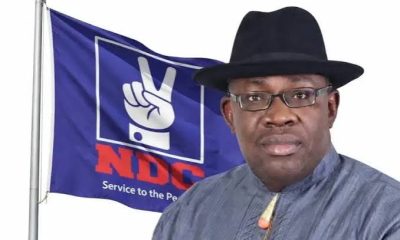
2027: DICKSON’S EX-ALLY VOWS TO WORK AGAINST NDC INTEREST IN BAYELSA