Connect with us

Business

‘Nigeria Must Stop Importing What It Has’

Published

on

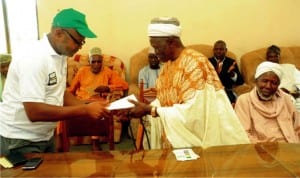
Zonal Coordinator, North Central, National Film and Video Censors Board, Mr Ailewon Danlami (L), presenting letter of  partnership to Chief  Imam of Jos, Sheik Lawan Adamu, during the Media Literacy Project and Sensitisation on Nigeria Movies to the public in Jos.With them is the administrative secretary, Jama'atu Nasril Islam Sheik Abdulaziz  Yusuf.

Zonal Coordinator, North Central, National Film and Video Censors Board, Mr Ailewon Danlami (L), presenting letter of partnership to Chief Imam of Jos, Sheik Lawan Adamu, during the Media Literacy Project and Sensitisation on Nigeria Movies to the public in Jos.With them is the administrative secretary, Jama’atu Nasril Islam Sheik Abdulaziz Yusuf.

The Emir of Kano, Alhaji
Muhammadu Sanusi II, on Saturday said Nigeria must stop importing what it has in order to boost local industries and create jobs.
The Emir stated this in Kaduna while inaugurating the new Council Secretariat of the Kaduna Chamber of Commerce, Industry, Mines and Agriculture (KACCIMA).
Sanusi said the current economic crisis induced by the crash in global oil price, should serve as a wake up call for the country to utilise its resources judiciously.
“Nigeria is full of experts in importing what we have and exporting what we do not have.
“We have cotton but we import textile materials from China; we have crude oil but we import fuel refined from our own crude from Russia and other countries.
“We have gas but we let it flare away instead of utilising it to produce power, yet import generators from outside.
“We eat our hides and skin and import shoes from outside, and we eat our tomatoes and import canned tomatoes paste from China.”
The Emir said things must change, and advised the Federal Government to give priority to education, industries, power and agriculture.
Sanusi noted that the textile industries in the past had employed more than 600, 000 people at a time.
He therefore advised industrialists to be in the vanguard of advising the administration on key directions to move the economy forward and always draw the attention of government when it derails from targeted national goals.
The Emir stressed that the persistent conflicts in the country were largely due to economic hardships and not religion or tribal sentiments.
He expressed the belief that the resuscitation of Nigeria’s industrial base would offer massive employment ant take off the streets, the huge number of idle youths used to foment crisis.
On the current economic hardship in the country, the Emir said Nigerians must be educated to appreciate that it was due to the low revenue accruing to government as a result of the fall in oil price.
“It is not possible to continue doing what you are doing when the price of oil was at $110 and now that it is selling at about $30.
“People ought to realise that the price of oil has bearing on the current hike in goods and services, and until things change, we must have to adjust our needs as a nation.”
Sanusi also spoke on the effect of smuggling on the nation’s economy and called for massive enlightenment to educate those involved on the harm they inflict on the wellbeing of the common man.
He called on religious leaders, to use their sermons in Mosques and Churches, to call for boycott of foreign goods and for patronage of Made-in-Nigeria products.
Earlier, the President of the Chamber, Dr Abdul Alimi-Bello, expressed the group’s appreciation to the Emir for his continuous support.
He disclosed that the chamber had set up a committee to establish a library on Nigeria’s economic potentials.


Continue Reading

Business

Pipeline Explosion In Abua Odua, LGA Chair Calls For Calm

Published

on

Fresh explosions have hit oil and gas pipelines in Odau Community, in Abua/Odual Local Government Area of Rivers State, triggering a major security and  environmental crisis that has forced residents to abandon their homes.
The first incident occurred  along the Kolo Creek – Rumuekpe crude oil pipelines, operated by Renaissance Africa Energy Company Limited.
This was followed by a gas pipeline explosion on the Ogboinbiri – Obirikom Gas Pipeline, operated by Oando Plc, in the same week.
In a statement by the Abua/Odual Council Chairman, Hon. Owolobi Michael Ofori said  the blasts, suspected to be the handiwork of militants, have unleashed persistent gas leakage in the area, raising fears of fire outbreaks and toxic exposure as residents of Odau have largely deserted the community due to the dangerous situation.
According to him, some residents of the area have been hospitalised after inhaling the leaking gas, adding that the impact has spread to neighbouring communities, including Obedum, Emirikpoko, and Anyu in Abua/Odual LGA, as well as Oruma and Ibelebiri in Bayelsa State.
Hon. Ofori expressed deep concern over the plight of the affected residents and urged the operating companies to act swiftly.
The Council expressed its deepest sympathy to all affected persons and communities and remained gravely concerned about the safety, health, and welfare of residents whose lives and livelihoods have been disrupted by these incidents.
“We call on Renaissance Africa Energy Company Limited and Oando Plc to immediately deploy all necessary technical and emergency response resources to contain the fires, halt the gas leakage, secure the affected pipeline corridors, and mitigate further environmental and public health risks.” the Council Chairman Said.
The chairman also appealed to the two oil firms to provide immediate humanitarian assistance and relief materials to the displaced residents while work continues to restore normalcy.
The Council Chairman said he is working closely with security agencies and emergency responders to monitor the situation and coordinate necessary interventions.
The Council Boss advised Residents of the Local Government Area to remain calm, cooperate with authorities, and adhere strictly to safety directives.
Ofori further called on the National Emergency Management Agency (NEMA), the National Oil Spill Detection and Response Agency (NOSDRA), the Rivers State Government, and other relevant bodies to intervene urgently to prevent  loss of lives and environmental damage.
Hon. Ofori assured that the council remains committed to the protection and welfare of its people and will continue to engage all stakeholders to resolve the crisis.
Enoch Epelle
Continue Reading

Business

Fidelity Bank Collaborates YEIDEP To Empower Nigerian Students

Published

on

Fidelity Bank Plc has reaffirmed its commitment to youth empowerment, financial inclusion and entrepreneurship through a strategic partnership with the Youth Economic Intervention and De-radicalization Programme (YEIDEP), a Federal Government-backed initiative aimed at equipping young Nigerians with the skills, support and opportunities needed to build sustainable livelihoods.
Under the partnership, the bank will support the enrolment of students and young people into the YEIDEP programme, which is designed to tackle youth unemployment, promote enterprise development and expand economic participation among Nigeria’s growing youth population.
The next phase of the initiative is scheduled to end today at Nnamdi Azikiwe University, Awka, where the enrolment exercise for students and youths across the South-East that started since July 1st would be concluded at the university’s Convocation Arena.
The exercise is expected to reach more than 60,000 regular undergraduate students.
Speaking on the partnership, Fidelity Bank’s Divisional Head, Product Development, Osita Ede, said youth empowerment remains central to the bank’s vision of building a more inclusive and prosperous society.
He noted that Nigeria’s youths represent the country’s greatest asset and stressed that providing them with the right skills, opportunities and financial support is critical to unlocking their potential and driving national development.
According to Ede, the bank continues to provide young Nigerians with tools for success through its digital banking platforms, financial literacy initiatives, youth-focused products and strategic partnerships.
He added that Fidelity Bank recognises that limited access to funding, mentorship and business development support remains a major challenge for many aspiring entrepreneurs, and is committed to creating pathways that will help them overcome these barriers.
The bank said its support for YEIDEP aligns with its longstanding commitment to empowering Micro, Small and Medium Enterprises (MSMEs), which it described as key drivers of economic growth and job creation in Nigeria.
Interested students and youths have been encouraged to open Fidelity Bank accounts and register for the programme through the bank’s dedicated online portal.
Nkpemenyie Mcdominic, Lagos
Continue Reading

Business

NPA Launches Multi-Agency Taskforce To Combat Apapa Traffic Gridlock

Published

on

The Nigerian Ports Authority (NPA) has launched a multi-agency task force to combat the resurgence of traffic gridlock choking the Lagos Port access roads, in a fresh push to restore seamless cargo evacuation and sustain recent gains in Port efficiency.
The intervention followed a stakeholders’ meeting convened by the Managing Director of  NPA, Dr. Abubakar Dantsoho, on June 23rd, 2026, where security agencies, freight forwarders, truck operators and representatives of the Lagos State Government agreed on coordinated measures to eliminate the bottlenecks disrupting cargo movement.
At the meeting, stakeholders identified illegal extortion points, overlapping responsibilities among security agencies and other operational distortions as major factors responsible for the renewed congestion along the port corridor.
Speaking on the outcome of the meeting, the NPA’s General Manager, Corporate and Strategic Communications, Mr. Ikechukwu Onyemakara, said the Authority’s overriding priority is to guarantee the unhindered movement of cargo to and from the nation’s seaports.
According to him, the task force comprises the NPA, the Police, the National Association of Government Approved Freight Forwarders (NAGAFF), the Association of Nigerian Licensed Customs Agents (ANLCA), the Federal Road Safety Corps (FRSC), the Maritime Workers Union of Nigeria (MWUN), the Nigerian Association of Road Transport Owners (NARTO) and the Association of Maritime Truck Owners (AMATO).
“The responsibility of the task force is to monitor truck movement on the Port access roads on a regular basis, identify any disruption capable of causing gridlock and immediately resolve such challenges,” Onyemakara said.
He stressed that members of the task force would not establish checkpoints along the corridor but would maintain strategic presence at designated locations to ensure compliance without obstructing traffic.
To enhance rapid response, Onyemakara disclosed that the task force has created a dedicated WhatsApp platform through which members can instantly report infractions or emerging traffic issues for immediate intervention.
On the long-delayed renewal of the Electronic Truck Call-Up (ETO) system contract, the NPA spokesman said the Authority is reviewing the terms to ensure a more robust contractual framework before awarding a fresh agreement.
He explained that although the previous contract had expired, the ETO platform remains operational under the management of the Truck Transit Parks (TTP) pending completion of the procurement process.
He expressed confidence that the renewal would be concluded soon.
Reaffirming the Authority’s commitment to maintaining free-flowing Port access roads, Onyemakara said efficient logistics remain central to the NPA’s drive to improve Nigeria’s Port competitiveness and preserve its growing international reputation.
“We are more interested in the free flow of logistics into our ports than anyone else because it is in our own interest,” he said
Nkpemenyie Mcdominic, Lagos
Continue Reading

Trending