
News
Ganduje Tasks Editors To Be Conflict Sensitive

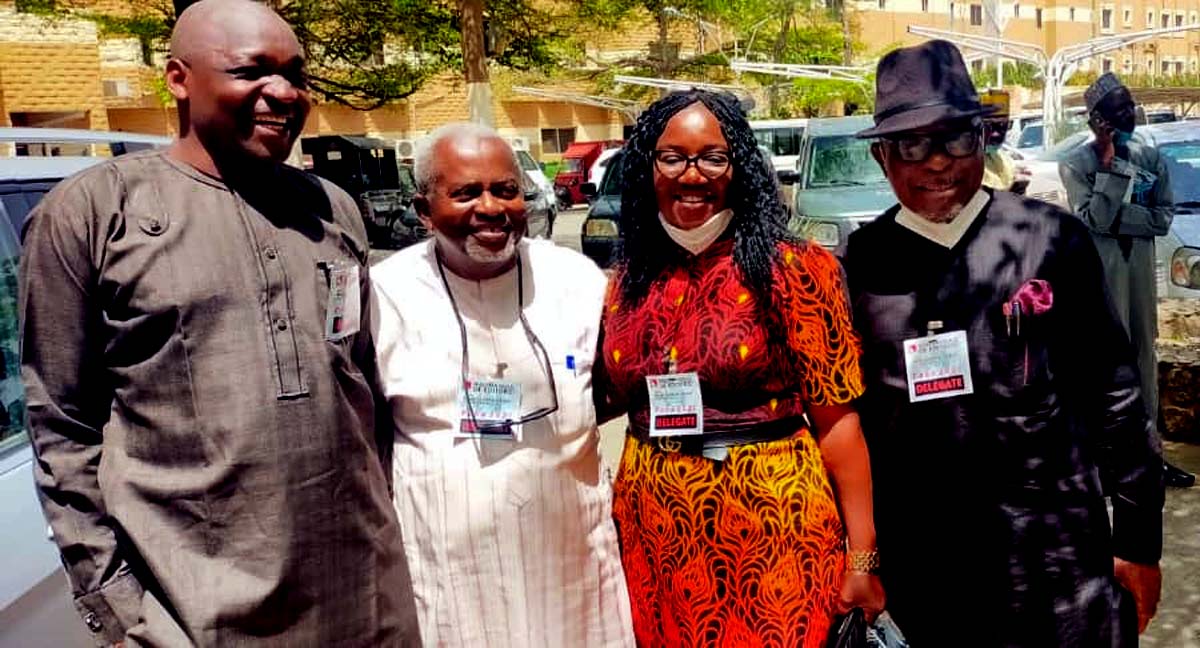
Governor Abdullahi Umar Ganduje of Kano State has declared open 2021 Nigerian Guild of Editors Biennial Convention, themed “The Media in COVID-19 Era: Challenges and Opportunities,” with a charge on editors to be conflict sensitive.
Describing the event as an opportunity to look into national development as it relates to media practice, he urges that, “It is very important at this time that we should use the media for the promotion of peace and stability and change the viewpoints that could alter public views and sentiment toward a more peaceful resolution of our multi-faceted current crises.”
Adding that, “If and only if we as a nation are interested in peace and harmony, we must reject hate propaganda machinery. In the main, this is a time Editors should be conflict-sensitive about our nation.”
He observed that, crossing of redlines by some media organisations in recent times has impacted on the nation’s unity, harmony and integration.
Urging that, “Our brave, collective pursuit in uniting this nation, underscores the fact that for as long as we have a common purpose, we will find no obstacle big enough to stop us from marching on. The media and particularly our gatekeepers have a role to play in this regard.”
While urging media to ensure looking into social responsibility aspect of their practice for national development, he maintains that, the call for freedom of the Press, observance of ethical standard must also be seen to be respected.
Ganduje also said that his government took bold steps in fighting the Covid-19 pandemic to a standstill, adding that the development was informed by the priority placed on the health of the people.
According to him such measures includes prevention, curative and palliative in line with the NCDC guidelines adding that if such measures were not quickly put in place, ,the consequences of Covid-19 on the people of the state would have been detrimental.
He said Kano was one of the states that took the Covid-19 pandemic very seriously and tackled it squarely in a manner which earned it commendation from the National Center for Disease Control NCDC.
Ganduje charged the Media to imbibe the theory of Social Responsibility especially in the reportage of issues concerning health.
The governor decried the misuse of press freedom by Journalists in the area of fake news and advised that they reflect on the true state of the nation.
Ganduje who assured the Guild of the safety of the state asked that as the watchdog of society,it is expected to live above board in the conduct of its election.
He told the Editors about his government ‘s numerous projects, and programmes as well as the appointment of members of the Press into key positions in his administration.
Prof Umar Pate, Vice Chancellor Federal University, Kashere, commended Ganduje’s effort in maintaining good working relationship with the media.
He explained in clearer terms that fake news now affects media credibility and development. He therefore called on media practitioners to stick to ethical standard and also follow suit in using technology, as it is obtained presently.
Present at the event were, former governor of Ogun state, Chief Aremu Olusegun Osoba, Senior Special Assistant to the President of Media and Publicity, Garba Shehu, Prof Umar Pate, former Presidents of the Nigerian Guild of Editors (NGE), former and serving Presidents of the Nigeria Union of Journalists (NUJ), among many other captains of the media industry.
Delivering his address, the President of the Guild, Mustapha Isah brought the challenges of press freedom in the country to the front burner.
Isah wondered if there was indeed press freedom in the country as recent clampdown on media houses recently by the National Broadcasting Commission NBC suggested the contrary.
“ It is rather unfortunate that Nigeria has consistently retrogressed in the Global Press Freedom Index since 2005 To think that this is happening in a democracy makes it more worrisome.
“ Yes, the 1999 Constitutiion gives the media the responsibility to hold the government accountable to the people. That means our duty is to ask pertinent questions about governance on behalf of the people and unearthed what the government is trying to hide.
“ This is what creates the friction between the government and the media.but government’s resort to self- help through arrest of Journalists and clampdown on media houses are not the solution.” he said.
The president spoke on fake news attributing the menace to the advent of the social media.
While he noted that the social media was not completely bad, he said its abuses were important for immediate solution through government and requisite agencies with service providers.
Isah said that practitioners of fake news” are not members of the NGE as members are trained Journalists and responsible gatekeepers”.
On the State of the Nation, the guild president described the prevailing insecurity in the country as frightening saying too many lives have been lost.
He said while it was the responsibility of the government to secure lives, it was incumbent on the guild to liase with security agencies through the provision of credible information on the activities of criminals.
However, a new Executive Committee to pilot the affairs of the Nigeria Guild of Editors (NGE) for the next two years has emerged.
This is the outcome of the Guild’s 2021 Convention held at the Tahir Guest Palace Hotel, Kano, last Monday night.
In a keenly contested election, devoid of acrimony and rancour, in which 241 delegates from various parts of the country voted, the incumbent President, Mustapha Isah was returned.
He scored 176 votes to defeat Victoria Ibanga, who got 54 votes; just as Ali Ali emerged Deputy President unopposed.
Samuel Egbala got 132 votes to beat Sheddy Ozoene, who scored 88 votes for the position of vice president, East.
Bolaji Adebiyi emerged as VP West with 151 votes; beating Ken Ogbechie, who garnered 80 votes.
For the position of VP, North, Habibi Nuhu emerged unopposed, just as Iyobosa Uwugianren was elected unopposed as General Secretary.
Assistant National Secretary’s position was clinched by Austeen Elewodalu, who got 126 votes; to beat Rose Moses, who got 86 votes.
Steve Nwosu won the election as Treasurer with 150 votes. Catherine Agbo scored 51 votes while Juliet Chinda Njiowhor scored 26 votes.
Others are Social/Publicity Secretary, with Eze Anaba winning with164 votes; while Chooks Oko got 53 votes.
For the two positions of Standing Committee Member, East, Ngwuoke Ngwuoke and Boma Nwuke we’re returned unopposed.
Fir Standing Committee Member, West, Onuoha Ukeh got 174 votes; Gabriel Akinadewo scored 174 votes; Woke Shogunle got 172 votes; and duly elected while Abimbola Tooki who got 61 votes, lost the election.
For Standing Committee Member, North, Umoru Ibrahim got 202 votes; and Gbenga Adeshina got 113 votes to emerged victorious while Mark Amarere scored 99 votes.
Earlier, the 2021 Biennial Convention of the Nigerian Guild of Editors (NGE) had kicked off in Kano with about 300 delegates.
Malam Sule Yau-Sule, the Chairman of the Local Organising Committee (LOC), confirmed to the News Agency of Nigeria (NAN) in Kano.
Yau-Sule disclosed that more than 278 had so far registered as against 250 expected by the committee, adding that more participants were being expected before the end of the day.
“People are happy with the peaceful atmosphere of the state, that is why the turn out is every impressive,” he said.
According to him, the challenges they are facing now is over shooting of expectation and they are able to take care of it.
The LOC chairman described the theme of the convention: “The media in COVID -19 Era: Challenges and Opportunities” as very apt and timely, and urged media practitioners and journalists to make use of the presentation to their advantage.
NAN reports that the NGE convention would last from May 31 to June 2, 2021.
It is the first to be hosted in Kano.


The Rivers State Universal Basic Education Board (RSUBE) has trained 1,000 newly recruited teachers with a view to raising standards in public primary and junior secondary schools in the state.
The two-day orientation and capacity building programme held in Port Harcourt introduced the teachers to civil service rules, classroom management practices, and professional conduct expected of educators in the state.
The State Commissioner for Education, Dr. Peters Nwagor, told the newly recruited teachers that teaching demands more than academic qualifications, and called for discipline, diligence, and a strong commitment to service.
He described teaching as a noble profession that is central to the development of the state.
The recruitment, he said, reflects the government’s investment in children and long-term development.
“Education is the foundation of societal progress, and basic education is where that foundation is laid,” Nwagor stated.
He urged the teachers to shape the values and character of pupils during their most formative years.
He pledged continued support from the Ministry of Education through training, resources, and an environment that allows teachers to perform effectively.
Nwagor directed RSUBEB to reject transfer requests from rural to urban schools, saying the newly employed teachers have an obligation to serve where they are posted and help strengthen education in those communities.
In his opening remarks, the RSUBEB Chairman, Hon. Sam Oge, explained that the recruitment process began in 2023 under the previous board, adding that after assuming office, he consulted widely and secured Governor Siminalayi Fubara’s approval to complete the exercise.
Oge said the selection was competitive, with 1,000 candidates chosen from more than 5,000 applicants, and urged the teachers to treat the opportunity seriously and avoid lobbying for reposting.
He directed the teachers to resume at their assigned schools immediately, saying request for reposting will not be entertained.
The former RSUBEB Chairman, Ven. Dr. Fyneface Akah, who delivered the keynote address, described the orientation as the teachers’ formal entry into the civil service.
He urged them to be creative, purposeful, and open to learning on the job.
Akah stressed that teachers have a role in restoring values lost to moral decline, and urged them to model national values and see their work as a calling with lasting impact on the society.
He thanked the State Government for approving the recruitment, noting that the exercise will improve access to quality basic education across the State.
Akujobi Amadi

The Independent National Electoral Commission (INEC) has disclosed that no fewer than 1.4 million members of the National Youth Service Corps will be deployed for the 2027 general elections.
The Chairman of the commission, Prof Joash Amupitan (SAN), made this known on Monday during a courtesy visit to the Director-General of the NYSC, Brig Gen Olakunle Nafiu, at the Yakubu Gowon House, headquarters of the scheme, in Abuja.
Amupitan, in a statement signed by his Chief Press Secretary and Media Adviser, Adedayo Oketola, described the meeting with the NYSC senior management team as more than a formal courtesy visit, saying it was also a mission of gratitude.
According to him, the NYSC remains a critical pillar in Nigeria’s democratic process.
He noted that corps members had participated in virtually every election cycle since 1999, stressing that, “INEC cannot conduct elections in Nigeria without the NYSC.
“As the Chairman of the Independent National Electoral Commission, I am honoured to discuss our collaborative efforts toward ensuring seamless and credible elections in Nigeria.
“You provide the heartbeat of our field operations. When we speak of election manpower, we are essentially speaking of corps members.
“They are the most dedicated, educated and patriotic election duty staff we have, and their presence at polling units brings a level of neutrality and public confidence that is irreplaceable.
“They form the backbone of our election processes, especially as ad hoc staff, whose dedication, discipline and patriotism are critical to the success of our elections,” he added.
Amupitan said institutional data from the 2023 general election showed the importance of the partnership between INEC and the NYSC.
He explained that INEC deployed about 1.2 million ad hoc staff for the 2023 elections, with over 70 per cent, nearly 850,000 personnel drawn from corps members and student volunteers.
Speaking on preparations for the 2027 elections, the INEC chairman said more than 1.4 million ad hoc staff would be engaged, with corps members making up the majority.
“For the 2027 general election, we will require 707,384 ad hoc staff for the Presidential and National Assembly elections scheduled for January 16, 2027.
“The same number will be needed for the governorship and Houses of Assembly elections on February 6, 2027, making a total of 1,414,768,” he said.
He added that INEC would also require 52,446 corps members for the Ekiti and Osun governorship elections, as well as by-elections in Nasarawa, Enugu, Rivers, Ondo, Kebbi and Kano states.
Amupitan said corps members accounted for nearly 90 per cent of Registration Area Officers and Presiding Officers in many states during previous elections.
“These young Nigerians did not just facilitate voting; they protected the sanctity of the ballot in 176,846 polling units across some of the most difficult terrains in the country,” he said.
He further praised the corps members for their role in off-cycle elections, particularly the Anambra governorship election and the FCT Area Council polls.
According to him, their digital proficiency contributed significantly to the seamless operation of the Bimodal Voter Accreditation System.
“In those exercises, it was the digital proficiency of corps members that ensured the seamless performance of our BVAS, proving they are the tech-savvy backbone of our modern democracy,” he added.
Amupitan acknowledged the sacrifices made by corps members during elections and assured that INEC would continue to work with the NYSC and security agencies to strengthen safety measures and welfare packages for them.
As the 2027 general election approaches, we are committed to ensuring adequate mobilisation and preparedness of NYSC members for this important national assignment,” he said.
He also noted that the Ekiti and Osun governorship elections, scheduled for June 20 and August 15, respectively, alongside several by-elections, would serve as tests for innovations ahead of the 2027 elections.
Responding, Brig. Gen. Nafiu thanked INEC for its continued collaboration with the scheme.
He recalled that the Memorandum of Understanding between both organisations was signed in 2011 and had been periodically renewed.
Nafiu described corps members as credible, reliable and easily trainable manpower.
“The last batch of millennials will soon exit the scheme, leaving behind Gen Z corps members known for their digital savviness, which will benefit INEC,” he said.
He assured the commission of the NYSC’s continued support in both the 2027 general elections and upcoming off-cycle elections.
-

 Featured2 days ago
WASSCE: RSG Distributes Science Materials To Secondary Schools
-
News3 days ago
Xenophobic Attacks: Nigerian Lives More Important Than Foreign Investment – Oshiomhole
-
Rivers3 days ago
MBA Forex Trial Adjourn To June 3, Amid Bereavement … As Court Declines Cost Application
-
News3 days ago
ActionAid Demands Probe Of Govs Using Public Funds For Campaign
-
Aviation3 days ago
Passengers Stranded As Delta Airline From Atlanta Route Back Eight Hours After
-
Business3 days ago
Customs Impound N2.35bn Cocaine, 15 Trailers of Rice
-
Politics3 days ago
2027: Bayelsa Senator Gets Critical Endorsement For Second Term
-
 Politics3 days ago
INEC Sets Rivers South-East Senatorial By-Election For June 20