
Nation
THE STATES

A Yola High Court presided over by Justice Ambrose
Mammadi, has fixed February 18, 2016 for ruling in a suit challenging the suspension of Alhaji Abdulrahman Abubakar as member of Adamawa State House of Assembly.
Mammadi will rule on the plenary objection challenging the jurisdiction of the court to entertain the suit, as well as pass judgement on the suit already argued before him by the parties involved.
Abubakar, who represents Mubi South constituency, had in 2015 dragged the Speaker, Alhaji Kabiru Mijinyawa and the Assembly to court over his suspension for three months and dissolution of the House Committee on Finance, which he chaired.
The state Attorney General was later joined in the suit as 3rd respondent.
In his argument before the court, counsel to Abubakar, Mr Ever Odo, argued that both the speaker and the assembly erred in law, as they have no powers to suspend his client for 30 days.
Jigawa
The Jigawa State Universal Basic Education Board
(SUBEB) says it has concluded arrangements to rehabilitate 10 schools in Malammadori Local Government Area of the state.
Malam Mukhtar Mukaddari, the Education Secretary in the area, told newsmen in Malammadori that the board would renovate and construct additional classroom blocks in the selected schools.
Mukaddari said the project would be executed in both primary and post-basic schools under the 2014/2015 SUBEB project.
He listed the benefitting schools to include Chac-Chanda, Baguwa, Shayya, Dakindo and Kampala.
Kano
Former Managing Director of Nigerian Ports Authority
(NPA), Alhaji Aminu Dabo has advised Nigerian youths to avoid acts capable of destroying their future.
He made the call when the National Association of Nigerian Students (NANS) presented him with an award in Kano recently.
He said the advice was necessary in view of the fact that they were the future leaders of the country.
He advised that “as future leaders of Nigeria, youths are supposed to exhibit good conduct and avoid anything that will destroy their future.
He commended the Association for finding him worthy of the award and urged members to face their studies with the seriousness it deserved to enable them to contribute their quota toward the development of the country.
Kebbi
The Emir of Zuru in Kebbi State, Alhaji Sani Sami has
urged Gov. Atiku Bagudu to intensify efforts at improving the education sector in the state.
The emir gave the advice while receiving members of the Old Boys Association of Government Secondary School, Zuru, who paid him a courtesy call in his palace.
He said that the education sector in the state had remained backward for too long.
Sami said that the education sector had suffered considerable neglect over the years.
“Structures are decaying, science laboratories are lacking and students receive lessons sitting on the bare floor, hence affecting students’ performance in external examinations,’ he said.
The emir, however, commended the association for organising an annual general meeting, charging members to task themselves for the overall development of the college.
Kogi
Seven registered voters in Kogi State have sued the Federal
Government in the Community Court of Justice of ECOWAS, alleging inconsistency in the election of Yahaya Bello as the state governor-elect.
The suit with registration number ECW/CCJ/APP/02/16 filed at the ECOWAS Court headquarter, Abuja was made available to newsmen.
The plaintiffs named as “citizens of Nigeria and registered voters in Kogi State’’ include; Sule Audu, Ikeleji Agada and Labaran Dadio.
Others are Isaka Isa, Abdul Audu, Ademu Abdullahi and Sulaiman Abdul.
The suit filed by the plaintiffs’ lawyer, Festus Ogwuche named FG as the sole defendant.
Lagos
An Ikeja Chief Magistrates’ Court has granted bail in the
sum of N250,000 to a driver, Shakiru Akinsola, for allegedly causing the death of a pedestrian.
The Chief Magistrate, Mr Tajudeen Elias, also ordered the accused to produce two sureties in like sum, and adjourned the case till January 25, for mention.
Akinsola, 25, who lives at No 2, Shola Olamide Close, Runsewe Estate, Ahmadiyya Ijaiye, a suburb of Lagos, was arraigned for reckless driving.
The Prosecutor, Insp. Benedict Eigbokhon, told the court that the offence was committed on December 27, at Capitol Junction on Old Agege, Area of Lagos.
Eigbokhon said the accused drove in a reckless way and caused the death of one Nwafio John, a 52-year-old man.
“After the accused knocked down the man, he wanted to run away, but was caught by the people at the scene,’’ he said.
Nasarawa
A 37-year-old businessman, Nasiru Alidu, charged with
forgery has been remanded in prison by a Mararaba Grade 1 Area Court in Nasarawa state.
The order to remand the accused in prison given by the judge, Mr Albert Maga, was sequel to the prosecution’s objection to his bail application.
The prosecutor, Cpl. Friday Adaji, had told the court that investigation on the case was ongoing and that letting the accused to go on bail may impede the process.
“It will take time to investigate this matter and letting the accused go on bail may impede the investigation,” Adaji said.
Alidu, who resides at Kudnawi Area of Mararaba is facing a three-count charge of criminal breach of trust, forgery and cheating.
He pleaded not guilty to the charges.
The judge upheld the prosecution’s objection and ordered that Alidu be remanded in prison.
Niger
As part of effort to boost rice production in Niger State,
the Agricultural Graduates Association of Nigeria (AGAN) said it had started collecting names of its members interested in collecting bank loans for rice production.
“We have started collecting list of members who have access to at least one hectare of land,’’ Alhaji Hussaini Iliyasu, the Chairman of the association in the state, disclosed this to newsmen in Bida.
Iliyasu said the Central Bank of Nigeria (CBN) had agreed to guarantee a N1.8 billion loan from commercial banks for the farmers under the Federal Government Rice Support Programme.
“We are currently working with some commercial banks towards accessing the loan for our activities. We have reached 80 per cent success with the banks.
Ogun
The Chairman of Ado-Odo/Ota Local Government Area of
Ogun State, Mr Kayode Ojumo, has advised residents to desist from dumping refuse indiscriminately in order to maintain a clean environment.
Ojumo, who gave the advice during a tour of the area, noted that indiscriminate dumping of refuse had prompted Gov. Ibikunle Amosun to close down some shops and markets in the area early this year.
According to him, this measure is part of efforts to avoid the outbreak of diseases and ensure a healthy environment that will attract investors to the area.
Ojumo said the Deputy Governor, Mrs Yetunde Onanuga, had also visited the local government earlier to sensitise them on the importance of a clean environment.
Ondo
Oba Adegoke Adewusi, Olufon of Ifon has lauded the
mega primary school initiative by Governor Olusegun Mimiko of Ondo State.
Adewusi gave the commendation while receiving the management of Ondo State Universal Basic Education Board (SUBEB), in Ifon, Ose Local Government Area recently.
According to him, the concept has enhanced education in the state.
The monarch thanked Mimiko for citing one mega primary school in the community, adding that the school was not only for academic activities, but also served as a tourist attraction in the town.
“Whenever the school is posted on social media, it always generates positive comments from sons and daughters of the community within and outside the country’’, he said.
Zamfara
The Zamfara State Government said that it would adopt
the Treasury Single Account (TSA) as part of its efforts to eradicate corruption in the state.
The state Commissioner for Information, Alhaji Umar Bukkuyum, made the disclosure at a news conference in Gusau.
Bukkuyum said the state government had set-up a seven-man committee toward achieving the objective.
He said the committee to be headed by the government would also have the commissioners for Finance, Commerce and Industry as well as Local Government and Chieftaincy Affairs as members.
Others are commissioners for Works and Transport and Science and Technology while the Secretary to the State Government, Prof. Abdullahi Shinkafi, would serve as secretary.
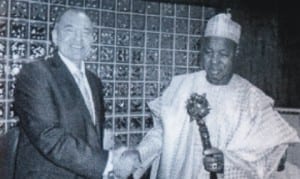
Ambassador of Ukraine to Nigeria, Dr Villari Alexandruk (left), in a handshake with Governor Aminu Masari of Katsina State, after the envoy presented his country’s symbol of power to the Governor in Katsina on Thursday




The Hydrocarbon Pollution Remediation Project (HYPREP) has commemorated the 15th anniversary of the release of the United Nations Environment Programme (UNEP) Environmental Assessment Report on Ogoniland, reaffirming its commitment to restoring the environment and improving the livelihoods of affected communities.
In a statement signed by the Project Coordinator, Prof Nenibarini Zabbey, to commemorate the anniversary, HYPREP described the anniversary as a significant milestone in Nigeria’s environmental restoration efforts, noting that the project has made remarkable progress in implementing the recommendations of the landmark UNEP report released on August 4, 2011.
The UNEP report had revealed extensive oil pollution across Ogoniland, severe environmental degradation, and serious public health risks resulting from decades of petroleum operations. It also recommended an initial $1 billion fund to commence the cleanup of the affected communities.
According to HYPREP, the Federal Government formally launched the Ogoni clean-up in 2016, while the Project Coordination Office was established in 2017 to drive the implementation of UNEP’s recommendations.
Zabbey said the current administration has continued to prioritise the project under the Renewed Hope Agenda.
Providing an update on the cleanup, the Project Coordinator disclosed that 30 of the 65 contaminated sites identified by UNEP have been fully remediated, while work is ongoing at several medium- and high-risk locations. It also stated that more than 1.5 million mangrove seedlings have been planted as part of what it described as the world’s largest restoration of oil-degraded mangroves, with over 1,000 hectares of shoreline already rehabilitated.
Zabbey further revealed that 49 Ogoni communities have been connected to potable water schemes through multiple water projects and booster stations aimed at providing safe drinking water across the region.
In the health sector, he said the 100-bed Ogoni Specialist Hospital in Kpite and the 43-bed Cottage Hospital in Buan are nearing completion, adding that several existing health facilities have been upgraded with modern medical equipment, while five ambulances have been donated to improve emergency healthcare services. The Project Coordinator also disclosed that a three-year human health biomonitoring study is being conducted in collaboration with the World Health Organization’s International Agency for Research on Cancer (IARC).
On economic empowerment, Zabbey stated that the Project has created more than 8,000 direct jobs and trained thousands of Ogoni youths and women in various vocational and technical skills, including software development, cybersecurity, aviation, commercial diving, seafaring, mechatronics, and creative arts. The project also reported awarding scholarships to more than 1,000 students, providing grants to small businesses, and supporting persons living with special needs through skills acquisition programmes.
The statement further highlighted ongoing legacy projects, including the Ogoni Power Project and the Centre of Excellence for Environmental Restoration, which it said is about 96 per cent complete. HYPREP also welcomed the recent designation of the Ogoni Wetland as a Ramsar Site of International Importance and pledged to continue promoting biodiversity conservation and sustainable management of the ecosystem.
Marking the anniversary, Zabbey said the progress achieved over the past 15 years demonstrates the collective commitment of government, development partners, stakeholders, and local communities to restoring Ogoniland. He called for renewed collaboration to sustain the cleanup effort, promote environmental sustainability, and support the long-term development of the region. 3
-

 News2 days ago
RSG Targets Nine Million Residents in Mosquito Net Distribution Campaign
-

 Oil & Energy2 days ago
Aiyedatiwa Signs New Electricity Bill
-

 Maritime2 days ago
Marine Minister Commends President Tinubu On NPERA Bill Assent
-

 Oil & Energy2 days ago
NLNG Commissions Research And Innovation Centre In RSU
-

 News2 days ago
KenPoly Holds Eight Convocations, August 29
-

 News2 days ago
RMAFC Completes Revenue Sharing Review, Proposes New Pay
-

 News2 days ago
RSG Begins Another Phase of Projects Commissioning Today
-

 Maritime2 days ago
NAGAFF Petitions IGP Over Alleged Maritime Police Harassment