
Maritime
Nigerian Customs Personnel And Smuggling Curtailment

Situated in the southern part of Nigeria, Ogun State shares boundary internationally (border) with Port Novo which is the former administrative capital of the French speaking Republic of Benin.
The area apparently appears to be a very versatile, dynamic and welcoming environment in view of the porosity of this land border/demarcations through the existence of series of unapproved border routes which tend to have increased smuggling activities. This have necessitated the Ogun 1 arm of Nigeria Customs Service determination to confront and drastically reduce to is barest minimum status, this anti-progressive economic activities.
Considering the motion’s maximum challenge as the urge to patriotically bring our industrial productions to conform with sustainable, safe and innovative successes via very strong entrepreneurial commitments, the Nigeria Customs Service seems to be committed to discovering, nurturing as well as growing stakeholders in the various relevant sectors of the nation’s economy thereby fostering sustainable development and dependable trade internationally. When achieved, the nation’s industries will succeed in the improvement of competitiveness through modernized industrial practices.
Internationally, smuggling is classified as a social economic and political vice. It is therefore maximally detested based on its highly destructive and sabotaging tendencies. Often times there exist indications that wealth of nations might have been deliberately sub-merged and unnecessarily high jacked by greedy cum dare-evil practitioners of this aged obnoxious act.
The Nigeria Customs Services which is an indigenous international trade facilitator and dependable revenue earner for the Nigeria Federal Government has among its onerous responsibilities, the task of securing the nation from smugglers incursion into international trading activities.
Notably, every nation has its customs organization which has intuitively brought about international cooperation in this regard leading to the formation of and collaboration with classical global trade boosters like the World Customs Organization (WCO) as well as the World Trade Organization (WTO).
Their objectives are to among others maximally boost and ideally facilitate trade between nations for greater economic upliftment and progress. Emphatically, a nation in desire of maximum economic, social as well as political benefits or growth should have nothing to do with smuggling.
Classifyable as an international crime which involves taking, sending and bring goods or products into or cast of countries secretly and illegally, smuggling is tantamount to a cankerworm which eats destructively into the economic fabrics of un-careful nations.
Instructively, it would not amount to an overstatement to posit therefore that in the absence of smuggling, nationals of nations can live their lives to their utmost potential as the act can especially be regarded as an international disability which possesses nefarious consequences. Rather than encourage it, we should foster effective and efficient commercial friendship with our trade partners, develop dynamic leadership skills followed by creation of good and assessable jobs or employment opportunities.
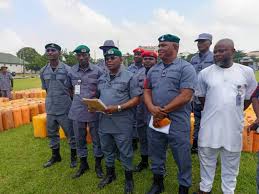
Elucidating on the nation’s para-military efforts in this regard recently, the Customs Area Controller Ogun 1 Area Command, Idiroko Land Border, Deputy Comptroller (Mr) Mohammed Salisu Shunibu who wore an extraordinarily decent looks and corporately kitted in Nigeria Customs Services outfits of ash coloured treasurer, jacket and a pair of black boot told a gathering of Nigerian newsmen that his organization (NCS) have resolved to henceforth radically and comprehensively neutralize smuggling in all it ramifications in the nation’s numerous land border routes within the Ogun 1 Command.
As if alluding to the assertion that a tremendous financially struggling nation like Nigeria must abbor this disability causing act known as smuggling the Area Controller who stool and spoke with media representatives stated that the Nigeria Customs Services Management as ably represented by him have patriotically commissioned a novel/new phase of intensified initiatives and efforts to maximally safeguard Nigeria’s economic integrity.
Emphatically, the Deputy comptroller explained that he has made it crystal clear to the entire workforce under him that their assigned mission forthwith must be outrightly driven and determined by professionalism, integrity and renewed commitment to curbing smuggling as well as other economic sabotaging activities.
“The Nigeria Customs Service under the able leadership of the Comptroller General of Customs (COC), Mr Bashir Adewale Adeniyi (MFR) has indeed provided us with the guidance, tools and requisites motivations to carry out this critical responsibility and we are determined to justified this historic and lofty trust” he declared.
Further speaking at the maximally attended Ogun Customs Public enlightenment experts briefing, Deputy Comptroller Mohammed S. Shunibu expressed determination and willingness to update the Nigeria Pen Publishers strategically and regularly with the outcome of the command’s operational activities.
According to him, the command’s operation have sofar yielded series of celebrate-able successes and remarkable achievements leading to numerous seizures made at specific and various locations within its catchment communities in Ogun State stating that the command under his watch was determined to make a positive head way in this regard.
The Ogun I helmsman humbly and steadfastly announced to the inquisitive media men that within the past few days, his command has intercepted successfully, varieties of goods and items whose Duty Paid Value (DPV) stood at Two Hundred and Twenty-Nine million, One Hundred and Twelve Thousand, Four Hundred and Twenty Four Naira (N229,112,424,00).
These items he said include 2,166 bags of foreign parboiled rice weighing 50 kilograms each, smuggled through unapproved routes, 1,128 parcels of cannabis sativa otherwise known as Marijuana (igbo) weighing 1,109.3 kilograms, 21 bales and 2 sacks of used clothes 166 pieces of pneumatic tyres, 4,360 cartoons of imported shoes, 250 kegs of Premium Motor Spirit (PMS) also known as petrol weighing 25 litres in kegs each, 20 units of vehicles used for conveyance and one (1) unit of foreign used vchicle 2012 model Toyota Highlander.
The Area Controller asserted that the seizures were recorded professionally at strategy locations which include Idiroko, Ilaro, Alanala-Rounda axis, Obada Oko-Abeokuta axis, Abule Kazeem-Abeokuta axis and Imeko-Afan axis, which are widely known to be smuggling hotspots in the command explaining that “our operatives remain resolute in dismantling smuggling networks that undermine our economy, endanger lives and hinder the development of local industries”.
The Deputy Comptroller highlighted the significance of the various interceptions which he said was to the maximum advantage of the Nigerian developing economy, social and political development can upliftment.
“The Illegal importation of rice poses significant threat to Nigeria’s economy. It does not only hamper local rice production but also undermine the Federal Government’s efforts to achieve food self-sufficiency and thus the considering of it as economic sabotage and will not relent to bringing perpetrators to justice in this regard”, he maintained.
On cambia sativa, the new Ogun 1 Customs Area controller pointed out that the implications of cambia smuggling are even dare as this help the dangerous substance to destroy lives. Fuels criminal activities and jeopardized safety and security of our communities stressing that the area command shall remain vigilant and will more-than-ever continue to collaborate with other sister security agencies in a bid to out rightly rid our society of this menace.
Apparently referring to the legality or otherwise of used clothings, Deputy Comptroller Shunibu averred that importation of used clothes was totally burned for obvious health as well as economic reasons stating that apart from being a conduit for hazardous materials it discourages the growth of Nigeria local textiles industries which invariably possesses the potentials to generate jobs for the numerous unemployment Nigerias.
The Area Controller who vowed to leave no stone unturned in his determination to frustrate smugglers incursion into the nation’s economy warned smugglers and their collaborators against pushing dangerously hard in their illegal trade as the command was fully prepared more than ever to match their evil activities with superior intelligence, unwavering commitment as well as very lawful force where and when necessary stating that smugglers must desist from their illegal activities or face the full weight of the law.
While assuring the people of Ogun State particularly and Nigerians generally as well as law abiding traders that the customs workforce operations were targeted at law violators only, he asserted that his administration will maintain open door policy, work with local communities including encouraging legitimate trade that will foster national economic development.
The newly assigned Area Controller who declared that he was barely seven days in office when he achieved this anti-smuggling feat at Ogun 1 Command, commended the hardwork and dedication to duty of the command workforce who intercepted the seizers urging them to continuously remain vigilant, disciplined and committed to the task at hand while simultaneously applauding the media practitioners support in helping to educate the general public on the dangers of smuggling and economic sabotaging acts indicting that their role as dependable partners in progress was invaluable, while similarly reaffirming his commitment to the mandate accorded Ogun 1 Command which include safeguarding the nation’s economy, protecting communities and upholding the integrity of the Nigeria Customs Service.
Undoubtedly, international trade being a dependable catalyst has the potentials to positively spearhead economic prosperity and therefore vulnerable to smuggling exploitation that is equally capable of destroying, the global economy.
Conclusively, the Nigeria Customs Service like it counterparts globally assigned with the task of controlling and administering international movement of goods, they are strategically positioned to secure instruments of trade and contribute to socio-economic upliftment via revenue collection as well as facilities track.
By Martins Ilhilae a public affairs analyst.



-
Business3 days ago
PHICCIMA President Welcomes N60m BOI Micro, SMEs Initiatives
-
Politics3 days ago
Tinubu Hails Atiku For National Dev Efforts
-
Business3 days ago
FG Commences N1.45trn Port Upgrade, Targets 20,000 Jobs
-
Politics3 days ago
2027: 108 Rivers Groups Jostle To Work With Chinda’s Campaign
-
Politics3 days ago
Political Killings: Consider Emergency Rule In Delta, Reps Tell Tinubu
-
Politics3 days ago
Amupitan Tasks RECs On Flawless Mock Election, ’Morrow
-
Politics3 days ago
My Ribadu’s Phone Tapping Claim Was Political Rhetoric, El-Rufai Tells Court
-
News3 days ago
IG Suspends Wanted Declaration Against Obaigbena, Eight Others