Features
Sustaining JAMB’s Computer-Based Test


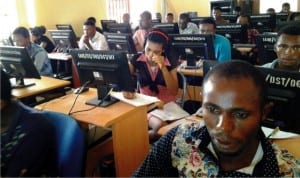
JAMB candidates during Computer Based Test at the Ignatius Ajuru University of Education, Rivers State. Photo: Sogbeba Dokubo.
The mode of writing ex
aminations, using computers, which was spearheaded by the Joint Admission and Matriculation Board (JAMB), has obviously changed the face of the Nigerian educational system.
Unlike in the 1980s, up to early 2000s, the use of paper and pencil in writing exams was the in-thing, as entrance exams into the nation’s tertiary institutions were done manually, giving room to all sorts of misdemeanours.
Observers recall that in those days, candidates often faced myriad difficulties in accessing their results and they were forced to wait for several months to get their results.
They also note that the money spent on paper-based exams at that time was quite substantial, in spite of the fact that the examination mode also gave room for cheating by unscrupulous candidates.
The Registrar of JAMB, Prof. Dibu Ojerinde, who is Nigeria’s first professor of Tests and Measurement, said that the Computer-Based Test (CBT) had been identified as the only panacea to the growing menace of examination malpractice, such as impersonation and other ills associated with public examinations.
Popular international exams such as Scholastic Assessment Test (SAT), Medical College Admission Test (MCAT), Law School Admission Test (LSAT) and Test of English as a Foreign Language (TOEFL), among others, are computer-based tests, in line with global best practices.
These exams are required for admission into universities and colleges in various countries across the globe and at times, the need may be a combination of one or more of these and other tests/examinations that are unique to a particular country and its education system.
Observers, therefore, insist that JAMB, under the auspices of Ojerinde, should be commended, rather than vilified, for introducing CBT for entrance examinations into the country’s tertiary educational institutions.
Justifying the adoption of CBT, Ojerinde said that the only constant thing in life was change; adding Nigeria’s education system must either change, in line with the global technological transformation and advancement, or be left behind.
“We in JAMB cannot afford to be left behind,’’ Ojerinde said, adding that after a couple of dry runs in 2015, JAMB abandoned the Pencil-and-Paper Test and opted for the CBT.
The examination body began the full implementation of the CBT mode in March but a cocktail of challenges, including server failures, power fluctuation and systems’ malfunction, among others, nearly cast doubt on the reliability of the CBT.
A lot of controversies trailed the March 2 Unified Tertiary Matriculation Examination (UTME), which was conducted by JAMB, as several candidates grumbled about certain disparities and inaccuracies in the results assigned to them.
Such complaints informed the move by the House of Representatives to come up with a resolution urging JAMB to return to the pencil-paper method of conducting UTME.
The lawmakers proposed that candidates should be allowed to choose between computer-based tests or pencil-paper examinations.
Moving the motion on the “conflicting’’ scores of candidates in the 2016 UTME, Rep. Oghene Emma-Egoh (PDP-Amuwo Odofin), said that the “technical flaws’’ recorded in the exam had exposed JAMB’s lack of ability to handle computer-based tests.
The lawmaker cited the case of one Foluke, a 17-year-old girl in Ejigbo, Lagos, who scored an aggregate of 156 marks in the first result, while in the subsequent result that came out later; she had an aggregate of 196 marks.
He stressed that besides the conflicting scores resulting from technical hitches, it was obvious that many candidates were unable to do well in the examination because they were not computer-literate.
Emma-Egoh argued that the implication of this development was that the hopes of many intending students had been dashed due to the technical glitches and their inability to use computers.
All the same, analysts criticise the lawmakers’ motion as hasty and unfounded, although they concede that the lawmakers have the right to intervene on pertinent issues like this.
They, nonetheless, underscore the need to exercise caution and hear from parties that are involved in the matter.
Mr Clement Abegunde, a lecturer in Kwara State Polytechnic, said that Nigeria could not afford to go back to the age of paper-and-pencil tests, stressing the need for all to be progressive and pragmatic by giving tangible support to JAMB in efforts to improve on the CBT.
He said that candidates’ complaints were a recurring phenomenon in the past while pencil-and-paper mode of exam lasted, adding that efforts should, therefore, be directed at consolidating the gains of computer-based UTME rather than jettisoning it altogether.
Clement said that the lawmakers could facilitate efforts to improve on the CBT by instructing the Federal Ministry of Education to provide the requisite tools that would aid the smooth conduct of computer-based tests in the country.
He reiterated that reverting to paper-and-pencil tests would not augur well for Nigeria’s aspirations to meet basic international standards in the conduct of examinations, in line with global best practices.
Clement said that the advantages of the CBT far outweighed its disadvantages, saying that the adoption of CBT would reduce the time and cost of managing examinations, while curbing incidences of examination security breaches.
He said that the advantages also included instant feedback to candidates, greater flexibility with respect to locations and timing, improved reliability, enhanced impartiality, greater storage efficiency and improved question styles, which incorporated interactivity and multimedia applications, among others.
The Proprietress of Divine Gold International School, Lagos, Mrs Bosede Rotimi, said that it would be hypocritical for any secondary school student nowadays, irrespective of his or her location, to pretend to be computer illiterate when most students now owned smartphones and fiddled with touchscreens like toys.
She noted that even the cheapest phones in the market now had internet facilities, saying that some students habitually used phones for Facebook, twitter and other social media.
“In essence, there is no excuse for any student to complain about not having rudimentary computer skills,’’ she added.
Rotimi said that any effort to compel JAMB to suspend the CBT and revert to the archaic paper-and-pencil test would be very retrogressive and counterproductive.
“We must be moving forward and not backward; we should make concerted efforts to support JAMB in efforts to perfect the CBT,’’ she said.
Insisting that no country could claim total perfection, Rotimi emphasised that the ability to identify and overcome challenges was the hallmark of a great nation.
This is not to suggest that JAMB is not aware of the complaints that trailed the 2016 computer-based UTME.
Its Registrar, Ojerinde, while addressing a news conference, admitted that the CBT had some challenges and promised to work out modalities to overcome the perceptible challenges.
He claimed that the multiple results, posted to some candidates during the recent UTME, were due to a system glitch, which was promptly corrected.
He said that the multiple results, which occurred on Saturday, February 27, and Monday, February 29, involved about 145,000 candidates.
He reiterated that the multiple results stemmed from a system error, which could not be ruled out in an exercise where the entire process was purely technical.
“The moment the error was detected, we corrected it and subsequent exams never had such incidence. In other words, there was not a repeat of the incidence in other turns of the exam.
“The fate of the candidates who got extra marks due to this error will not be decided by JAMB alone, the Federal Ministry of Education will be consulted for advice,’’ he said.
Nevertheless, Mr Rowland David, an educationist, said that those who provided centres with little or no facilities should be sanctioned, as part of strategies put in place to ensure hitch-free conduct of UTME.
“Owners of examination centres with inadequate facilities who, nonetheless, secured contracts for handling the exam with false claims, should be sent to jail,’’ he said.
He said that reports from JAMB officials deployed to supervise the exam in various centres indicated that some of the centres had no facilities but merely borrowed the equipment, which they presented to the accreditation team, just to get accreditation and payment from the Board.
David, nonetheless, argued that examination administration in Nigeria was going through a remarkable transformation, stressing that modern systems should be adopted in managing public examinations.
All in all, analysts commend JAMB for adopting CBT for its examinations.
They, however, urge stakeholders to ensure that the CBT is improved upon, while resisting any temptation to revert to the old tradition of paper-and-pencil tests.
Ogunshola is of the News Agency of Nigeria.
Femi Ogunshola