Front Pix
Reps Halt Power Tariff Hike

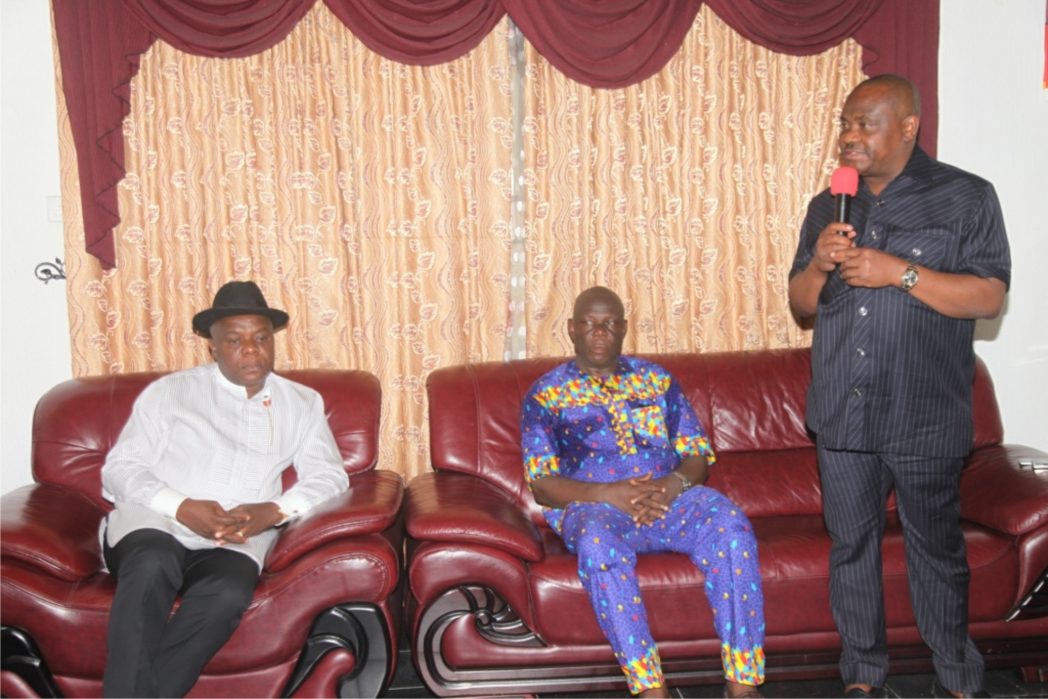
Rivers State Governor, Chief Nyesom Wike (right), condoling the family of Elder Lawrence Amadi (chief mourner) (middle), during the burial ceremony of late Mrs Eunice Ada Akure Amadi of Ozuoba in Obio/Akpor LGA on Saturday. With them is former Deputy Speaker, House of Representatives, Hon. Austine Opara .
The House of Representatives yesterday directed the Nigerian Electricity Regulatory Commission (NERC) and distribution companies in the country to halt any plans to further increase electricity tariff.
It also summoned NERC and all ‘DISCOs’ operating in the country to appear before the lawmakers to explain why an upward review of tariff was necessary at a time consumers complained of poor supply of electricity.
In a resolution passed unanimously during its plenary, the House further asked NERC and distribution companies to “immediately begin the provision and installation of pre-paid metres to every consumer nationwide.”
The House passed the resolution after debating a motion moved by a member from Plateau State, Solomon Baren.
He said handlers of the power sector and the distribution companies were taking Nigerians for a ride by contemplating another tariff hike when the reality on the ground was that electricity supply had not improved.
Part of the motion reads, “The House further notes that power generation and distribution in Nigeria is in a state of comatose, leading to the closing down of many industries, thereby creating unemployment in our dear country and hampering the development of small and medium scale enterprises.
“That this House, indeed, resolved against further collection of flat rates or service fees by Discos, which were termed illegal and not in tandem with best practices.
“That NERC had directed DISCOs to comply with the above resolve.
“That these DISCOs are about devising another way of collecting this money under another guise.”
The House noted that about two years after the distribution companies took over power distribution in the country, they had not added any infrastructure to the sector to warrant frequent tariff hikes.
In the same vein, members of the House of Representatives, yesterday, backed the licensing of more refineries in the country to ease fuel supply shortages and expand the oil industry, as a bill on refineries passed second reading.
It was also a session where some lawmakers from the Niger Delta kicked against the destruction of “illegal refineries” by security agencies, preferring that the operators should be licensed and regulated.
The session was presided over by the Deputy Speaker, Mr. Yussuff Lasun.
The long title of the bill reads, “A Bill for an Act to Provide for the Licensing, Regulation and Incentives to Petroleum Refineries in Nigeria and for other Matters Connected Therewith.”
It was sponsored by a member from Abia State, Uzoma Nkem-Abonta.
He told his colleagues that with more refineries in operation, Nigeria, a leading crude oil producer, would not need to import petroleum products to service domestic requirements.
He stated, “The bill seeks to provide a framework of licensing and regulating the oil sector and its advantage is enormous, because it would provide employment and save the country some foreign exchange spent on oil import.”
The new bill is being pushed by the House at a time the two chambers of the National Assembly have consistently failed to pass the more robust Petroleum Industry Bill.
A member, Nicholas Garba-Shehu, though supporting the bill, quickly observed that investments in refineries would remain unattractive so long as the Federal Government retained its fuel subsidy regime.
But, House Minority Leader, Leo Ogor, said the bill could help address unemployment in the country if passed.
“There are huge opportunities the refineries can provide in the area of employment.
“Unfortunately, all of that is being wasted as we are not even thinking or looking in that direction,” he added.
On his part, Oghene Emma-Egoh, kicked against the destruction of illegal refineries in the Niger Delta region.
He argued that if Nigerians had the “ingenuity” to refine crude oil locally, there was no point spending foreign currency to import refined products.
“Recently about 57 refineries were destroyed in the region.
“What we should do is to license the operators, regulate them and ask them to pay some revenue to government.
“In that way, they will not have to operate in hiding or in breach of the law because they have been licensed,” Oghene-Egoh said.