Front Pix
Act Most Condemnable …That Police Siege On NASS

Nigeria’s Senate President, David Mark, as Head of the National Assembly last week, shut both chambers. He did so on account of what many Nigerians consider a siege on the Legislative House, by men of the Nigeria Police.
The House of Representatives had reconvened from its break to address a matter of urgent national concern. President Goodluck Jonathan had asked for extension of the state of emergency in three boiling points of North-East, Nigeria, for another six months and urged the legislative to authorise same.
It was to address the same presidential letter that the Upper Chamber decided to summon service chiefs to properly brief them on the propriety of the Commander-in-Chief’s request. But the lower chamber could not discuss the letter elaborately on account of the Police action.
Speaker of the House of Representatives Alhaji Aminu Tambuwal summed up the day’s sad incident in the words: ‘we are under siege’, and advised the Presidency to leverage on existing constitutional provisions to contain the security concerns in Adamawa, Yobe and Borno States, since no debates could go on.
What was the siege all about? Some members of the lower chamber were prevented by some officers and men of the Nigeria Police from gaining access to the Assembly premises. In the ensuing verbal exchanges, Police fired tear gas canisters on the law-makers and their aides.
In fact, some members of the House were pictured on television jumping the Assembly’s high gates to gain access into their hallowed chamber, while others ran for their dear lives. So dehumanising, was the spectacle displayed on television for the world to see.
Who authorised such Police action and why? What was the action intended to achieve? The power of the gun and uniform over laws and reason?
These questions deserve answers, and answers Nigerians must have if we are to check any other excess of its kind. This is because, if members of the National Assembly can suffer such humiliation in the hands of the Police, there is no telling what ordinary Nigerians have to face without a word of protest.
The Police’s Power-show-off, many thought, was limited to protesting students, striking workers or civil society groups on one form of campaign or another, but to visit such level of humiliation on members of an arm of government like those of the National Assembly is most unacceptable.
Inspector-General of Police, Suleiman Abba has since denied ordering such action with a promise to fish-out the culprits. He has since ordered a probe into the matter.
But prior to the IGP’s denial, media reports, quoting police sources had claimed that the security operatives had prior knowledge of a potential threat to security and likely invasion of the National Assembly. That since it had categorised the area as a prime target for terrorists, it was determined to check any breach of peace in the precincts of the legislature. Another report even claimed that some members of the National Assembly, particularly, members of the lower chamber, were accompanied by thugs and other miscreants.
This cannot be an acceptable excuse. Policing in a democratic setting, sets very high ethical standards for operatives, who must be civil in handling matters of the kind. They are expected to use minimum force only when, necessary, but to visit such brute force on Honourable members is unbecoming of a Police under civil rule.
Unfortunately, the Police action has ignited other chain reactions which consequences are indeed grave and enormous.
With the National Assembly now shut, there is no telling how it will affect pending actions. For instance, the President’s request for extension of the state of emergency in the three states will remain on hold. This means, Nigerian troops engaging insurgents in the flash-point areas will be less empowered to go all out for the enemies. Although, the House Speaker, had advised the presidency to leverage on other existing constitutional provisions to do the work, there are indeed legal inhibitions.
Another is the expected review of the bench mark for Nigerian crude that sets the base for the 2015 budget. Ministry of Finance source are requesting a review from 77 dollars per barrel to 73 dollars in view of prevailing circumstances in the oil industry.
That too would put on hold meaning, actual work on the 2015 budget will suffer another long delay, before eventual passage.
In an election year when political differences often compete with national concerns, there is no telling how long the budget will remain in the works.
Perhaps, another issue urgently begging for action is the Petroleum Industry Bill (PIB) passage. But as it stands, work on that too could be delayed, for, none can tell how long for same reasons.
With political parties’ campaigns already on, and several lawmakers seeking re-election, there is little likelihood that much can be achieved between now and the forth coming parties’ primaries and preparation for eventual general elections.
These are only very few of the consequences of the Police action. The other, is the measure of bad blood it has injected into the relationship between the legislative and executive arms. Relations have not been warm since the defection of the Speaker from the Peoples Democratic Party (PDP) to the All Progressives Congress (APC) and the reported withdrawal of personal aides by security institutions.
The recent face-off between the Police and members of the House is like pouring petrol into a burning fire, that requires maturity, statesmanship and patriotism to address. The Police High Command must institute the high powered probe promised, and fish out not only those who carried out the action but indeed those who gave necessary orders.
For now, both the offices of the IGP and the National Security Adviser (NSA) have denied giving such orders, or even ordering the arrest of the Speaker, with a promise to investigate the immediate and remote causes of the Police action.
However, the reaction of some members of the House was a little less, honourable. Some of them reduced themselves to the level of protesting students chanting solidarity songs before national television. Some of them even questioned the necessity of the visit of the Senate President to House on television, and threatened to go physical on a colleague who advised caution.
Happily, Senate President Mark said he held no grudge against anyone over the actions of that day, even as he described Police action as barbaric and unacceptable. That is the truth.
The Police must come clean on this matter by fishing out the culprits, and their commanding officers, especially, those who orders the foot soldiers carried out. It is only when the Police High Command does that, that the general public will believe its claim of innocence, and possible neutrality in future.
For now, there is apprehension in the land over what Police role will be in the coming elections. And unless the Police High Command boosts public confidence in its operations, a lot can go wrong under the excuse of lack of trust.
In all these, neutrality should be the key word. Civility, the order and professionalism, a vow. Without these, a roundly partisan Police cannot be depended upon to do right.
My Agony is that the probe, if it indeed takes off, will last long enough for Nigerians to forget and face more important concerns – like stomach infrastructure, elections and hunger. Too busy to ask further questions, it will then be business as usual.
That siege on the NASS should not end that way, in the interest of our democracy.
Soye Wilson Jamabo
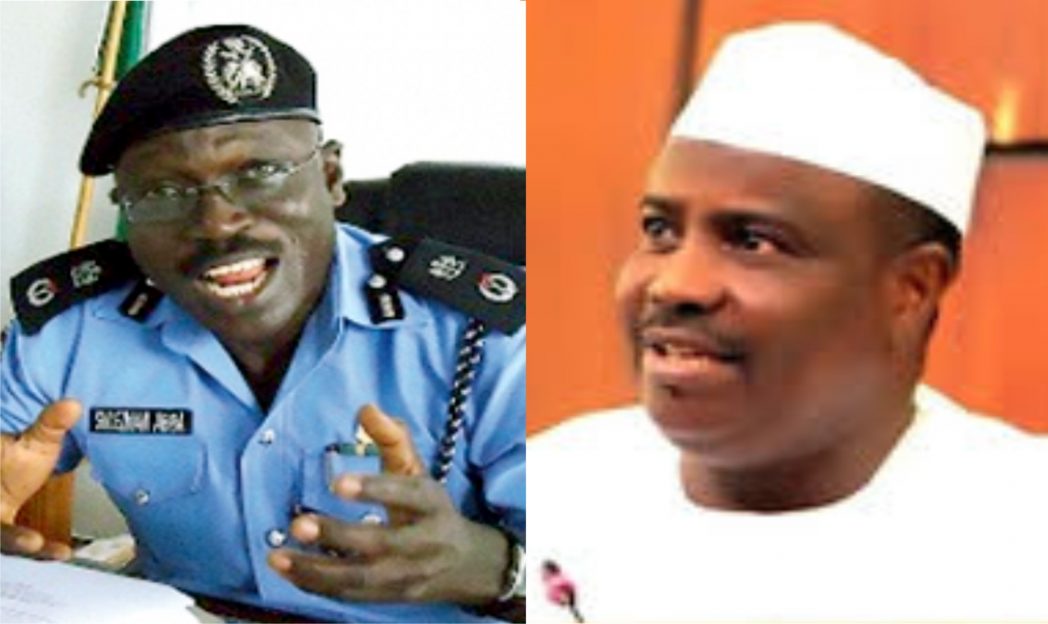
Suleiman Abba, IGP And Tambuwal, Speaker, House of Reps