
Featured
Don’t Borrow Money Without Approval, Wike Warns New LG Chairmen

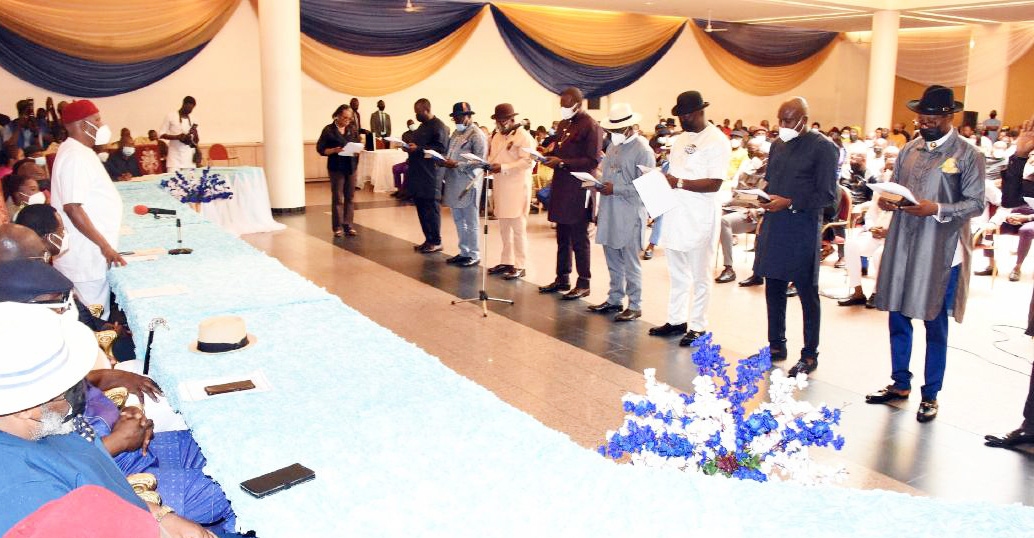
The Rivers State Governor, Chief Nyesom Wike, has told newly sworn-in chairmen of the 23 local government areas of the state not to approach any financial institution to borrow money without first clearing with the state government.
The governor gave the warning shortly after the elected chairmen of the 23 LGAs took their oath of office at the Banquet Hall of Government House, Port Harcourt, yesterday.
According to Wike, the caution has become necessary in order to stem unguarded desire of some council chairman to access money without any development plan.
“Don’t go and borrow money without the state government approval. Some of you tried it last time and started with your blackmail, saying help us, we are finished. You have no authority to go and borrow money. Even we as state government, before we go and borrow money we get approval from the Debt Management Office. No bank will even give us.
“Before you borrow money, the state must know what you want to use it for, and how you will pay it back, so that others who are coming will not suffer because of your indebtedness.”
Wike also charged the council chairmen to pay proper attention to issues of security in order to stem likely security breaches in their various councils.
The governor particularly urged them to establish a robust working relationship both with the Divisional Police Officers (DPOs) and the traditional rulers that will engender having regular security meetings for proper briefings.
“Stay in your council areas. Don’t stay in hotels and in Port Harcourt. If you’re not at home, how do you know about the security situation in your local government? Security is key!
“Relate with your DPOs. It does not cost you anything. Even if it cost you, governance is not easy. Governance is expensive. Security is expensive. Some of you cannot relate with the DPOs.
“It’s only when you have a problem that you relate with your DPOs and some of them are intelligent and when you call them that time, they turn their face the other way. You must make effort to relate with your DPOs.”
The governor urged the council chairmen to ensure they hold Security Council meeting weekly or better still, once in every two weeks for proper briefing.
Speaking further, Wike warned them against embarking on needless travel outside of the state and the country without notifying the state government.
He also encouraged them to work to strengthen the unity of the party in their various councils, consult widely with the leaders over appointments, and on other issues that will give everybody a sense of belonging.
Wike frowned at the worsening sanitary conditions particularly in Obio/Akpor, Port Harcourt City, Eleme, Oyigbo LGAs, and charged the council chairmen to work assiduously to regularly evaluate refuse dumped on major roads in their councils.
The state governor revealed that the state government prevented the former chairmen whose tenure ended, last Wednesday, from paying local government workers salary due to security report and complains by some councillors and political appointees that they will not be paid what was due them.
“So, I decided to suspend the payment of local government workers and political appointees, so that the newly sworn-in chairmen will have to pay them without any crisis whatsoever.”
He said the state government will set up a committee to oversee the payment of all entitlement of immediate past chairmen, their political appointees and councillors.
According to him, “All the former council chairmen, all political appointees and councillors must be paid their money.”
Wike said he has received intelligence report that some council chairmen have sworn that they will not swear in some elected councillors who they perceive to be opposed to them.
He warned that if this happens, appropriate sanction will be taken against the erring council chairmen.
The newly sworn-in chairmen are, Daniel E. O. Daniel (Abua/Odual); Benjamin Eke (Ahoada East); Hope Ikiriko (Ahoada West); Rowland Sekibo (Akuku-Toru); Barrister Awortu Erastus (Andoni); Onengiyeofori George (Asari-Toru); Irimagha David ( Bonny); Michael Williams (Degema); Obarilormate Ollor (Eleme); Dr. Lloyd Chidi (Emohua); Obinna Anyanwu (Etche); Deko Confidence (Gokana); and Engr Nwanosike Samuel (Ikwerre).
Others include, Bariere Thomas (Khana); Barrister Ariolu George (Obio/Akpor); Nemieboka Vincent (Ogu/Bolo); Akuro Tobin (Okrika); Nwaiwu Chisorom (Omuma); Vincent Job (Ogba/Egbema/Ndoni); Enyiada Cookey-Gam (Opobo/Nkoro); Nwaogu Akara (Oyigbo); Ihunda Allwell (Port Harcourt City); and Mbakpone Okpe (Tai).



Governor of Rivers State, Sir Siminalayi Fubara, has reaffirmed the unwavering commitment of his administration to peace, unity, security, and inclusive development as Rivers State marked its 59th anniversary, last Wednesday.
In a goodwill message issued on Wednesday to commemorate the anniversary, Governor Fubara stated that despite the challenges faced over the years, the people of Rivers State have continued to demonstrate resilience, strength, and an enduring spirit of unity that has sustained the state since its creation.
The Governor noted that the strong bond of brotherhood among the various ethnic nationalities of the state, including the Ijaw, Ikwerre, Ogoni, Etche, Ekpeye, Andoni, Kalabari, and others, remains one of Rivers State’s greatest strengths and a critical foundation for peace, stability, and progress.
He further observed that Rivers State has remained a major driver of Nigeria’s economy for decades, not only because of its abundant oil and gas resources, but also because of the exceptional contributions of its people across diverse sectors including academia, jurisprudence, business, entertainment, public service, and sports.
Governor Fubara assured the people that his administration will continue to prioritize policies and programmes that promote peace, protect lives and property, and expand development across all parts of the state. He emphasized that governance must be people centered and impactful, with equal attention given to every Local Government Area of the state.
The Governor also paid tribute to the elders and founding leaders of the state for preserving the spirit of unity and coexistence over the years, while urging the youths to remain hopeful, responsible, and actively committed to building a greater Rivers State through innovation, hard work, and patriotism.
He equally acknowledged the invaluable role of women in strengthening families, communities, and society, describing them as indispensable partners in the continued growth and stability of the state.
Governor Fubara called on all Rivers people to use the occasion of the anniversary as a moment of reflection and renewed commitment to peaceful coexistence, mutual respect, dialogue, and collective progress, stressing that the unity and future of Rivers State must always rise above personal interests and political differences.
Rivers State was created on May 27, 1967, by General Yakubu Gowon.


The Rivers State Government has distributed science equipment and materials to all senior secondary schools across the state to support students during the ongoing West African Examinations Council exams and to strengthen practical learning.
Flagging off the distribution at the Rivers State Senior Secondary Schools Board premises in Port Harcourt, on Monday, the State Commissioner for Education, Dr. Peters Nwagor, said the move demonstrates Governor Siminalayi Fubara’s commitment to improving education standards in the State.
Nwagor said the materials were approved and provided by the state government specifically to boost the teaching and learning of science subjects, describing science education as the foundation for technological advancement, innovation, and national development.
“No society can compete globally without deliberate investment in science and technology,” the Commissioner stated.
He commended the governor for consistently prioritising the education sector by providing tools needed for effective teaching and hands-on learning.
The Commissioner directed principals to ensure that the equipment are used strictly for practical lessons in their schools, warning that any principal or administrator found diverting, hoarding, or selling the materials wil face disciplinary action under public service regulations.
Nwagor also warned against examination malpractice, saying any principal found aiding or encouraging malpractices will be decisively sanctioned.
“We must collectively restore the dignity and credibility of our educational system,” he said.
Also speaking, Chairman, Rivers State Senior Secondary Schools Board, Tony Egwurugwu, urged school heads to make judicious use of the materials for students’ benefit.
He thanked the State Government for providing the resources, and assured that monitoring mechanisms would be put in place to ensure the materials serve their intended purpose.
In his own remarks, a Board Member for Technical Education, Nwisabari Bani Samuel, expressed appreciation to the governor for prioritising education and acknowledged the Commissioner’s role in advancing education development in the State.
He said the distribution covers all senior secondary schools in the State and is intended to improve students’ performance in both internal and external science examinations.
Akujobi Amadi
-

 Rivers2 days ago
Police arrest 3 suspects over killing of driver in Rivers
-
Politics2 days ago
I DIDN’T PROMISE YOU TICKETS, AKPABIO TELLS APC SENATORS WHO FAILED PRIMARIES
-

 News2 days ago
FUBARA ASSURES NUT OF SECURITY OF SCHOOLS IN RIVERS
-

 News2 days ago
NDLEA Arrests Four Notorious Female Drug Dealers In Four States
-

 News2 days ago
WORLD FOOD SAFETY DAY: VETERINARIANS TASK GOVT ON MODERN ABATTOIR IN RIVERS
-

 Sports2 days ago
Okpekpe Road Race Gets Mobility Solutions, Fan Engagement
-
Politics2 days ago
Court Dismisses Rivers PDP Members’ Suit Over LG Election Candidates
-
Politics2 days ago
POST PRIMARIES: IKWERRE MONARCHS ADVOCATE ISSUES-BASED POLITICS IN RIVERS