
Nation
THE STATES

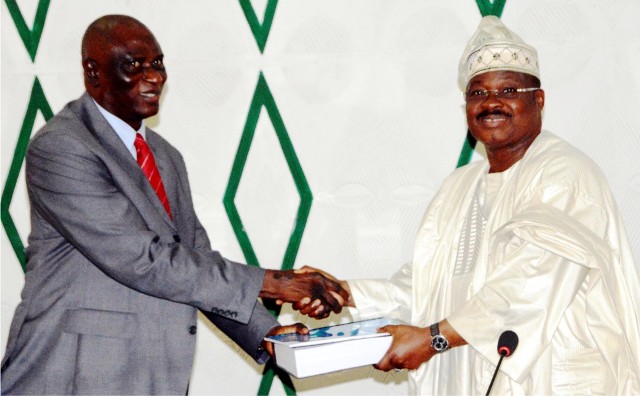
Adamawa
Governor Muhammadu Bindow of Adamawa
State along with members of his Cabinet,
celebrated Eid el-Kabir with Internally Displaced Persons (IDPs) at the Malkohi Camp.
Bindow said at the occasion that he would continue to support the cause of humanity, especially the disadvantaged people.
He assured the IDPs of his administration’s resolve to facilitate their prompt integration.
“We will continue to support you and give you a sense of belonging.
“My administration will continue to identify with the disadvantaged in the society.
Borno
Borno State Government has no plans to force
Internally Displaced Persons (IDPs), whose communities have been liberated by the military to return home, Governor Kashim Shettima, has said.
The governor made the statement while speaking with newsmen shortly after performing the two rakaat Eid prayers in Konduga, headquarters of Konduga Local Government Area.
“I want to say without any fear of contradiction that government has no plan to force any persons back home to his or her community.
“We will not compel individuals to go back to their place,’’ Shettima, who was accompanied by the Director-General, National Orientation Agency (NOA), Dr Garba Abari and other top government officials said.
FCT
As schools resume amid economic recession,
parents have canvassed for home-made food for wards.
A cross section of parents who spoke to our correspondent in Abuja said this became necessary due to the inflation in food prices and transportation fares.
Mrs Helen Solomon, a trader, said it was necessary “during this period to find alternative means of surviving in order to cut cost.’’
Solomon said that she had decided to start making meals for her children to take to school, saying home-made food was cheaper and healthier.
Gombe
The Emir of Akko,Alhaji Umar Atiku, has appealed
to Nigerians to pray to God to bring to an end the hardiship in the country.
Atiku said this when he spoke with newsmen in Kumo, headquarters of Akko Local Government Area of Gombe State.
“Instead of criticising leaders,we need to seek for God’s intervention through prayer,to bring an end to the current hardship being experienced in the country.
“We should also intensify prayers for our leaders at all levels for wisdom,” he said. He said in this hard time, a lot of people could not afford one square meal, talkless of the three.
Kaduna
The Kaduna State command of the Federal Road
Safety Corps (FRSC) says it has secured 45 convictions of motorists for various traffic offences in Kaduna. The Command’s Legal Officer, Mr Ibrahim Tanko, made the disclosure in an interview with newsmen. He said the motorists were convicted via a mobile court during Sallah and ember months’ operations, which commenced on September 7.
Kogi
Five top civil servants in Kogi State have been
arrested for allegedly diverting N230 million pension fund to their private uses.
The Accountant-General of the state, Alhaji Yusuf Okala, confirmed the development to newsmen in Lokoja.
Okala, who is also the Chairman of the Staff Screening and Verification Committee, said the alleged fraud was discovered in the course of the committee’s work.
“Yes, it is true. We have been able to recover N20 million from them through the efforts of the police command in the state,” Okala said.
Niger
A former Head of State, Retired Gen. Abdulsalami
Abubakar, has advised Nigerians to stop vandalising infrastructure provided by governments for the development of the nation.
Abubakar gave the advice at the Minna Central Mosque after the two Rakaat prayers for the Eid-el-Kabir.
“The ongoing destruction of our infrastructure in the country is capable of hampering our development if it is not checked,’’ he said.
He appealed to individuals and groups engaged in such act to make their grievances known to government by reporting to the appropriate authorities to address their issues, instead of taking the law into their hands.
The former Head of State said that meaningful development could only take place in a conducive environment.
Osun
The Chairman of the Association of Local
Governments of Nigeria (ALGON) in Osun State, Mr Soji Ajayi, has called for social reorientation for the youths.
Ajayi,who made the call in an interview with newsmen in Osogbo, stressed the need to make youths more responsible and productive.
He said that the level of social consciousness of the youths was low considering the enormous responsibility of nation-building before them, hence, the need for social reorientation.
The ALGON chairman added that many of the youths were not ready to take up responsibility but rather preferred easy route to success and wealth.
Plateau
Mr Obadiah Samuel of the Centre for Peace and
Conflict Management, University of Jos, says corruption and mismanagement of public funds have posed a serious threat to the corporate existence of Nigeria.
Samuel said this in Jos while delivering a lecture entitled, “The Right to Peace and Security” at a seminar on security. The seminar was organised by the Justice Development and Peace Commission (JDPC) of the Catholic Archdiocese of Jos.
Samuel said that the diversion of public funds into private pockets had led to the high level of insecurity in the country.
“Corruption, mismanagement and absence of political will have really stagnated a lot of things in this country; they have contributed immensely to our present insecurity situation”.
Yobe
Residents of Damaturu, the capital of Yobe State,
have expressed satisfaction with the tight security in the state during the Eid el-Kabir festival.
They told our correspondent that they felt secure with the presence of the security operatives.
Alhaji Musa Buba said: “it is better to trek and be secured than to allow free movement of vehicles and live in fear.’’
Dr Mohammed Fari, Commandant Nigeria Security and Civil Defence Corps in the state, said a special surveillance square was deployed to check movements of persons.
Zamfara
The Acting Governor of Zamfara State, Alhaji
Ibrahim Wakkala, has charged the people of the state to be security conscious.
Wakkala stated this when he paid Sallah homage to the Emir of Gusau, Alhaji Ibrahim Bello at his palace.
He said relative peace had been restored in the state which had suffered in the hands of armed bandits, kidnappers and cattle rustlers in the last three years.
Wakkala advised the people not take chances of the situation by being so free with strangers that might come their way.
He said the state government would remain grateful to the Federal Government for the bold steps it took to address the security issues in the North West particularly in Zamfara.



The Rivers State Commissioner for Education, Dr. Peters Nwagor, has commended the orderly conduct of the ongoing 2026 West African Senior School Certificate Examination in the state and urged schools to sustain the standard.
Dr. Nwagor gave the commendation on Tuesday during a monitoring tour of selected secondary schools in Port Harcourt and environs where the WAEC exam is ongoing.
The commissioner, who was accompanied by directors and monitors from the Ministry of Education, said he was impressed with the peaceful atmosphere at the centres visited.
“The students conducted themselves properly and wrote their papers under conducive conditions. Invigilators and supervisors also performed their duties professionally,” he stated.

Nwagor noted that the Rivers State Government had invested heavily to ensure the smooth and credible conduct of the examination across the state
He urged candidates to reciprocate government’s effort by shunning all forms of examination malpractice and focusing on their studies.
“Government has done so much to ensure successful examinations in our schools. Students should take advantage of it by remaining focused,” the commissioner said.
While no case of malpractice was recorded in the centres inspected, Dr. Nwagor warned that any principal, teacher, invigilator, or official caught aiding malpractice would face strict sanctions in line with regulations.
He also commended school administrators, teachers, WAEC officials, and security personnel for upholding the integrity of the process.
Centres visited included County Grammar School, Ikwerre/Etche; Government Comprehensive Secondary School, Borokiri; Government Secondary School, Borokiri; and Pabod Model Secondary School.

Rivers State University and the Otonti Nduka Foundation for Values Education jointly hosted a two-day National Conference on 8 and 9 May 2026 to examine the state of values in Nigeria.
The two days conference held at Rivers State University convocation arena brought together academics, policymakers, legal experts and education leaders under the theme _“Trends and Challenges in Upholding Values in Nigeria.”_
The gathering focused on policy gaps, curriculum reform, and the role of ethics in public service and education.
The event opened on Friday with remarks from Vice Chancellor Prof. Chief Isaac Zeb-Obipi, who stressed the need to address declining moral and civic values across Nigeria’s education and public sectors. A book of abstracts for the plenary sessions was also presented to participants.
Key speakers included former Attorney General Chief Dr Kanu Agabi, SAN; NERDC Executive Secretary Prof. Shehu Salisu; Prof. Hauwa Imam, FNAE, of the University of Abuja; former Rivers SUBEB Chairman Ven Dr Fyneface Akah, ; former NIMASA DG Dr Hon. Dakuku Adol-Peterside; and RSU Director of ICT Prof. Sunny Orike.
Discussions centered on integrating values education into schools, tertiary institutions and public institutions, alongside the impact of technology on moral development among young Nigerians. Panel and plenary sessions produced practical recommendations for curriculum and policy reform.
On Saturday, the foundation marked its centenary with the unveiling of the book _Otonti Nduka in History_, launched by Chief Engr. Grant Offor, FNSE. The Nigerian Academy of Education held a ceremonial procession led by its President Prof. Olu Jegede and the Ikwerre Professors Forum.
In a communiqué, participants called for stronger collaboration between government, civil society and academia to mainstream values education nationwide. They recommended reviewing teacher training curricula and expanding digital platforms to promote ethical civic engagement, with the foundation pledging to share the outcomes with education authorities for implementation.
Dignitaries present included Ogbakor Ikwerre Worldwide as Chief Host, Prof. Emeritus Chief T. Uzodimma Nwala, the Ikenga 1 of Mbaise and first philosophy student of Prof. Otonti Nduka, alongside scholars and community leaders.
Amadi Akujobi
-

 Rivers2 days ago
Police arrest 3 suspects over killing of driver in Rivers
-
Politics2 days ago
I DIDN’T PROMISE YOU TICKETS, AKPABIO TELLS APC SENATORS WHO FAILED PRIMARIES
-

 News2 days ago
FUBARA ASSURES NUT OF SECURITY OF SCHOOLS IN RIVERS
-

 News2 days ago
NDLEA Arrests Four Notorious Female Drug Dealers In Four States
-

 News2 days ago
WORLD FOOD SAFETY DAY: VETERINARIANS TASK GOVT ON MODERN ABATTOIR IN RIVERS
-

 Sports2 days ago
Okpekpe Road Race Gets Mobility Solutions, Fan Engagement
-
Politics2 days ago
Court Dismisses Rivers PDP Members’ Suit Over LG Election Candidates
-
Politics2 days ago
POST PRIMARIES: IKWERRE MONARCHS ADVOCATE ISSUES-BASED POLITICS IN RIVERS