Features
Removing Rickety Vehicles From PH Roads


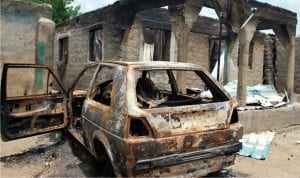
Rickety Vehicle along one of the roads in Port Harcourt.
By all accounts, the
growing rate of rickety vehicles in Port Harcourt, the Rivers State capital, is daunting and arouses genuine concerns in residents of the city. Some observers insist that if the development is not checked, it will threaten the safety of commuters and affect transportation of goods on our roads.
Many of them expressed worry over the recent spate of avoidable accidents caused by sudden breakdown of unserviceable vehicles on major roads in Port Harcourt and asked the police, the Vehicle Inspection Office (VIO) and the Federal Road Safety Commission (FRSC) officials to work hard to reduce the incident. They asked the agencies to synergize to ensure safety and prevent carnage on our roads.
“Nobody can question the fact that the state of vehicles we find plying on Port Harcourt roads is disgusting and does contribute so much to the accident rate on roads in Port Harcourt. They do. Some of them are so bad that their emission can choke and kill people within the vicinity.
“Recently, I was driving along Olu Obasanjo Road and a vehicle within a distance of four vehicles from mine emitted thick smoke to the extent that the vehicle directly behind it ran into it at a traffic control point because of poor visibility. That incident led to a multiple accident at the spot. The agencies that deal with road safety in the state have to take these vehicles off our roads”, said a Port Harcourt-based businessman, Mr. Isdore Ekezie.
A law student at the Rivers State University of Science and Technology (RSUST), Ms. Victory Amadi, advised the Rivers State Government to ensure that only road worthy vehicles were allowed to drive on roads in Port Harcourt to avoid accidents. According to her, many vehicles lacked important traffic signs and other vital components that was why they caused accidents so frequently.
“Some of the vehicles don’t have functional break and therefore lose control and drive into people and either maim or kill them. Others drive their vehicles into oncoming ones and this leads to fatal accidents with high casualty rates. There are vehicles that drive into houses and kill people that are resting inside their houses. What will you say about that? It is because such vehicles are not road worthy and I believe it is the duty of the police to make sure that they are out of our roads”, Amadi said.
When The Tide spoke with some drivers, particularly commercial vehicle drivers, they attributed the increase in unusable vehicles on our roads to the hard economic times that had prevented them from maintaining their vehicles. They said the inflation occasioned by the devaluation of the naira had led to the high cost of spare parts.
“This vehicle is my own. I know how much I spent in maintaining it. But now I cannot because everything is costly. We cannot buy spare parts because of the cost. Any driver you see now is just managing. Look at the fuel situation; fuel is not affordable. When we manage to see it we cannot buy it because of the high cost. Many of us are out of business so how can we maintain our cars?
“Look at a small spare part cost so much depending on the motor. How much do we make a day that we can maintain our cars? Please tell the government to help us bring down the cost of things and the cost of fuel so that we can drive and make profit”, a commercial vehicle owner, Mr. Ebere Ofoha, lamented.
Similarly, another taxi driver, Mr. Vincent Akujobi, blamed the multiplicity of rickety vehicles in the “Garden City” to the many extortions by touts and security agents, especially the police. According to Akujobi, a part of the money they would have used in maintaining their vehicles were usually lost to these persons thus leaving them with little or nothing in the end.
Hear him: “Because of too much collection of money by agbero boys and police people, we cannot make enough money to maintain our motors. The money we are supposed to use to make them road worthy is collected by these people. Even our union people collect so much from us. So how much do we have to service our motors?”
Meanwhile a journalist, Mr. Owuje Harry, also expressed concern for the growing rate of rickety vehicles in the state. He observed that the vehicles were not only dangerous to pedestrians (as they could be knocked down by them at any time) and commuters, but were death traps that required the attention of the government. He said the authorities should also act concerning abandoned vehicles littered every corner of the state capital.
“There are too many rickety and abandoned vehicles in Port Harcourt that I would want the agencies concerned to check regularly. Such checks should include the age of the vehicle, the tyres, head lamps, mirror, break, oil etc. Also, the state governor, Barrister Nyesom Wike, should re-establish a traffic control agency to complement existing agencies in looking out for these unwanted vehicles”, Harry opined.
Continuing, the journalist noted that there was need for the state government to enact a law to regulate or outrightly prohibit the use of such vehicles in the state. “Let the government consider enacting a new traffic law that will get these rickety and abandoned vehicles off the roads to make our roads safer and to achieve our governor’s plan of rehabilitating all the roads in Port Harcourt”, he concluded.
A public affairs analyst, Mr. Lucky Uche, also called for the immediate ban of all rickety vehicles on major roads and streets of Port Harcourt and its environs. Uche said recent findings had revealed that they caused most accidents and road traffic gridlock. He said they caused road accidents because many of the vehicles lacked side mirrors and brake lights. According to him, they were the reason for environmental hazards and pollution on the roads.
He said as all the roads in Port Harcourt were being given a face-lift by Governor Wike, such vehicles should not ply the roads as Port Harcourt was gradually reassuming its former “Garden City” status. The public affairs analyst noted that though some families were dependent on proceeds from these vehicles, it was time for sanity to prevail on our roads.
He insisted that rickety vehicles suddenly break down in the middle of the road and caused avoidable obstruction to free-flow of traffic. According to him, the vehicles lacked traffic signs on them and therefore risked the lives of other road users. He called on the VIO at the Rivers State Transport Ministry and other relevant agencies to live up to their billings.
When The Tide visited the VIO office at the Transport Ministry, a source said the inspection of vehicles in Port Harcourt had been an ongoing exercise.
Arnold Alalibo