Front Pix
Undermining The Institution Of Governor …That Military Attack Of Yeghe


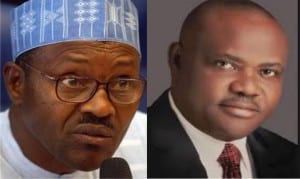
Buhari and Wike
Last week, Ogoni-land came under heavy armed military attack, like an enemy invasion, which in its wake, left several dead, some of them defenseless men, women and children. It was like a commando-style enemy invasion that took many by surprise.
When the dust died down, the lone explanation close observers had was that the armed invaders were after a suspected cult lord, declared wanted by the security community. And in pursuit of just one man, several had to pay the supreme price at peace time.
A visibly disturbed Governor Nyesom Wike, after visiting and beholding the casualty figures in hospitals and mortuaries decried the attacks. According to the governor, there was no prior hint by the military authorities of such invasion. That even as governor, he heard of the raids only after the deaths left in its trail. How so?
Is it possible for soldiers to raid a community in a state, without the knowledge of a Governor, who is the chief security officer of a state, in a democratic dispensation? Does that not amount to a declaration of war on a state? At peace time.
Under civil rule, security structures submit themselves to civil order. Their primary functions being to defend the sovereignty and security of the nation’s borders, their day to day operations are limited to the barracks. Except when called upon to quell insurrection, as the protracted insurgency in the North Eastern part of the country, soldiers ought to limit their operations to the barracks.
In states where insecurity and criminality rise to unacceptable levels, the joint forces within a state under the superintendence of the Governor may form task forces to address certain challenges, like oil theft, illegal bunkering, war against kidnapping, armed robbery and indeed cult-related violence.
In such instances, the heads of the Police, Army, Air Force, Navy and the civil defence corp synergise to address such challenges. That, of course, is when the issue cannot be handled singularly by the Civil Defence and the Police. Even so, the decision must be the product of security meeting with the State Chief Executive and security officers.
This is why it came to many as a rude shock that the military raid of Yeghe, in Ogoni-land, that left several dead, was without prior information of the state governor, who swore an oath to protect lives and property in his state. We do not want to believe that security issues are also becoming play things or toys in the hands of politicians.
This is why the issue raises some pertinent questions. Who invited the soldiers to Yeghe for that raid? Why? Was the state’s security community briefed of the circumstances informing the invitation of armed soldiers into Ogoni-land? Was there a formal report to the police? If such was extensively done, is it probable that the Chief Security Officer of the state, in this case Governor Wike would not be properly briefed? Finally, who authorized the military raid?
These questions have become necessary because of the increasing militarisation of the once peaceful state over issues that are more political than of insecurity. On the last count, masked armed men had invaded parts of Asari-Toru and Akuku-Toru Local Government Areas of the state, with casualties. Because such raids were not properly explained, they opened the room for criminals to attack their victims, cart away prized belongings and even abduct innocent people, using similar costumes.
We think that the Nigerian Armed Forces should be more professional in their dealings with civilians as demanded in a democracy like ours. They must refuse to be tools in the hands of politicians, political party, or an influential individual. They must avoid being used as instruments of oppression or intimidation against perceived enemies, by selfish public officers.
A professional soldier is that one who maintains the line between the demands of his military duties in times of war as against his expected sanity within a civil culture, at peace time. A soldier must realise that he is a symbol of state security, of forthrightness, impartiality, honour, respect and patriotism. He must not allow himself to be used by one citizen against another, without obvious criminal breaches.
Even in such instance of clear breaches, it is expected that such suspects be handed over to the police. The tendency of some Nigerians rushing to military barracks, to invite soldiers against perceived enemies, at the slightest provocation questions the professionalism of a trained soldier. Soldiers, must therefore, resist such temptations no matter the price.
This brings us to the threats of making Rivers State ungovernable and eventually attract state of emergency, as a means of taking from Gov. Wike, what the electoral and judicial processes could not deny him. What would be the rational for such animosity against one’s own state?
This is the only time in the Rivers political history that bitter animosities, criminal vendetta, campaigns of calumny, vindictiveness, hatred and lack of unity, will hold sway long after elections have been contested and won. And still drag on for a re-run and yet another round of bitterness.
What is most worrisome is that, in their bitterness and hatred, opposition politicians have inadvertently desecrated the institution of Governor, which is the symbol of our statehood, through very insulting and disparaging appendages. Still in disbelief that Chief Nyesom Wike is today governor, amidst their doubts, boasts and threats, opposition politicians are yet to accept that it is the respect we give to the throne that the throne would be worth.
That each time we undermine and disrespect the integrity of the institution of Governor, we inadvertently belittle ourselves, for it was the same price that stretched all political parties through the electoral gambit and others through the courts.
It is regrettable, that after months of the insulting reference of ‘Caretaker’ governor, the opposition All Progressives Congress (APC) still finds it difficult to see Chief Nyesom Wike as a duly elected governor of the state. The refusal to accept that fact amounts to nothing. It merely makes them bad losers. But that is not what Rivers people need.
Rivers people want politicians to leave their differences behind and tinker on ways of moving the state forward. Politics is not a do or die matter. It is like a game of sorts, where, all cannot be winners. Some will win, others, lose.
The important consideration is the future of the state and the welfare of the citizenry. They must show the people that they care and would serve them even better. If they must criticise, they must do so with measured decorum and not to inflame avoidable rivalry and enmity.
Strangely, the Governorship of the state is not up for re-run. So, the governor should be seen as a political father to all. No matter what reservations any politician may have against the occupier of the office of Governor, it must be stated that institution of the office of the governor is a prized treasure for all, that must be respected, adored and at all times defended.
If politicians value the instrument of governor as such, they would not by-pass the Chief Security Officer of a state and launch a military attack on a community in his own state, without his knowledge.
The military high command must investigate the circumstances surrounding the Yeghe raids and come up with answers. This is because, the raid of a community at peace time, that left innocent men, women and children dead, cannot be defended.
If the governor of a state can no longer defend his people on account of such security breaches it would only push the people into searching for alternative forms of self preservation and protection and in the end be pitched against the conventional armies. This is how vigilante emerges, grows into a community security and when questioned, rises to become insurgency.
The military must be apolitical in the handling of civil issues, if they must continue to enjoy the confidence, respect and love of the citizenry.
My Agony is that some opposition politicians believe that the Buhari Presidency is a sure opportunity to make Rivers ungovernable and get through the back door, what the political process and the courts denied them. With that mindset, they have been embracing the same impunity which they repeatedly condemned, and preached against.
That is not what politics should be.