Environment
As Harmattan Defies Human Permutation In Rivers


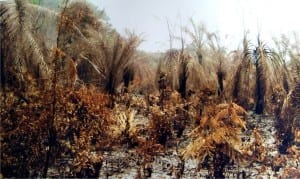
A farm where crops like palm trees and pinneapples were razed by harmattan fire at Orhua community in Uhunmwode Council Area of Edo State, recently.
If the prevailing harmat
tan weather condition in the country is anything to go by, then many people have causes to worry.
The fears are based largely on the negative impacts of the weather on the socio-economic sector of the country.
Investigation revealed that, the impact of the weather is being greatly felt in the rural areas.
Sources informed The Tide that in the riverine areas of Rivers State, the situation is already threatening the socio-economic condition of the people.
According to sources, fishing communities in the state are on the verge of starvation, due to poor visibility occasioned by the weather, adding that, this situation had made it difficult for most fishermen to venture into the deep sea.
The sources further said that the harmattan haze has made attacks by pirates and other criminal elements more frequent in the riverine areas.
However, opinions are now divided on the situation of the weather while younger people described it as unusual, some members of the older generations believed that nothing is wrong for the harmattan season to stretch into the month of February even March.
Mr Morrison Ellah, sixty-year-old man, said that there is noting unusual about the season.
He told The Tide in an exclusive interview in Port Harcourt, that people of his generation had always witnessed the harmattan season from September every year, with the rainy season around March.
He, however, said that for sometime now, the situation had been different.
Mr Ellah also told The Tide that the weather might have negative effect on agriculture as such crops like plantain may not germinate.
He, however, urged the people to pray for early rains to avoid food shortages that might occur if the season continues for too long.
In his view, an environmentalist and Associate professor at the University of Port Harcourt, Dr Fidelis Allen blamed the weather on climate change.
Dr Allen told The Tide in a telephone interview that the prevailing weather condition is a clear sign that the climate is changing.
“What is happening today should really be a source of concern to people. The extreme weather condition is a clear sign that something is happening to the climate”.
The university don posited that the situation is not peculiar to Nigeria alone as people in other countries are also experiencing extreme weather conditions, adding that humanity must be held responsible for the problem.
“Man is responsible for this problem. Man has contributed more than necessary green house gases to the atmosphere” he said.
Dr Allen who said that the resolutions at the lost Earth Summit in Paris, france was welcome, however, urged governments and world leaders to go beyond rhetorics and do something about climate change.
“We should be sincere with what to do about fossil fuel. We should move away from rhetorics by restricting further development of fossil fuel.
“It is clear that world leaders are bent on supporting the development of fossil fuel, which is responsible for the amount of greenhouse gases we have in the atmosphere.
“We can no longer deny the reality of climate change”, he said.
Speaking on the health implication of the weather, Dr Damiete Ibim of the Braithwaite Memorial Specialist Hospital (BMSH), said that the situation poses a great danger to the health of the people.
Dr Ibim said the weather coupled with pollution by vehicles, may lead to upper respiratory track infection, which may lead to constant sneezing.
He said that the only way to avoid this, is for people to constantly wear face mask to avoid inhaling dust.
According to him, parents should ensure that their children wear masks over their faces while going to school in the morning.
The medical doctor also said that the weather condition will have negative effect on farming that may lead to food shortages this year, adding that if the rains delay, there is the possibility that crop may not grow well and that can lead to food shortages.
Another respondent, Mr Steve Obodoekwe of the Centre for Environment Human Right and Development (CEHRD) also blamed the weather on climate change.
He said that the sooner the issue of climate change is addressed, the better for the society, pointing out that the prevailing weather condition is an indication that something terrible will happen to the earth.
“I blame the situation on climate change. The level we have reached now is very clear that something terrible will happen to the earth,” he stressed.
The environmental activist also urged the government to take serious the issue of gas flaring in the Niger Delta.
On his part, Mr Thomas Ikaraba also agreed that the situation may lead to famine as the continous delay in rainfall may affect the growth of food crops.
He, however, called for prayer to avert the impending calamity.
other respondents also agreed on the risk posed by the weather to the socio-economic condition of the country.
However as the hamattan continues across the country, it is important for the government to commence series of seminars to sensitise people on the socio-economic implications of the weather.
John Bibor / Patricia Karrbo