Front Pix
Averting National Security Crisis …Of Kogi, Bayelsa, Rivers Polls

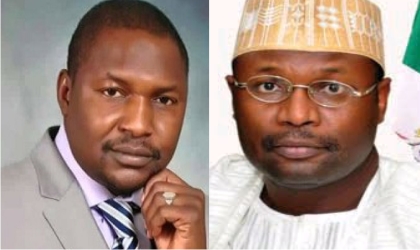
Malami and Yakubu
There is growing discontent and frustration in the land over the conduct of elections in the country and conflicting court rulings arising from complaints from the last general elections. And unless the needful is done to address the brewing unrest, it will be very calamitous for a nation battling challenging economic concerns.
When last month, the Kogi State governorship elections were declared conclusive and thereafter one of the candidates in that election, Prince Abubakar Audu died, many Nigerians expected the Independent National Electoral Commission (INEC) to seek proper legal and constitutional guidance across a broad spectrum of the judicial community. But INEC preferred to accept hook-line-and-sinker the singular view of the Attorney General of the Federation (AGF).
INEC without delay authorised the All Progressives Congress (APC) to replace its dead candidate as advised by the AGF, amidst legal disputations by various interest groups including the opposition, Peoples Democratic Party (PDP), which insisted that by the death of one of the leading candidates, its candidate, incumbent governor Idris Wada, with the highest number of votes of candidates alive be declared winner.
Another was the argument by late Audu’s running mate, Hon. James Abiodun Faleke that as heir to the joint Audu/Faleke ticket, he was most qualified to inherit the votes earlier secured before the elections were declared inconclusive. He indeed made good his threat to seek legal redress although the court denied jurisdiction.
In the end, APC substituted the former candidate with Yahaya Bello, the first runner-up in the party’s primaries, with Faleke as running mate, an arrangement the latter jettisoned. Yet without a valid running-mate, as demanded by law, INEC went ahead to conduct supplementary polls and declared the elections in favour of Yahaya Bello, who with less than 7,000 votes he secured, also inherited the votes of late Audu and Faleke.
What Kogi experiences today is the peace of the grave-yard. Already, members of the State House of Assembly have started tossing their leadership and that may result to even more profound confusion and crisis. Although most of them still set their sights on the election tribunal as ordered by the courts, they do so with very shaky faith of a fair outcome.
Kogi is a PDP state. It is at the risk of falling to the APC, just as several other states risk doing same. Akwa Ibom and Rivers States were also on the line with uncertainty beclouding the eventual outcome of the litigations until last week when the Court of Appeal upheld the decision of the tribunal, annulling virtually all elections in Rivers State. It did so to Akwa Ibom.
Like Akwa Ibom and Rivers, Bayelsa is another PDP state which governorship election was also declared inconclusive, on account of massive rigging and security breaches. Amidst the inter-party name- calling, the Federal Government ought to take the blame for not merely over-militarising the electoral process, but also being unable to ensure the required security.
Amidst massive security presence, including virtually all arms of the armed forces, lives were lost, persons were maimed and ballot boxes snatched. It has also confirmed that ex-agitators were used to snatch sensitive materials, fake results written at night and some even attempted to submit same as valid will of the people.
The voiding of the Southern Ijaw polls and plans for supplementary election on January 9, is merely postponing the doomsday. This is because a lot of desperation has set in with stakeholders ready and willing to do everything to defend their interest, whether constitutionally or not.
This kind of insecurity is brewed when, among other things, the will of the majority is at the risk of being subverted by a powerful minority with state’s support. An attempt of that kind on a state like Bayelsa will be most disastrous and should have been prevented.
Bayelsa, like Rivers State, is home to an army of ex-agitators who would naturally not sit by and watch the will of the majority being subverted. They naturally would resist it and that would amount to confrontation with the conventional security, which were accused by some of demonstrating open partisanship.
Although the Police and military sources denied culpability of their ranks, the fact that their presence did not abate the level of insecurity reported, before, during and immediately after their elections is an indictment that should worry our forces.
While fears still trail likely happenings in a rescheduled election in Bayelsa, Rivers State has gradually joined the stream of flash-points. The Appeal Court last week, voided the elections of all three senators elected on the platform of the PDP in the state along with the governor, and ordered fresh polls within between 60 and 90 days.
This means another round of unrest. Another bout of violent exchanges. Yet another round of hate-filled campaigns and above all, a likelihood of fresh insecurity in the land.
Nigeria is today fighting a war on terror principally ravaging the North-East of the country. It is a war that has been most costly in terms of casualties and destruction of property. There are thousands of Internally Displaced Persons (IDPs) still hoping to get their lives back. The Nigerian State and other international donors are still battling with the challenges posed by the refugee situation.
In the midst of this, there have been violent public protests in parts of the South-East and the South-South over the actualisation of the sovereign state of Biafra. In course of such protests, some lives have been lost and property destroyed.
So worrisome, the military establishment has repeatedly warned the protesters against breach of the peace or have them to contend with. If the protesters fail to heed, as they have vowed they won’t, it would amount to the armed forces fighting two battles, one in the North East and another in the South-East.
With the gloomy picture now surrounding the Bayelsa polls, the threats and counter threats by desperate stakeholders and indeed the desperation of the various political parties, there is no telling if there would not be a rehash of the insecurity experienced in the last run. It would be worse if the people have a feeling that maximum force is being employed by the state to subvert the will of the majority, as was suggested in the last attempt.
Already, ex-agitators, troubled by the goings-on have threatened to return to the creeks, their ‘home’ for the insurgency before the Yar’Adua government granted them amnesty. Such return would not be in the interest of the people and the state.
This is because, it would mean that our armed forces would be fighting insurrection on three fronts, the North-East, the South-East and the South –South. How ready are our troops for this?
Former President Goodluck Jonathan made the right point when he said, no body’s ambition is worth anyone’s blood. He also affirmed it by accepting the outcome of the Presidential elections and congratulated his successor, even as an incumbent President, a gesture strange to the African continent. A gesture never ever contemplated in this part of the globe.
But from goings-on, it appears that Jonathan’s statesmanly sacrifice was indeed in vain. The ruling APC seems to be doing little to ensure political neutrality necessary to deepen the democracy that brought it to power.
For instance, when Edo State Governor Adams Oshiomhole led a team of election conductors to Bayelsa, to superintendent the APC Governorship Primaries, he was alarmed at the level of thuggery displayed by one of the candidates. Oshiomhole after fleeing from the crisis zone, told journalists how one of the aspirants, Chief Timipre Sylva had used thugs to terrorise the process.
On his part, Sylvia called the Edo State governor a liar.
What did the supposedly reformist APC do? Change the electoral panel and still produce Sylva as its candidate, one publicly vilified, indicted and declared uncivil by an electoral panel set up to conduct the party’s primaries.
That did not speak well of the change Nigerians look forward to. And because it was not nipped in the bud, “it was no surprise that Bayelsa boiled over as it did during the party’s primaries. Do we need to look very far for answers? Is the Buhari government satisfied with the turn of events in Bayelsa and elsewhere?
With fresh elections ordered in Rivers, is there any guarantee that the Bayelsa example would not be duplicated? How ready are the security forces? How impartial will they be? How apolitical will INEC be? How peaceful will the process be?
My Agony is that court rulings being churned out these days appear to be robbing Peter to pay Paul and would on the long run, leave Peter too impoverished even to talk. I only wish, am wrong.
Soye Wilson Jamabo