Politics
APC And The Change That Begins From N’Assembly

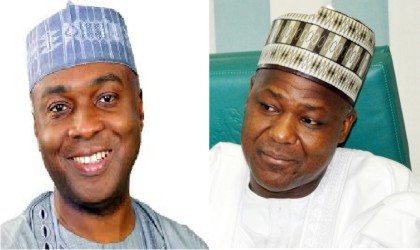
Senate President, Senator Bukola Saraki and Speaker, House of Reps, Yakubu Dogara
The emergence of
Senator Bukola Saraki and Hon. Yakubu Dogara as Senate President and Speaker of House or Representatives, respectively, is no doubt an historical event that will attract a lot of references in years to come.
If for nothing else, the intrigues surrounding the election of the two principal offices of the 8th Assembly last Tuesday are enough to embed the entire proceedings in the hearts of close watchers.
At the end of the day, the ball seems to have been played to the court of the ruling party, All Progressives Congress (APC) to make good it’s widely acclaimed mantra – change, which started with its defeat of an incumbent national government, the Peoples’ Democratic Party (PDP).
The major plot thickened a few days to the election when the leadership of the APC made it clear that it would prefer consensus candidates for key positions in the National Assembly, which necessitated the call for a meeting to resolve the situation.
Penultimate Saturday preceding last Tuesday’s showdown at the NASS, the APC had conducted mock elections to elect candidates for the two offices. Ahmed Lawan from Yobe and Femi Gbajabiamila were elected as the party’s consensus candidates for Senate President and Speaker of the House, respectively.
But Saraki and Dogara, who are also members of the party, boycotted the election and rejected its outcome, vowing to defy the party and seek for the mandate of their colleagues in an election billed for Tuesday.
The following day, the NationalSsecretary of APC, Mai Mala Buni, issued a statement urging Saraki and Dogara to abide by the decision of the party, but the two contenders rejected the plea by the party leadership and stuck to their gun.
Next, Vice Yemi Osinbajo waded into the matter. According to one of the lawmakers loyal to Dogara, the VP had invited all members to a meeting, even as he said they would boycott it.
“We received text messages from the party informing us of a meeting with the Vice President today; however, we see no difference between the Vice President and those trying to impose leaders on the House of Representatives, so we would not be attending,” he said.
By Monday, it was the turn of governors of the APC, who called an emergency meeting to seek ways of re-uniting members of the ruling party. Sources at the national secretariat of the APC confirmed that the meeting was called by the Chairman of the APC Governors’ Forum and Governor of Imo state, Rochas Okorocha.
And finally on Tuesday, another meeting, allegedly called by the President, Muhammadu Buhari, was scheduled to hold at the International Conference Centre (ICC). The meeting was slated for 9 am while the inauguration was billed to hold at 10.00am at the NASS.
Buhari was said to have abstained from the meeting, when, according to close associates, reports reached him that the exercise would be futile, given PDP’s adoption of Saraki and Dogara.
Earlier, the ruling party had allegedly ordered that every entrance into the National Assembly be shut. As early as 6.00am, the road leading to the National Assembly had been cordoned off, while policemen and other security agents had been deployed to stop human and vehicular movements into the premises.
Unknown to those at the meeting, at about 9.30 am, security agents allowed National Assembly staff and other accredited visitors to walk into the premises, paving the way for the inauguration to start at 10 am. It was learnt that the senators were still awaiting the arrival of Buhari when the news got to them in ICC that Saraki had emerged as the Senate President.
Reacting to the development in a statement signed by its National Publicity Secretary, Lai Mohammed, the APC declared that “Senator Bukola and Hon. Dogara are not the candidates of the APC and a majority of its National Assembly members-elect for the positions of Senate President and House Speaker.
“The party duly met and conducted a straw poll and clear candidates emerged for the posts of Senate President, Deputy Senate President and Speaker of the House of Representatives, supported by a majority of all Senators-elect and members-elect of the House of Representatives.
“All National Assembly members-elect who emerged on the platform of the party are bound by that decision. The party is supreme and its interest is superior to that of its individual members.”
The APC decried the development, saying it amounts to “a situation in which some people, based on nothing but inordinate ambition and lack of discipline and loyalty, will enter into an unholy alliance with the very same people whom the party and indeed the entire country worked hard to replace and sell out the hard won victory of the Party”.
It continued that “consequently, the APC leadership is meeting in a bid to re-establish discipline in the party and to mete out the necessary sanctions to all those involved in what is nothing but a monumental act of indiscipline and betrayal to subject the party to ridicule and create obstacles for the new administration”.
The whole episode is reminiscent of what the PDP suffered in 2011 when lawmakers on the platform of the defunct Action Congress of Nigeria (ACN) helped Hon. Aminu Tambuwal and Hon. Emeka Ihedioha to defy the zoning formula of the PDP to emerge Speaker and Deputy Speaker in the House.
That act of defiance by PDP members in 2011 is believed to have haunted the PDP, resulting in the eventual defection of Tambuwal along with several other PDP lawmakers to the APC. It is also believed to be one of the factors that led to PDP’s woeful performance at the 2015 polls.
Given the emergence of Saraki and Ekweremdu as Senate President and Deputy Senate President, respectively, the APC had wittingly or unwittingly brought about a second major change in the country’s polity.
For the first time in Nigeria’s political history, the opposition not only won the position of Deputy Senate President, but, was instrumental to the emergence of the Senate President.
As Saraki said in his acceptance speech, “We (NASS) have today demonstrated that even though we may belong to different parties, we are ultimately united by our common desire to entrench democracy and allow its principle guide our conducts.
“The change that our people voted for is a change from a life of poverty, misery to a life of prosperity, happiness, security and comfort, accountability and respect for democracy.
“This is a change that all of us in the National Assembly must strive to justify. Nigerians want to see a proactive National Assembly.”
Soibi Max-Alalibo