Politics
Who Is Afraid Of 2015 Polls?

The recent postponement
of the 2015 general elections to March 28 and April 11 from the initial February 14 and 28 by the Independent National Electoral Commission (INEC) has no doubt attracted mixed reactions across the country.
In fact, since the penultimate week’s postponement, reactions have not ceased: till date, more reactions have continued to emerge from various individuals, groups political parties, etc.
In the face of these reactions, however, two phenomena are easily identifiable: the one party blaming a perceived opposition for the postponement; and emphasis on the need for all and sundry, particularly those who believe on the same goal, to remain calm in the face of what they term deliberate intent to cause problem in the polity.
There had been accusations and counter-accusations, name-calling and pointing of fingers to various directions to the point that the question of who is afraid of holding the 2015 polls has become inevitable. All of these have mostly circled around the key actors the ruling Peoples’ Democratic Party (PDP) and the main opposition, All Progressives Congress (APC).
In spite of assurances given be INEC Chairman, Professor Attahiru Jega, on holding the elections, as stipulated by the body’s programme over a year ago, on February 14 and 28, and amidst speculations of a possible shift, the first noticeable hint of a shift came from the PDP, as alleged by the opposition.
According to the opposition, the PDP-led Federal Government started the process by first putting Jega under intense pressure. The physical manifestation of this pressure, they alleged, came through Chief Edwin Clark, a First Republic politician regarded as President Jonathan’s Godfather.
Clark, they recalled, had called for Jega’s resignation some weeks earlier over allegations of the INEC boss having been acting the script of the APC. He was send to be backed by such key figures as the Senior Special Assistant to the President on Public Affairs, Dr Doyin Okupe, the National Publicity Secretary of the PDP, Olisa Metuh, and the Director of Media and Publicity for the President Goodluck Jonathan Campaign team, Femi Fani-Kayode.
Metuh was quoted in a statement to have alleged that “The party (PDP) had received overwhelming evidence from citizens in APC states following its earlier alarm that non-indigenes who form the bulk of PDP supporters in Lagos were being denied their PVCs”.
The PDP further alleged that in addition to Lagos, the same thing also applied to other APC-controlled states, including Kano.
While debunking these allegations, APC’s National Public Secretary, Alhaji Lai Mohammed said in a statement, “it is shameful that those who should be working hard to promote peaceful elections as secheduled are the same ones doing everything possible to trigger violence.
“Those who should ordinarily be seen as elder statesmen have degenerated to dangerous partisans and shameless promoters of a narrow, parochial interest at the expense of the national interest,” he said.
When the election was finally postponed on reasons of insecurity and logistics the national leader of the APC, Bola Tinubu, was quoted as saying that the postponement was not due to the reasons given by INEC.
According to Tinubu, “what happended on Saturday was actually not a postponement due to security or logistics reasons. What happened was the by-product of over political interference undermining the independence of the election management body. INEC.
“The elections were postponed not because they could not safely be held. They were postponed because one man, President Goodluck Jonathan, feared that an election held in February would for him become an election lost,” hence “while the month was (that of) Jega, the words were (that of) Jonathan,” he said.
In his reaction, Governor Adams Oshiomhole of Edo State, said the May 29 hand-over date of the PDP-led Federal Government to the APC cannot be postponed.
Speaking while receiving some defectors from the PDP in Benin City, Oshiomhole said, “you heard what happened. They said they have postponed the elections. Few days back, they called us for a meeting at the council of state and we said they should go ahead and do the election.
“In any event, we are not the only country with security challenges. Even election is held in Afghanistan and Iraq so, whether they postpone the election or not, we won’t fight. They can’t postpone Christmas.
“They can postpone the election, but they cannot postpone May 29 handover date. Two wrongs don’t make a right. Don’t fight, make peace, we will use the remaining six weeks to mobilise more, pull out more people from the PDP so that Edo State will be 100% for APC”, he said.
The International Community also had things to say about the postponement: while the government of the United Kingdom (UK) declared the postponement as being wrong, the Economic Community of West African States (ECOWAS) called on all political actors to respect the decision by INEC and accept it in good faith.
The UK’s Foreign Secretary, Philip Hammond, in a statement, noted that the decision by the INEC to postpone the election was a cause for concern.
“The Nigerian people have the right to credible, peaceful and transparent elections. There should be no further delay in delivering democracy and I urge all to remain calm during this period of frustration,” he said.
Hammond continued that while the UK supports Nigeria “in its struggle against terrorism, the security situation should not be used as a reason for denying the Nigerian people from exercising their democratic rights.
“It is vital that the elections are kept on track and held as soon as possible in accordance with international norms,” he said.
While noting the concerns and disappointments of Nigerians and all other stakeholders occasioned by the postponement, the ECOWAS urged all political actors to respect INEC’s decision.
The regional body used the opportunity to call on the Nigerian security services to be dedicated towards restoring normalcy in the North-Eastern part of the country.
It also encouraged the electoral body to take advantage of the postponement to complete all pre-election arraignments, particularly the distribution of Permanent Voters Cards (PVCs), in order to ensure free and credible elections, while also encouraging political stakeholders to refrain from utterances that may incite their supporters or opponents to violence.
The opposition also expressed fear of what they hinted could culminate into a constitutional crisis. National Chairman of the APC, Chief John Odigie-Oyegun clearly captured this stance in a media briefing in Abuja.
According to him, “it is important to note that the Service Chiefs letter to INEC demand postponement for ‘at least’ six weeks. This, we must note, is a body trap. Embed in that phrase ‘ ‘at least’ is a window to push for another postponement.
“It is clear, however, that any further postponement can only lead to a constitutional crisis. The constitution demands at least 30 days before the handover date of May 29, we have strong suspicions, but hope this postponement is not part of an agenda to create, a constitutional crisis in the country. We are just recently recovering from the crisis precipitated by the political crisis of 1993. We can’t afford aother,” he said.
In spite of the seeming convention of the opposition that the postponement of the elections from the earlier scheduled February 14 and 28 to March 28 and April 11, is a ploy for the PDP to want ample time to catch up with the popularity of the APC, the PDP also allege that the postponement is to prevent an imminent crisis APC was planning as a back-up plan to excuse its non-acceptance by the populace.
The Ekiti State chapter of the PDP stated unequivocally that “the postponement of the general elections has saved the nation from monumental electoral crisis that would have trailed the outcome if the election were to be conducted as earlier scheduled.”
A statement by the secretary of the state PDP, Dr. Tope Aluko, stated that “the outcome of the election would have been sarcastically embroiled in an unprecedented crisis by the time the APC looses out.
“The opposition APC would have incited almajiri’s and their likes in other parts of the country that president Jonathan had deliberately disenfranchised voters in the North Eastern States, where they claimed is their stronghold, to facilitate their failure in the election.
“The APC had chosen this as their back-up strategy to destabilise the country after the election, which they knew many not be won by their candidate, General Mohamadu Buhari”, he said.
Dr Aluko stated further that “although the leadership of the APC is armed with the field report that even in Borno State, PDP can spring surprises because of the popularity of PDP leaders there, they still wanted the election to proceed in order to actualise their plans of causing national disaster.”
Advising the country’s security agencies ahead of the new dates for the elections, a body of prominent Nigerian’s under the aegis of “The Patriots” urged security agencies to be politically neutral in the discharged of their duties during and after the 2015 elections.
While addressing the media after a meeting attended by the members at of the FRA Williams Chambers in Lagos, the chairman and foremost Nigerian Constitutional lawyer, Professor Ben Nwabueze, said the body supports the decision to shift the election date for security reasons.
“We’ve studied the reason cited by the INEC. When you give security reasons, it is not easy for you if you are not knowledgeable about security to say no.
“When they said they needed time to strengthen the security, it is only a foolish chairman that would say they’re saying rubbish. There is also the issue of preparedness of INEC to provide all that is needed. So, it makes sense to postpone election,” he said.
In all of the claims and counter claims, allegations and counter allegations and the sort on the postponement of the elections, all parties involved seem to be more bothered about countering whatever stance the opposition takes than considering the key issues raised.
These positions taken do not seem to be far from the fact that all political players one way or the other understands themselves, and know the capabilities or otherwise of the other, backed by what they seem to inadvertently, picture as an unreliable political system incapacitated by a constitution that can be taken for granted by anyone privileged to do so.
The implication is that all concerned acknowledge that the constitution as it is currently can be exploited at will and little can be done about, hence it can be not be trusted, even as it is widely quoted.
Thus if all the parties concerned really care for Nigeria as true patriots, perhaps, one major exposition of events related to the 2015 general elections is the fact that Nigeria is in dare need of a system that could really be trusted.
Soibi Max-Alalibo
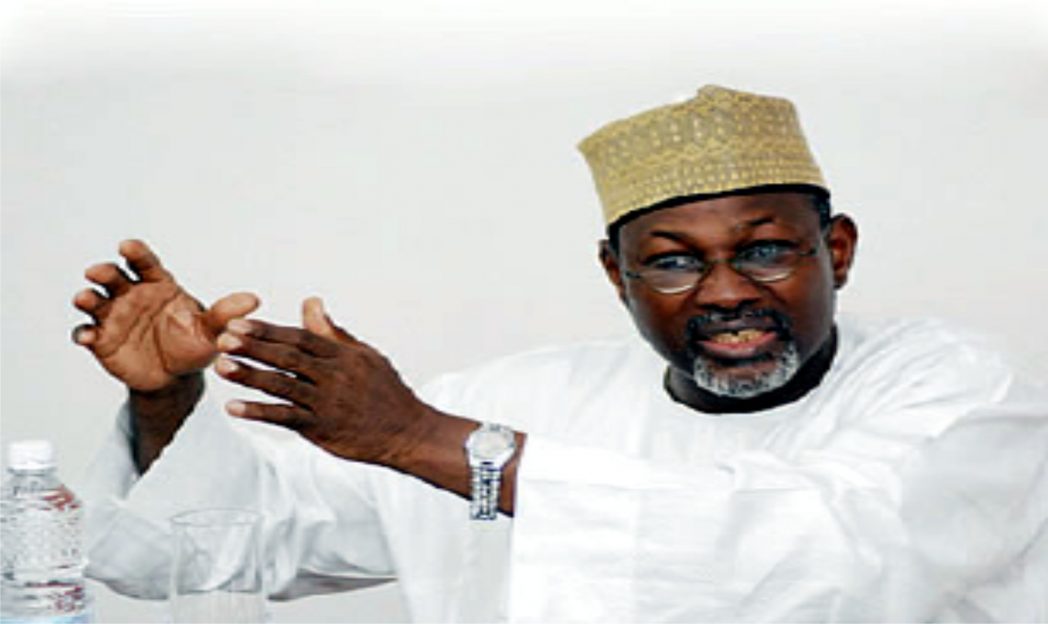
Prof Jega