Front Pix
2015: Task Before Parties …Beyond Foul Language, Bad Blouthing

With just months to the 2015 general elections, there still remains a huge gulf between what the parties have in stock for the voting public and what they hope to address. if elected.
Instead, the political climate has been avoidably charged with inflammatory remarks, vain criticism and sometimes highly personalised bad-mouthing.
In the past many months, virtually every issue of national concern has been politicised with hardly any room for a consensus. From the growing insurgency, to the fluctuating fortunes of the nation’s economy, what Nigerians have so far heard and seen are name-calling and blames.
In fact, no day passes without one leader or another from the dominant political parties questioning the other’s patriotism, sincerity of purpose and indeed competence to tackle a problem without any effort to tell Nigerian how differently they hope to tackle the nation’s many maladies.
Now, perhaps is time to tell the parties and their leaders what Nigerians want to know, hear and accept as facts necessary to turn things around for the better. In the case of the ruling party, we expect to know what they hope to sustain and what they hope to do differently if re-elected, while the opposing parties should tell Nigerians how they hope to address the issues, which they consider disturbing.
Let’s consider some of the defining issues in next year’s elections.
State of Insecurity
From a ‘bomb, kill and die’ terrorist’s style insurgency, the Boko Haram has grown to become a full-fledged army with an expansionist tendency. They are now intent on not only wasting human lives but also bent on annexing Nigerian territories, hoist flags and even rename won-territories.
The ruling party says it is equipping the Nigerian troops and forming transnational coalitions to combat the terrorists, knowing that the Boko Haram group moves from one country to another. Army Chief Godwin Minimah also said efforts were made to boost the morale of troops and that they are better equipped and more nationalist-minded to confront the enemy.
Minimah listed troops’ victories in Damaturu, Mubi, Kutiga among others as a reflection of the new spirit of combat-readiness, and involving the civilian populace.
We expect other parties to say what they hope to do differently and more effectively to end the insurgency once and for all.
They should get to the root of the problem and state for sure, what informed the insurgency and how they hope to end it finally.
Falling Price of Crude Oil
From well over 100 dollar per barrel last year, the price of crude is heading far lower than 70 dollar per barrel. For this reason, Federal Ministry of Finance sources are requesting to peg the benchmark for crude at N65 dollars, in the 2015 budget.
With Nigeria’s near total dependence on oil, with no reasonable investment in refining and producing by-products from crude, the global fall in the price of crude is easily felt here in Nigeria than elsewhere.
In announcing what seems fresh austerity measures, the Minister of Finance and Co-ordinating Minister of the Economy Dr. Ngozi Okonjo-Iweala last week said, the ruling government plans to eliminate wastes in government, avoid duplications, and plug all loop holes of drain, while, announcing welfare measures for the most vulnerable lot of the societal chain-like pregnant women, children and the aged.
Are these measures enough? When some states cannot even pay workers’ salaries as at when due or pay at all. When infrastructural development in some states have been halted on account of poor proceeds?
What will other parties do differently to ensure that falling price of crude does not define our national growth and progress. Specifically, what will the parties do in the short, middle and long terms to re-jig the nation’s economy?
Poverty and illiteracy Eradication
In spite of favourable comments by globally renowned financial experts about the positive health of the Nigerian economy and the amount of foreign investments it attracted recently, poverty and illiteracy remain a serious issue.
Available statistics show that more than 60 percent of the Nigerian population are illiterate and live below the poverty level.
What will the parties do to address this issue, beyond occasional provision of rice, beans, wrappers and other provisions for selected women? Nigerians expect a programme that identifies the most vulnerable, more vulnerable and vulnerable groups, list their various needs and articulate measures that would frontally address peculiarities of each group.
More importantly, Nigerians expect an economic management style which success can be measured by the impact it makes on the many poor.
Graduate Unemployment
Nothing can be more frustrating to indigent parents than borrowing fortunes to see their children and wards through University education only for such graduates to remain liabilities to the same families that expect them to be bread-winners.
The ruling government claims it has provided more than three million jobs and nearly 30 million in the informal sector through special programmes.
Nigerians will like to know what other political parties will do differently that will bring the country back to the years when even school certificate holders were sought after for job placements.
Nigerians want to know what special programmes will be put in place to address the problem in the short, medium and long terms.
Industralisation
Years ago, industries formed the bulk of employers of labour and helped to reduce the people’s appetite for foreign goods. Over time largely due to the oil boom, investments in industries became less profitable while key players blamed the nose dire on challenges ranging from poor infrastructure and cost of raw materials.
The situation got to a point when many government-owned companies closed down after huge public investments. With some of such enterprises now privatized, not much has come by way of employment creation.
Nigerians would like to know the political partys’ programmes on industrialization and manufacturing what plans, if there are, should be expected to encourage a revolution in the industrial and manufacturing sector.
Health and Education
One of the principal responsibilities any government owes the people are functional health and basic education. Is the state of Health and Education, today what it should be? Or can it be better?
We expect political parties to tell Nigerians what plans they have to better both sectors. Most importantly, what plans they have to address the abysmal failures in the West African School Certificate Examinations (WASCE) and the Joint Admission Matriculation Board (JAMB) examinations.
Failure to get admission into a university, fresh from post-primary school, is a major National problem. This is because, the age-bracket of such children makes them most vulnerable and to not be engaged for a full year, waiting to re-write same exams can be very frustrating.
Therefore, what plan can be put in place to reduce, if not eliminate failures in those examinations and ensure university education for the children?
The Niger Delta Question
Even with the falling oil prices, the country still relies on proceeds from oil sourced from the oil producing Niger Delta. The protest and later militancy which erupted in the area, during the Yar’Adua Presidency resulted in the amnesty programme and creation of the Niger Delta Ministry. But what positive changes are there to ensure non-resurgence of militancy in the Niger Delta?
Being the main provider of foreign revenue, the Niger Delta still occupies a vital fulcrum of our national survival.
So, what plans do political parties have for the zone, beyond oil? Will the Niger Delta be abandoned when oil finally dries up? What plans are there to give the area some measure of hope in years beyond oil and gas?
My Agony is that the elections are barely months away, yet all, Nigerians have witnessed are abuses, bad mouthing, campaigns of calumny and hate messages. That is not what Nigerians deserve.
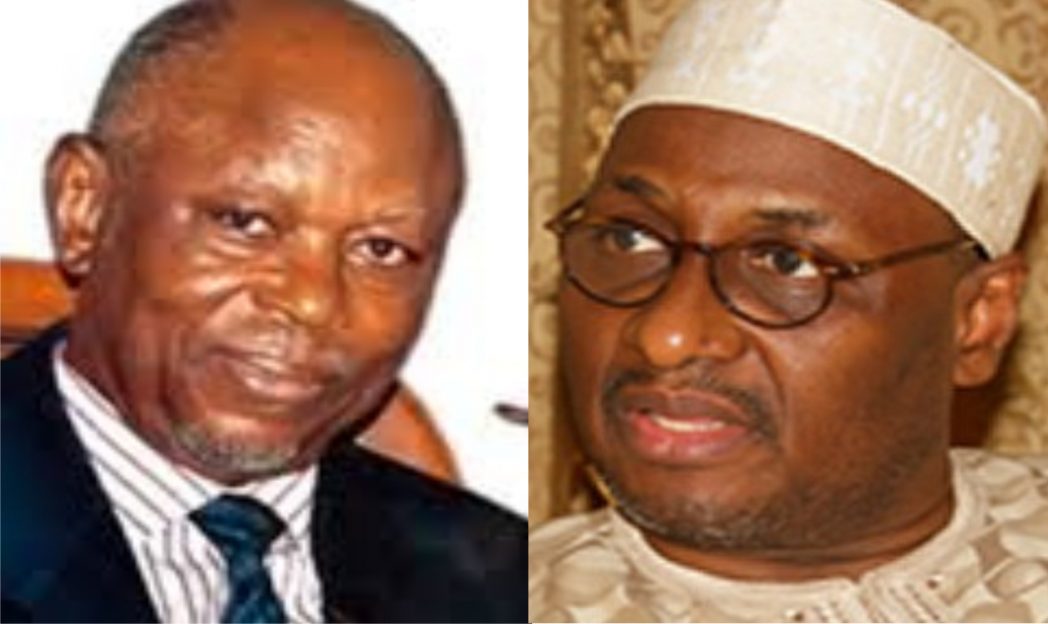
John Oyegun, APC National Chairman and Adamu Mu’azu, PDP National Chairman