Features
Making Nigerian Roads Motorable

Nigerians, since the
return of democratic rule in 1999, have been clamouring for sustained delivery of democracy dividends.
Their argument is that it is only if democratic rule positively touches the lives of majority of the citizens that the struggle can be regarded as fruitful.
This, perhaps, underscores the decision of the President Goodluck Jonathan’s administration to accord priority to the provision of motorable road network as a way of positively touching the lives of ordinary Nigerians.
Jonathan said that his emphasis on road infrastructure was based on the belief that a good and well-maintained road network was the bedrock of an efficient economy.
The president who declared open the 1st Africa Regional Congress meeting of the International Road Federation, held recently in Abuja, reiterated the commitment of his administration to the provision of motorable roads across the country.
“This administration has embarked on an ambitious programme to restore and modernise the country’s road network. This we are achieving through enhanced government investment as well as participation of the private sector and multi-lateral development institutions.
We are also putting in place best practices to drive Public-Private sector Partnership (PPP) in road sector development and all other areas.
Our overall aim is to provide better and safer roads for Nigerians, as well as enhance socio-economic development,” the president said.
He said that the gains of improved and sustained government investment in the road sector were manifesting nationwide.
The president urged the congress to discuss how to address the challenges hindering the full development of the road sector, especially in Africa.
“Government policy makers and other road sector stakeholders in member-countries will look forward to the outcome and resolution of your congress as a credible guide in moving the sector forward.
“I am confident that you shall meet these high expectations,” Jonathan added.
He noted that the critical Trans-African Road Projects, such as the Lagos-Algiers; Lagos-Abidjan-Dakar and the Mombasa roads were at various stages of implementation, under the auspices of the Programme for Infrastructure Development in Africa.
Jonathan commended the federation for its advocacy and for influencing policy formulation in member-countries over the years.
Appreciating the giant strides achieved by the administration in the road sector so far, the President ofthe International Road Federation, Mr Patrick Sankey, praised the Federal Government on its road transformation efforts.
He stated that the federation would continue to partner all its member-countries in the development of their road network.
The Minister of Works, Mr Mike Onolememen, said the congress had delegates from at least 17 countries, including U.S., Belgium, Canada, Germany, UK, UAE, Libya, India, and South Africa.
Other countries represented at the conference were Tanzania, Sudan, Uganda, Mali, Zambia, Cameroun and Burkina Faso.
To further justify the huge investment in the road sector, Onolememen said that the Jonathan’s administration was determined to increase the length of federal roads from about 52 per cent (17,742km) to over 83 per cent (28,320km).
Available records showed that the administration had so far completed numerous road projects while others were at various stages of completion.
Notable among such projects are the reconstruction of Mokwa-Bida, Akure-Ilesha, Sokoto-Tambuwal-Jega, Enugu-Abakiliki and Vandekiya-Obudu.
Others are Onitsha-Enugu, Lokoja-Benin, Abuja-Minna , Lagos-Ibadan Expressway, Apapa-Oshodi Expressway, Benin-Shagamu, Enugu-Port Harcourt Expressway, and Kano-Maiduguri dual carriage way.
It is also on record that work is also in progress on the Abuja-Abaji-Lokoja road while the Onitsha-Owerri and Vom-Manchok roads have been completed by the Jonathan administration.
Records also showed that the rehabilitation of Yola-Numan road in Adamawa, Gombe Bye-pass in Gombe State, Kaduna Refinery road in Kaduna State, Kano-Daura-Mai Adua road in Katsina State, Aba-Owerri road in Imo, and Oyo-Ogbomosho road in Oyo State had been completed.
Statistics from the Federal Minsitry of Works also revealed that the administration had so far constructed a total of2,000 kilometres of road as at the end of2013, and also awarded contracts for the construction of bridges.
One ofthe bridges is the 1.9 km Loko-Oweto Bridge, linking Nasarawa and Benue states.
Retired Gen. Martin-Luther Agwai, Chairman of the Subsidy Reinvestment and Empowerment Programme (SURE-P), who inspected the Loko-Oweto Bridge project funded by SURE-P, expressed satisfaction at the progress of work.
Agwai said that the SURE-P committee was satisfied with the work done by the contractor, and noted that what was on ground was commensurate with the funds that had so far been released for the job.
“If you expect anything, you must inspect and closely monitor the progress of work that you have given out; that is what we are doing today.
“We have been signing billions of naira for this project and today 1 decided to pay a visit to the site and see what some of the SURE-P committee members have been monitoring.
“I must say that 1 am satisfied with what 1 have seen so far; the contractor has done well and 1 think it is worth the monies that we have released so far for this project,” he said.
Agwai said that SURE-P’s intervention in the Loko-Oweto project was one of the gains of the current administration’s policy on partial removal of subsidy in the petroleum downstream.
Agwai said that the project could be completed by mid 2015 if the contractor sustained the pace of work on the project.
He said that the work already done on the site had justified the 40 per cent payment already made to the contractor.
Expressing confidence the project would be completed on schedule, the Director of Bridges in the Federal Ministry of Works, Mr Anietie Effiong, said 57 per cent ofthe work had been completed.
He said that SURE-P had released N17 billion out of the N36 billion contract sum to the contractor from 2012 to date.
Sharing similar sentiments, Mr Hassan Loko, the Community
Sani Adamu
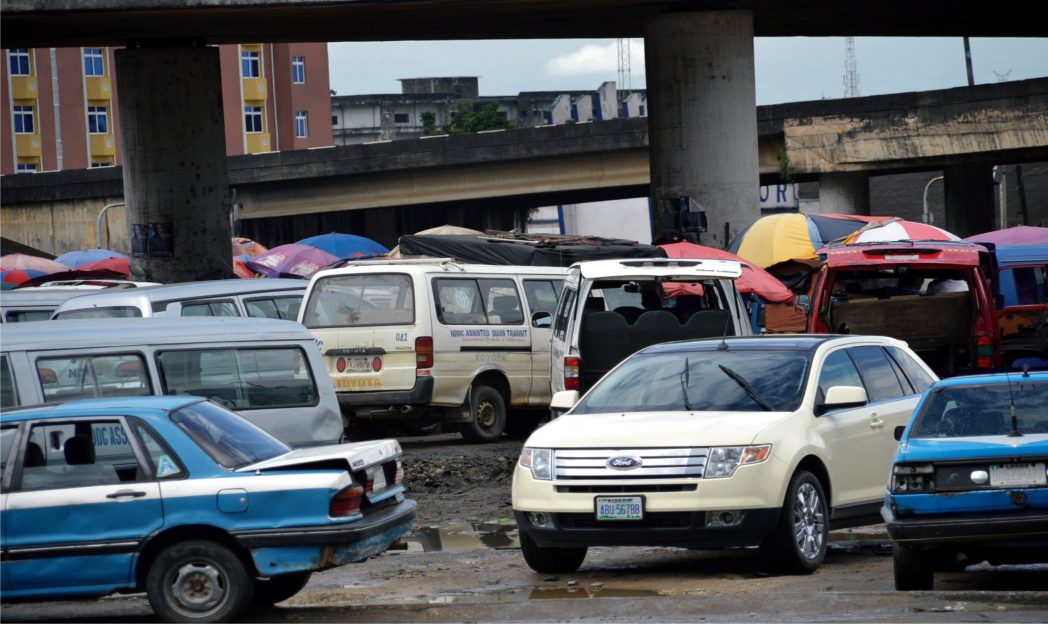
Vehicles Parked at a bus station in Port Harcourt