Features
How Skills Centres Fight Youth Unemployment

In their determination to
checkmate the ever growing labour market, states have turned to skills acquisition centres as a way of creating jobs and fighting youth unemployment, a recent survey has shown.
Survey across the nation showed that thousands of youths have been engaged in one form of trade or the other after completing their training at the various skills acquisition centres set up by the states and some organisations.
In Rivers State, the Director, Youth Enterpise Development and Promotions, in the State Ministry of Youth Development and Employment, Mr. Pene Dimkpa said the state was prepared to fight unemployment.
He said the measure would assist the government to realise its objective of creating employment in line with its transformation programme tagged “Change We Can See”.
The director said “aside from Iriebe Rehabilitation Centre and Rivers Skills Acquisition Development Centre, government established others in the 23 Local government areas”.
Dimkpa said that the centres had trained many youths in the state in various skills.
“The Iriebe Rehabilitation Centre is for general skill acquisitions such as computer, catering, tailoring, carpentry, bead making among others and was established under the administration of Governor Peter Odili.
“I may not ascertain the actual figure of people graduating but we graduate an estimate of 115 youths in a month,” he said.
“On the duration, some training last either three or six months depending on the skills, “we do not give loan or any grant but over 60 per cent of the trainees make the best use of what they have learnt,”, he said.
“We always advertise on radio for those living in the city for registration but for those living in thr rural areas, we send application forms direct to them through the youth officer.
“The youth officer will mobilise the youths and educate them on the benefits,” he said.
In Jigawa, the commissioner for Economic Empowerment, Alhaji Rabui Isah said 2,310 youths had also been trained by various sponsors, especially the political office holders in the state.
The commissioner added that the beneficiaries were trained at the skills centres at Hadejia, Gumel, Dutse, Birnin Kudu, Ringim and Kazaure.
The apprentices were trained in tailoring, welding and fabrication, leather works and shoe making, tie and dye, brick making, auto mechanic as well as electrical engineering.
“The sum of N35 .6 million was also disbursed as soft loans to 4,366 of the trainees through micro finance banks to enable them to set up their businesses,” he said.
According to him, the trainees were encouraged to form a cooperative society to enable them to access loans and other facilities.
In Ondo State, the government, in conjunction with the National Directorate of Employment (NDE) established 27 centres in different parts of the state.
The Commissioner for Employment and Productivity, Mr Taye Akinleye,said 50 people, including 30 graduates, had just concluded training as bakers in a pilot scheme in the Akure South Local Government Area.
He said the 18 local governments had been directed to train 100 people each to reduce unemployment in the state.
He said the ministry employed 473 graduates of various trades to work in different government departments in the state.
“Some are working as traffic and crowd control corps, tree planters, market managers, street sweepers, bus drivers, conductors and others,” he said.
The coordinator of the National Directorate of Employment, (NDE), Mr Olaitan Olayinka, said the directorate had begun training 450 people in the three senatorial districts of the state.
Olayinka said the centres were located in Akure, Ondo Central, Ilutitun and Ogbagi-Akoko.
According to Olayinka, each of the centres has 10 classes of trades with 15 trainees in each class.
Olayinka said the trades included computer, cell phone repairs, radio/TV, electrical installation, interior decoration, catering, hairdressing, welding, plumbing and making of cane furniture.
He said the programme was being funded by the Debt Relief Fund (DRF) for the Millennium Development Goal (MDGs), stressing that there were other training programmes that had engaged graduates.
The coordinator said the program had a study duration of six months and that it would run twice a year with a stipend of N5,000 for each trainee.
The coordinator said the National Open Apprenticeship Scheme, which had been divided into basic and advanced programmes, were still being operated in the state.
“The Rural Employment Promotion Department recruited 80 graduates and non-graduates for training on both livestock and arable farming for a period of four months at our agriculture centre at Mariwo in Ifedore Local Government Area,’’Olayinka said.
According to him, the directorate acquired five hectares of land for farming.
“This year we have embarked on different employment programmes that engaged 100 graduates and 590 non-graduates mostly in agricultural skills in the state,’’ he said.
In Kaduna State, more than 6,000 youths have been trained in various skills during the year as part of efforts to empower the youths to be self reliant.
More than 4,800 are currently being trained under the Subsidy Reinvestment Programme (SURE-P) while the rest are receiving training at the 23 Business Apprenticeship Training Centres in the state.
Governor Patrick Yakowa said in Kaduna through his deputy, Alhaji Mukhtar Yero, that the aim was to empower the youth and reduce poverty.
Yakowa said this when the beneficiaries of the programme paid him a courtesy visit.
According to him, 2,300 youths and 1,500 women are benefiting from the programme.
Similarly, more than 1,500 unemployed persons have been receiving training annually in the last four years at the 23 centres.
The Director, Technology, Ministry for Science and Technology, Mr Ishaku Daniel, told our correspondent in Kaduna that the centres were established about 40 years ago to offer skills to the youths.
The participants are trained in carpentry, auto repair, electrical installations, welding and fabrication, building and masonry, plumbing and pipe fittings.
The director said the participants were made to undergo a three-year training programme involving theory, practical work and industrial attachment.
Daniel said many of the trainees had been engaged by companies and agencies, including the NNPC, Peugeot Automobile Nigeria Ltd., the military and the state water board.
“A lot of them have however, established their own businesses and are doing very well.
One of the beneficiaries of the programme, Garba Igabi, told our correspodent that he graduated from the centre in 1987 and now had four welding shops in Kaduna.
Igabi said the workshops were located in Igabi, Sabon Kawo, Mando and Hayin Banki, adding that he had 40 apprentices and workers in the workshops.
He decried the epileptic electricity supply in the state, adding that it was affecting the business.
“ Inadequate power supply has forced us to resort to the use of diesel, which currently is very expensive, thereby contributing to high cost of production.”
Malam Hassan Abdulazeez, an instructor and former trainee of the centre, called on government and individuals to patronise or employ the services of the trainees.
Also, Mr Francis Ambi-Anto, Centre Manager of the National Directorate for Employment (NDE) in Kachia Zone, said the directorate had trained 450 unemployed youths and women in the state.
He said the training was in the area of computer repair, electrical and satellite installation, GSM phone repairs, welding, decoration, fashion design, hairdressing and wood work.
The spokesman of the board, Malam Aliyu Yakasai, told correspondent that those trained in the Kafanchan and Kaduna Centres were issued with tools to set up their businesses.
The survey showed that 10,044 youths had been trained in various skills under the newly established Adamawa Local Apprenticeship Scheme in 2011.
The Project Manager, Alhaji Sani Jada, said additional 12,400 were undergoing training this year.
Under the scheme, unskilled youths who registered were trained from three months to two years in any of the 24 trades of their choice.
The trades include tailoring, hairdressing, GSM phone repairs, welding, auto mechanic, baking, masonry, plumbing and electrical/electronic repairs.
He said at the end of training, graduates were provided with free kit and equipment required to set up their businesses.
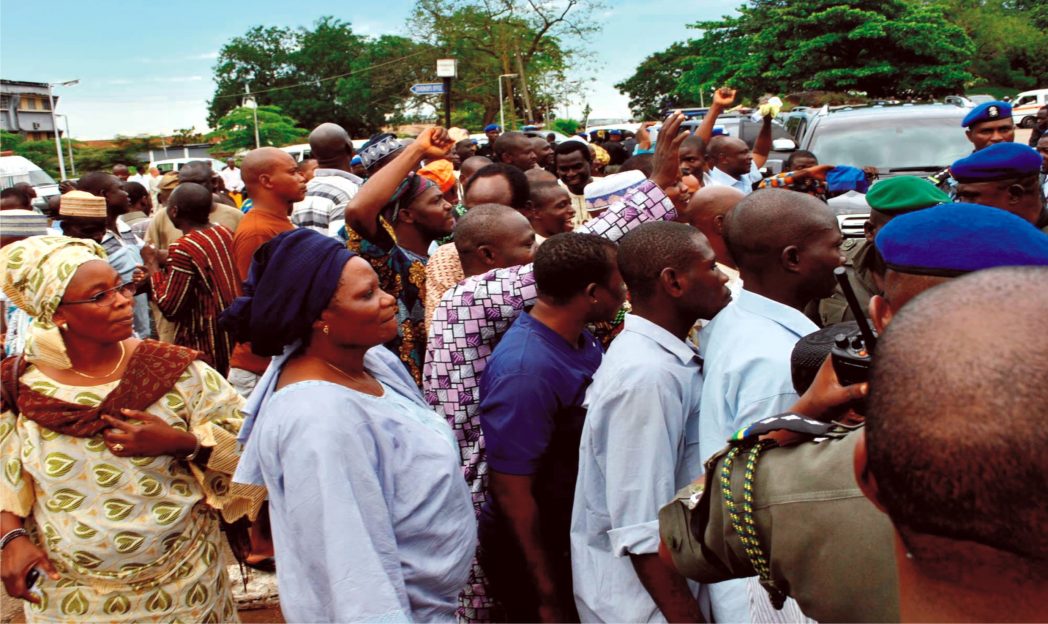
Youths awaiting empowerment