Ict/Telecom
‘BTS Meant To Foster Socio-Economic Development’

The Minister of Communi
cations Technology, Mrs Omobola Johnson, says the Base Transceiver Stations (BTS) built across the country are meant to foster an enabling technological environment for socio-economic development.
Johnson told newsmen in an interview on Tuesday in Abuja that the project was executed with subsidies provided by the Universal Service Provision Fund (USPF).
“The Federal Government of Nigeria established the USPF to facilitate extension of telecommunications services to underserved and unserved communities.
“The law establishing the USPF which is the Nigerian Communications Act (NCA) of 2003, empowers it to promote widespread availability and usage of network services throughout Nigeria.
“It does this by encouraging the installation of network facilities and the provision of network services to institutions and to unserved and underserved areas and groups in Nigeria,’’ Johnson said.
She also disclosed that the USPF was initiating various programmes and projects to facilitate the deployment of ICT infrastructure and services. The minister said this was designed to extend ICT and other telecommunication services to people living in rural areas where operators were unlikely to provide services.
“One of the programmes designed by the USPF to extend telecommunications services is Accelerated Mobile Phone Expansion (AMPE) programme which ensures the extension of mobile telephony services to unserved and underserved communities.
“The AMPE Programme is implemented in collaboration with Network Operators.
“BTS is one project under the AMPE which the USPF provides subsidies to operators to extend telecommunications services to unserved communities,’’ Johnson said.
Johnson disclosed that the Federal Government, as part of the transformation agenda, would not lose focus on an estimated 40 million Nigerians that still lacked access to ICT services.
She said that in order to address the ICT needs of the rural populace, the USPF had based on a Geographical Information System (GIS) study, created ICT Gap Clusters of areas that were unserved or underserved.
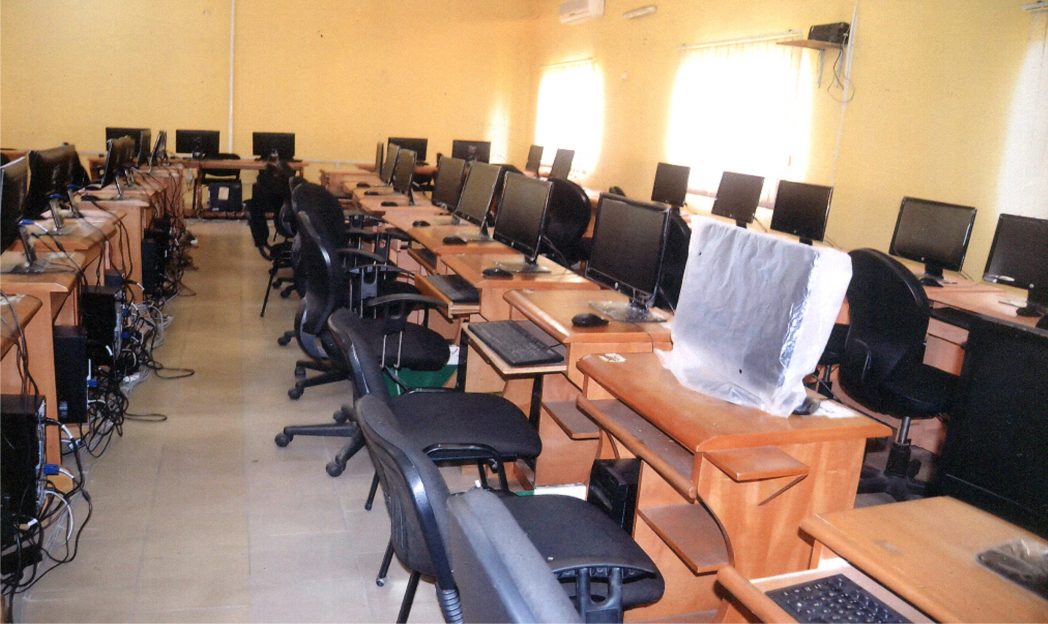
The Computer section of Rivers State University of Science and Technology, Port Harcourt. Photo: Chris Monyanaga