Front Pix
Common Ground, So Elusive …Of Parties’Mudslinging, Bad Mouthing

One of the best attributes of a responsible political party is its ability to properly educate the citizenry on alternative ways of solving national problems. While the party in power may rationalize its actions and claim successes in various sectors, the opposing party or parties must tirelessly find better alternatives to burning issues they believe are not properly addressed by government.
In this regard, parties can disagree without necessarily being disagreeable. They can criticize constructively without necessarily employing foul language and campaigns of calumny. More importantly, they must be reasonable enough to achieve common ground on areas of national interest, particularly security and Health.
But the ever increasing bitterness demonstrated by political parties in Nigeria today makes such compromise most elusive. Infact, even well-known national achievements are underminded for political reasons while no serious thought is given to the dire consequences of a possible collapse of national security. To some politicians, everything is politics and whatever it takes to pull the other down, is okay.
Two instances will tell the story better.
One is the successful containment of the deadly Ebola Virus Disease (EVD) and the other, is the killing or non-killing of the Head of the terrorist group, Boko Haram, simply called Abubakar Shekau. Both issues ought to test the level of the average politician’s love for country, membership of different political parties, regardless.
On October 3, 2014, media reports had it that with the last patient under surveillance for Ebola completing the mandatory 21-day monitoring period, October 2nd, 2014, the United States centre for Disease Control and Prevention (CDC) had said that Nigeria should be declared Ebola Virus Disease (EVD) free.
A report on Nigeria’s response to the outbreak, which appeared in a September 30 early release issue of the CDC’s Morbidity and Mortality Weekly Report (MMWR), noted that Nigeria’s success story was due to her strong emergency operations centre and Polio eradication experience.
According the report, “…There have been no new cases since August 31 and the last three patient contacts will exit their 21-day follow-up on October 2 – strongly suggesting that the out-break in Nigeria has been contained”.
The report said Nigeria’s decision to use the emergency operations’ centre to respond to the Ebola outbreak resulted in a repid, effective and coordinated response.
The CDC’s Morbidity and Mortality Weekly Report (MMWR) further described how Nigeria contained the virus. It reads: “The Ebola outbreak in Nigeria appears nearing a possible end due to a rapid response coordinated by Nigeria’s Emergency Operations Centre with assistance from international partners, including the Centre for Disease Control and Prevention.
The official end to Ebola outbreak comes when two of the 21-day incubation periods for the Ebola Virus have elapsed without any new case.
“During the outbreak, there were 19 laboratory confirmed and one probable Ebola cases in two Nigerian States ( -Lagos and Rivers) Nearly 900 patient contacts were identified and followed; all but three have completed 21 days follow up period without Ebola Symptoms.
“There have been no new case since August 31, and the last three patient contacts will exit the 21-day follow-up on October 2, strongly suggesting the outbreak in Nigeria has been contained”.It further said.
The report gave credit to Nigeria not the Peoples Democratic Party (PDP), the All Progressives Congress (APC) or any other, party, for that matter. Infact, the Ebola containment success was one of the most positive reports on the country and should have united the political class in love for country.
The success was, without doubt, a result of positive coordination and collaboration between the Federal Ministry of Health and those of the affected states, Infact, on a near daily basis, the Ministers of Health and Information briefed the media of challenges and successes and treated the Ebola outbreak as a national emergency.
On a non-partisan basis, the PDP-controlled Federal government and the APC-controlled governments of Lagos and Rivers collaborated effectively with additional financial support from the centre to the affected states.
It was, for once, the actualization of the most elusive common ground in addressing national issues, as professionals from the affected parties left behind their differences to fight a common course.
In the end, the credit goes to both the Federal and affected state governments. It was indeed a victory for Nigeria. But as President and Commander-In-Chief on whose shoulders lies success or failure of the country rests, Dr. Goodluck Jonathan did not err by claiming the country’s success, just as he would have been blamed for failure.
That is why it is hard to farthom how such claim should generate bad mouthing by opposition politicians.
Infact, the image-maker of APC, Lai Mohammed faulted President Jonathan on grounds that he was claiming the success recorded by APC – controlled states, while at the same time conceding the proactive steps of the Health Minister, Dr. Onyebuchi Chukwu, describing them as unlike the PDP-led Federal Government’s.
In the same vein, when the Rivers State government announced the first case of Ebola, through the state’s Health Commissioner, Dr. Sampson Parker, the State PDP described the announcement as political Ebola. They went to the extent of accusing the state government of concocting the news only to dissuade would-be participants of the Transformation Ambassadors of Nigeria (TAN) rally billed for the State capital.
If the citizenry had believed the PDP position, containment of the EVD in Rivers state would have been most challenging. All in the name of politics.
Another issue is the killing or otherwise of the Boko Haram main master-mind Abubakar Shekau. In late September, this year, the Director of Defence Information Maj. Gen. Chris Olukolade said during a news conference in Abuja that Shekau had been killed and the body of the insurgents’ leader was identified by the people of Kodunga.
Olukolade illustrated the Defence Authority’s claim with pictures of the bullet-ridden body with Shekau’s semblance and a video of the battle in which he was killed. He said Shekau whose real name was Mohammed Bashir had used other names like Abacha Abdullahi Geidam and Damasack.
The Nigerian Military had in the previous week, said that Shekau had long been killed and that a man who had been posing as the group’s leader in the videos had also been killed after fighting with troops in far North East.
That message came with a measured skepticism to the heavily politicised media.
But as soon as a video clip emerged from only God knew where, ostensibly by the ‘late’ Shekau, saying that ‘he was alive’, the media that did not see the Shekau directly during the shooting of the said video, screamed in headline after headline: Shekau Still Alive, while some said, Shekau says He’s Alive.
How sure are they that Shekau indeed said so, since there was no indication of where or when the 36-minute video was shot. But it showed either Shekau or his look-alike in combat fatigues and black rubber boots, standing on the back of a pick-up truck and firing an anti-aircraft gun into the air.
Standing in front of three camouflaged vans and flanked by four heavily armed, masked fighters, he then speaks for 16 minutes in Arabic and the Hausa language, claiming, “Nothing will kill me until my days are over … I’m still alive. Some people asked you if Shekau has two souls. No, I have one soul, by Allah, “he said, apparently reading from a script.
A press briefing by the Nigeria Military which showed a dead Shekau and his double along with video of the battle ground where he was killed, and video clip posted round the world by insurgents without verifiable venue, which is believable?
But in the name of politics, many are prepared to believe that Shekau is still alive and that the Nigeria Military lied when they claimed to have killed the insurgents’ leader. For the opposition, to accept that Shekau is dead, may well be a plus to the ruling government therefore, he is better alive:
The question is, in whose interest is a Boko Haram victory over Nigeria? Or whose loss should it be, if Nigerian troops lose the battle to Boko Haram? It will instead be a national pain and loss. There is no guarantee that the non-election of anybody would automatically wipe away Boko Haram. Far from it.
This is why the political class must understand and define issues that ought to rise above usual politicking – National Security is one such.
They must avoid comments and actions that tend to demoralize troops who left their families behind to fight for the nation. That Nigerians may know peace.
What such troops deserve is our unalloyed support, solidarity and prayers and not utterances that inadvertently demoralize them, all in the name of politics.
My Agony is that the political class still does not seem to appreciate the fact that Nigerians are getting wiser and with the entrance of a new crop of young, educated voter-population, some of their faniliar vituperations would count against themselves and not sway voters. Methinks, the political parties need to do a lot more in articulating viable solutions to existing national problems and avoid personalizing their campaigns and badmouthing individuals just for criticism sake.
Soye Wilson Jamabo
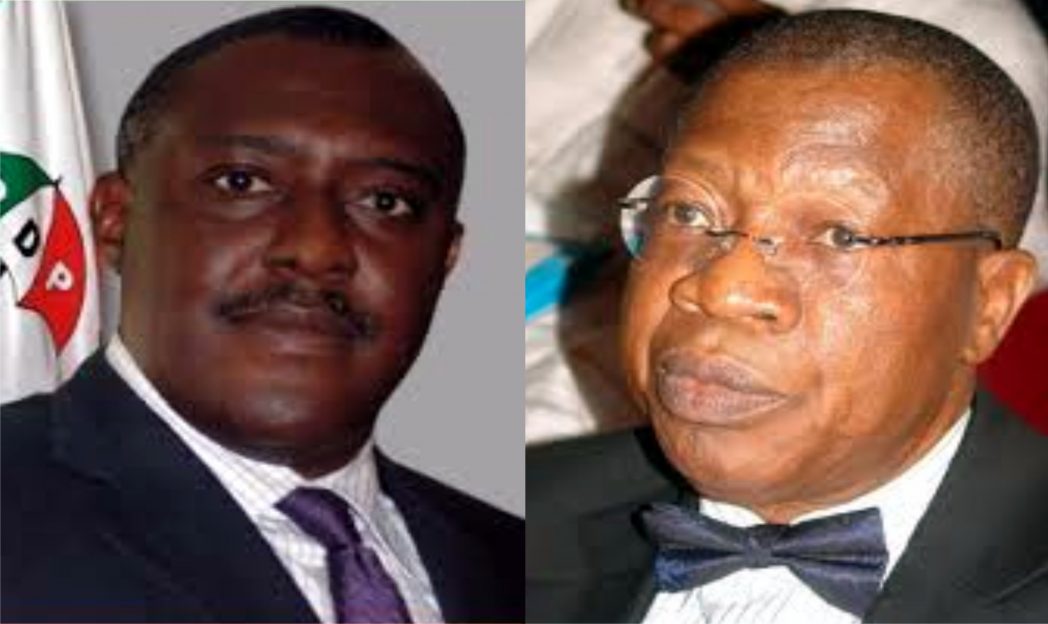
Olisa Metuh and Lai Mohammed