Features
Of Pipeline Vandalisation And Oil Spill

The negative impact
of oil spills on the environment is well known, and has been with Nigerian oil producing communities since the commencement of exploitation of oil in commercial quantities in Oloibiri, Bayelsa.
Bayelsa, which hosts the first oil well drilled by Shell Petroleum Development Company (SPDC) from 1956, also hosts the operations of Nigeria Agip Oil Company (NAOC), Chevron Nigeria Limited, in both onshore and offshore locations.
Stakeholders agree that oil spills are integral part of oil exploration and production, and that it is imperative to keep the spills within acceptable limits.
Director General, National Oil Spills Detection and Response Agency (NOSDRA), Mr Peter Idabor,said during a recent visit to oil spill sites in Bayelsa, that the state had the highest frequency of oil spills in the Niger Delta.
According to Idabor, Bayelsa records an average of 40 oil spill incidents every month.
Governor Seriake Dickson of Bayelsa, who decried the high incidents of oil spills in the state, called for stiffer laws to protect the environment.
Dickson, who spoke during a visit by officials of NOSDRA, said that the adverse health implications arising from environmental pollution required scientific studies to quantify the magnitude of the problems facing the people.
“When you look at all of these and particularly spill statistics, which I believe is only a tip of the iceberg; one is really left with no other conclusion than to say that we are actually facing a case of environmental terrorism.
“What has been going on in the Niger Delta since the discovery of oil is a situation where more than one spill takes place in Bayelsa every day going by what NOSDRA’s statistics is telling us, and all these sites are treated with reckless abandon.
“The environment is left to fend for itself; the livelihood and in fact the lives of the people and the ecosystem are not attended to. What then is more of terrorist action than this?”
However, an oil services expert; Mr Jame Ekio faulted the scenario created by the governor, noting that heaping the blames on the doorsteps of the oil companies was unfair.
“The three tiers of government are the greatest beneficiaries of oil revenues; remember the government holds majority stake of 60 per cent, while the oil companies own 40 per cent or less.
“The oil producing states get a derivation fund of 13 per cent of the volume of oil produced from its territory.
“What stops them from using part of the proceeds from oil to remediate and protect the areas, rather than use oil funds to develop the oil communities, they channel such funds into fancy projects restricted to the state capitals to the detriment of the oil bearing areas,” he said.
SPDC, one of the dominant operators in Bayelsa, blamed vandals for incessant spills, adding that more than 80 per cent of spill incidents within its operations were traceable to sabotage by third parties.
SPDC’s spokesman, Mr Joseph Obari says that the Okordia-Ikarama area in Bayelsa is a hotbed of pipeline sabotage activities.
Obari regretted that even the few reported cases of spills caused by equipment failure were remotely linked to sabotage as such spots were often compromised previously by vandals.
According to him, the oil firm is committed to prompt clean up and remediation of spill impacted sites within its operations irrespective of the cause of the spill.
“The perpetrators’ personal gains are the driving force of the illegal activities; a total of21 spills have been recorded in the area between 2009 and now.
“Of the number, 17 were due to deliberate cutting of SPDC pipelines and manifold. The four spills caused by equipment failure 0ccured at previously clamped sabotage points, already weakened by repeated cuts.
“SPDC Oil Spill Response and Remediation team is currently cleaning up the site of a spill that occurred in January 2014, and remediation of the 2013 spill sites that could not be remediated because oflast year’s flood in the area,” Obari stated.
Ikarama, an oil rich community in Yenagoa Local Government Area also hosts oil fields operated by NAOC.
Paramount Ruler of Ikarama, Chief Daniel Franco regretted that efforts to combat the frequent spills in the community were yielding limited results as the oil firms worked at ososs purposes The incessant spills from Agip’s oil fields in Bayelsa compelled the House of Representatives to order a probe into the operations of the company.
The House of Representatives Committee on Environment, headed by Mrs Uche Ekwunife is expected to commence investigations soon.
An environmentalist, Mr Alagoa Morris said the committee should hold an all inclusive investigation involving the government, oil firms, environmentalists, oil communities and media in order to find an enduring solution to frequent spills in Bayelsa.
While oil communities see spills as damage to the environment and an opportunity to agitate for compensation, applicable legislation absolves operators from paying compensation when the cause is sabotage or third party interference.
Stakeholders want the government to upscale enlightenment campaigns on the dangers of pipeline vandalism and other acts capable of causing oil spills.
Nwakamma writes for News Agency of Nigeria.
Nathan Nwakamma
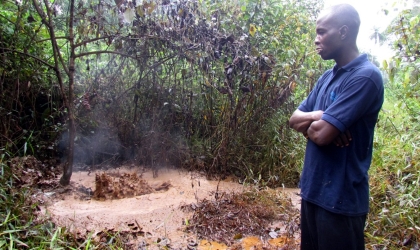
A youth leader in Kalaba community, Mr Samuel Oburo, at the oil spill site within an oil field in Kalaba community, Yenagoa Local Government Area of Bayelsa State, recently.