News
Suspension: Court Declines To Hear Sanusi’s Suit

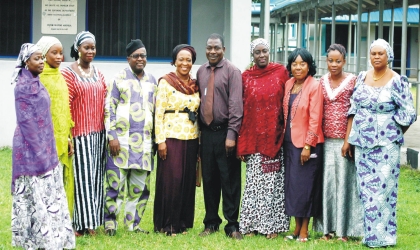
Newly elected President of Nigerian Association of Women Journalists (NAWOJ), Mrs Ifeyinwa Omowole (5th left), and the executive officers, during their visit to News Agency of Nigeria in Lagos, yesterday
A Federal High Court in Abuja yesterday ruled that it lacked jurisdiction to entertain a suit filed by Mallam Lamido Sanusi challenging his suspension as the governor of Central Bank of Nigeria, by President Goodluck Jonathan on February 20.
Justice Gabriel Kolawole held in his judgment that the matter was labour and employment-related, and therefore ordered it to be transferred to the National Industrial Court.
The judge also said the plaintiff was at liberty to challenge his decision at the Court of Appeal.
He added that he deliberately refrained from deciding the case on its merit so as not to make any prejudicial pronouncements before the matter gets to the Industrial Court.
The judge held that, in line with Sections 251(1) and 254(c) of the 1999 Constitution of the Federal Republic of Nigeria, the proper court, where Sanusi ought to have instituted the suit, was the NIC.
Sanusi had through his counsel, Mr. Kola Awodein (SAN), sued Jonathan and the Attorney-General of the Federation and the police, asking the court to declare his suspension by the president null and void.
But the court upheld the objection of the president and the AGF to the suit, declaring that the court lacked jurisdiction to hear the suit.
Sanusi’s tenure as the CBN governor expires on June 1.
It would be recalled that Justice Gabriel Kolawole, had on April 8 fixed the judgment day after hearing arguments of parties on both Sanusi’s suit and the respondents’ notice of preliminary objection.
The judge yesterday delivered a joint judgment on both the substantive suit and the notice of preliminary objection.
The Attorney General of the Federation, Mr. Mohammed Adoke, and the Inspector General of Police, Mr. Mohammed Abubakar, are the co-defendants in the suit.
Sanusi had previously obtained two separate judgments from the Federal High Court in Lagos, against the Federal Government since his suspension.
The first was the one awarding N50million against the AGF and the State Security Service for seizing his passport on the day he was suspended.
The second judgment restrained the Financial Reporting Council of Nigeria from investigating Sanusi on the grounds of bias.
The plaintiff’s lawyer, Kola Awodein (SAN), had during the hearing of the suit challenging Sanusi’s suspension, argued that the president lacked the powers to unilaterally suspend the CBN governor.
He argued that the president’s exercise of the executive powers provided in the Constitution was subject to the Act of the National Assembly.
Responding to the defendants’ objection to the suit, Awodein argued that the defendants misconstrued the plaintiff’s suit.
The defence, led by Fabian Ajogwu (SAN), had while arguing the preliminary objections, urged the court to strike out the suit because it was employment-related.
They argued the by virtue of Section 254(1) (c) of the Constitution, the Federal High Court lacked the jurisdictional powers to hear the case.
On the main suit, they argued that the suspension of the plaintiff by the president was within his powers.
They contended that the CBN was an agency of the Executive arm of the Federal Government, whose powers as contained in Section 5 of the Constitution is vested in the president.