News
Nigerians Demand Referendum On National Confab Decision

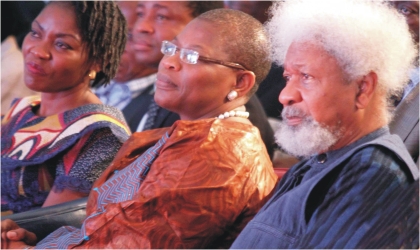
R-L Guest Speaker, Prof. Wole Soyinka; Guest of Honour, Dr Oby Ezekwesili and Representative of the Special Assistant To President Goodluck Jonathan on Documentation, Omolara Woods, at the Port Harcourt World Book Capital on Wednesday
A cross-section of Nigerians of all walks of life have urged the Federal Government to subject the outcome of the ongoing National Conference to a referendum.
A nationwide opinion survey of personalities conducted yesterday indicated that most respondents preferred ratification of conference decisions by referendum rather than the Presidential or National Assembly endorsement.
It would be recalled that President Goodluck Jonathan said while inaugurating the conference that its outcome may be subjected to a referendum.
“If the outcome of the National Conference is to be binding on Nigerians, the people must have a say in the final outcome,’’ said a Sokoto-based lawyer, Mr Ferdinand Okotote.
According to him, such an action would legitimise the decisions of the conference.
Many respondents, however, were of the opinion that asking the National Assembly to ratify the conference decisions would be less expensive and bear no cost to the economy.
“The National Assembly is already an established institution; but conducting a referendum is like conducting a fresh general elections.
“So, conducting a referendum would be more expensive and more cumbersome.
“If we want the outcome of the National Conference to acquire legitimacy and respect, and used as an instrument to amend the Constitution of the Federal Republic of Nigeria, there should be a referendum,’’ a respondent said.
However, Chairman of the Sokoto State chapter of the Nigerian Bar Association (NBA), Mr Steve Nwoke, was of the view that the resolutions of the conference should be submitted to the National Assembly for ratification.
A senior lecturer at the Niger Delta University (NDU), Amasoma, Bayelsa State, Mr Ebipado Sapere-Obi, expressed uncertainty about a referendum, “because of the absence of an enabling law for a referendum in Nigeria’’.
The Secretary, Sokoto State Council of the Nigeria Union of Journalists (NUJ), Mr Abdallah El-Kurebe, expressed support for a referendum.
“Nigerians must have the final say on the outcome, and they can only do so through a referendum,’’ El-Kurebe, said.
Also in support for a referendum was the Chairman, Sokoto State chapter of the Conference of Nigerian Political Parties (CNPP), Alhaji Abba Sidi.
He was supported by Chairperson, Rivers chapter, International Federation of Women Lawyers (FIDA), Mrs Florence Itamunoala who also held the view that the conference deliberations be subjected to a national referendum.
Itamunoala said the referendum would give a large number of Nigerians the opportunity to make their input.
“At least, we can boldly say that the generality of Nigerians have contributed, or made their input to the conference,’’ Itamunoala said.
The National Secretary, Alliance for Democracy (AD), Mr Rafiu Salau, also held that the outcome of National Conference should be subjected to a referendum.
He said that a referendum would not be seen as an imposition, but a collective decision and a democratic process.
A Port Harcourt-based lawyer, Mr. Edward Obiokor opined that a referendum was the best option rather than subjecting the outcome of the conference to presidential approval or ratification by the National Assembly.
Obiokor expressed fears that the National Assembly might not vote for a constitutional amendment to pave way for a referendum as its members may fear losing their seats.
“Nigerians have been advocating for the parliamentary system of government because it appears better and cheaper compared to the present presidential system.
“But for the country to move forward, our legislators should put aside their personal interests and allow for a constitutional amendment that will pave way for a referendum,” he said.
He urged the National Assembly to go ahead with the constitutional amendment process, saying it is only then that the ongoing national conference would have meaning and possibly change the fortune of the country for the better.
Director-General, Center for Research, Information Management and Media Development, Lagos, Dr. Raphael James also expressed the view that the conference resolutions be ratified by the National Assembly.
But a Benin-based legal practitioner, Mr Chris Ighoja, said that adoption of a referendum was the best option, adding: “the National Assembly makes laws, and the people make constitution’’.
Deputy Registrar, Information, University of Port Harcourt, Dr. Williams Wodi appealed to the leadership of the nation to subject the outcome of the conference to referendum.
“Every Nigerian entered the Nigerian federation as an individual and not as a group; and as such, power ought not to be left in the hands of a few Nigerians.
Dr Patrick Mbum of the University of Calabar, agreed that the outcome of the conference be subjected to a national referendum.
For Dr Emmanuel Ejere of the University of Uyo, subjecting the outcome of the conference to the National Assembly or the Presidency would amount to making the exercise a jamboree.
He said that the agitation for a national conference was actually a call for a sovereign national conference.
“This also means that whatever is the outcome of the conference shall be subjected to the will of the people and not the Presidency or the National Assembly.’’
A former National Secretary, Nigerian Guild of Editors, Mr. John Ndukauba said a referendum would be possible after an amendment of the Nigerian Constitution.
According to him, the constitution as it exists presently, does not provide for a referendum.
He, therefore, advised President Goodluck Jonathan to “deploy his lobbying powers to get the National Assembly to fast-track the constitution amendment process to incorporate referendum’’.
Secretary, Christian Association of Nigeria (CAN), Kwara chapter, Rev. Cornelius Fawenu said that the only way the outcome of the conference could be acceptable to the people was to subject it to a referendum.
He said it was proper that Nigerians were given a chance to contribute to the conference by subjecting the outcome to a referendum.
He said that since the delegates to the conference were not elected, decisions by them would not carry any legal weight unless they went through a popular referendum.
And from Enugu State, the Attorney-General and Commissioner for Justice, Mr Anthony Ani, advised the conference delegates from the South-East zone to address issues relating to creation of more states in the area.
Secretary-General, Students Union Government, Michael Okpara University of Agriculture, Umudike, Abia, Mr. Angel Nwokorie said government should ensure the implementation of the resolutions.
A community leader in Esit Eket, Akwa Ibom, Chief Ikemesit Ikot, said that the outcome of the conference should be made final, and described it as a step in the right direction.