Features
Of Centenary And Nigeria Project

The journey of
Nigeria’s chequered political history reached a crescendo with the historic celebration of a hundred years of its corporate existence as a country following the amalgamation of the of the Northern and Southern Protectorates by Lord Lugard in 1914.
While it is remarkable to note the fact of Nigeria Centenary celebration, it is also worthwhile to ponder over some issues bordering on the Nigeria Project, such as security, education, economy, social justice, co-existence, national integration politics, corruption among others.
Against all odds, President Goodluck Jonathan, in a recent emotion laden broadcast to nation on the centenary, gave some words of encouragement to Nigerians at the wake of a calculated tragedy orchestrated by the Boko Haram insurgents in Yobe State, in which defendless students were killed.
Like a regular homily, the President condemned the horrendious activities of the terrorist who have let loose their dragnet of brutality on innocent Nigerians. The President who described the attack as ‘mindless savagery’ reiterated the Federal Government commitment to the fight against terrorism in the country and tasked the security agencies on the need to stamp out the activities of the sect in the country.
Senate President, David Mark on his part described the attack on students in Yobe as ‘a declaration of war against Nigerians’ while the speaker of the House of Representatives, Waziri Tambuwal saw the incident as horrendous.
The Senate Committee on Defence, also ordered the immediate relocation of the Chief of Army staff Lt. Gen. Kenneth Minimah, to Maidugiri, with a mandate to do every thing possible to tackle the menace of Boko Haram in the North East and by extension, the country.
But beyond peripheral public gestures, the increase in the backlash against the peace forces in the country, appears the most ominous sign of our time. It underscores the porosity in Nigeria security system and places a huge burden on the operators of the security system.
The persistent painful recknoning experienced by Nigerians in the midst of the centenary celebration rekindles the need for reconfiguration and the search for lasting solutions to the country’s interactable problems.
The incubation of the Nigerian State which is entirely a British Creation, had been variously faulted by pundits, as a result of the glaring imbalances in the socio, economic and political culture.
Missing over the Nigerian Project, late environmental and Minority rights activist, Ken Saro Wiwa, had described Nigeria as “a quizotic political experiment of unwilling people put together by force of colonialism”.
Saro Wiwa also posited that the only solution to Nigeria political crisis is for the component units to discuss the basis of their co-existence through a sovereign National Confab.
Obafemi Awolowo, former premier of the defunct Western Region also defined the Nigeria State along ethnic lines. Awolowo who faulted the over concentration of powers at the centre, canvassed devolution of powers among the component units, noting that federal or central engagement should be basically negotiable on common terms. His political philosophy was akin to that of the United State, from where Nigeria borrowed its federal status.
Recently, at a public function in Port Harcourt, a University Don, and Political economist, Prof Willie Okowa, attributed Nigeria’s problems to systematic corruption. The University Don, noted that Nigeria leaders had over the years ‘misused its creative resources and sign up to a wrong notion of sharing of oil money, a philosophy that promote inequality and laziness among the emerging class.
Prof Okowa, opined that Nigeria lost touch with its creative ingenuity when it settled to be a consuming economy at the expense of the Niger Delta oil money.
He noted that that the ground for systematic corruption in the country was smoothened by the preponderance of a climate of political opportunism, where leaders emerge without credible electoral process.
Okowa however, settled for the planned National Conference as a platform of righting Nigeria’s wrongs and structuring the country on the path of egalitarianism.
The different agenda envisaged by the various interest groups in the country to grapple with power at the centre unmasks the intriguing dynamics of leadership selection and succession in Nigeria. Experience shows that there had been various attempts on the past by successive leaders to address the problems of Nigeria through reform policies.
Under the military regime of Gen Ibrahim Babagida (rtd), a political bureau was set up to map out a new political model that will serve as a structural dependency for socio-economic and political cohesion.
Events later revealed that the bureau’s far-reaching and forward-looking recommendations were jettisoned by the military junta, while the holier than-thou policies of the military aristocrats held sway. The rest they say is history.
The Abacha administration’s Constitutional Conference of 1994 that brought the draft of the 1999 constitution which divided the country into six geo-political zones was yet another attempt to strengthen the political future of the country. But unfolding events also indicated that the move was facile and not predicated on the enthronement of justice, but to make the various geo political entities amenable to easy political concessions into a surplus appropriating, centralized command system, where Abacha the ‘would be’ President will preside.
The search for a dependable grundnorm for the continuous political survival and exposition of Democratic liberties has therefore put Nigeria in the throes of unending political and constitutional reforms.
Armed with these glaring political revelations, pundits have pick holes in clauses now commonly referred to as ‘no go’ areas in the proposed National Conference. There has been calls across the country, that the conference will only address Nigeria’s intractable problems, when the various component groups converge to discuss extensively issues bordering on national unity on agreeable terms not withstanding Federal Government’s straight jacket on the conference.
Ostensibly realising the fragility of the Nations unity at the moment, the President had instructively warned that he would not preside over the disintegration of Nigeria. The onus therefore lies on the various delegates that will attend the conference to structure their demands on a note of primacy on Nigeria’s unity. The out come of the National confab will therefore decide the next steep to Nigeria journey towards statehood in the next 100 years and beyond.
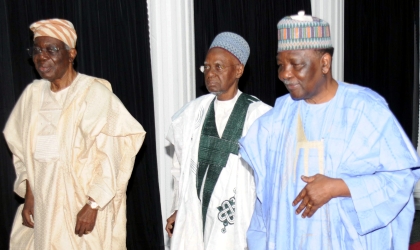
L-R: Former Head of Interim National Government, Chief Ernest Shonekan, former President, Alhaji Shehu Shagari and former Head of State, General Yakubu Gowon, at the Centenary Conference in Abuja last Thursday.
Taneh Beemene