Ict/Telecom
Cashless Policy: CBN, NIGCOMSAT Partner On Internet Access

The Central Bank of Nige
ria (CBN) has said it has concluded plans to partner with Nigerian Communication Satellite (NIGCOMSAT) for the provision of wireless internet service.
The CBN Principal Manager, Shared Services, Mr Aaron Yaduma, said that the measure was to give necessary push to cashless policy in the country, last Tuesday.
Yaduma made this known in a paper titled: “Cashless Policy, the Journey So Far”, presented at a three-day sensitisation workshop on CBN cashless policy in Bauchi on Tuesday.
He said that the effort was to address the internet connectivity problem, being one of the major challenges affecting the implementation and penetration of the cashless policy in the country.
“A tripartite MoU has been drafted for NIGCOMSAT, CBN and Nigerian Interbank Settlement System (NIBSS) for the provision of the Wi-Fi hotspots.
“If the partnership arrangement is concluded, we hope to connect every part of this country with internet service via Wi-Fi hotsport.
“We have already commence discussion with NIGCOMSAT to see how we can make General Packet Radio Service (GPRS) technology available in rural areas for the deployment of Point-Of-Sales (POS) terminals,’’ he said.
Yaduma said that the cashless policy was introduced in 2012 with the main objective of reducing the amount of physical cash circulating in the economy through the encouragement of more electronic-based transactions.
He said that the policy was introduced for a number of key reasons, namely to meet Vision 2020 requirements, modernise Nigeria’s payment system and reduce the cost of banking services.
According to him, it is also to improve effectiveness of monetary policy, reduce high security and safety risks and foster transparency and curb corruption.
He said that besides internet connectivity, people misconception of the policy and fuelled conspiracy theories amongst stakeholders had also hampered the adoption of the policy.
“There was also resistance due to prevailing cash culture, Techno-fobia , Illiteracy, entrenched poverty, insufficient infrastructure, distrust in banking system and merchant apathy, “ he said.
He, however, said that steps were being taken to address all the challenges, adding that the cashless Nigeria project was gaining massive adoption rate across the nation, especially with the support from Federal and State governments.
Earlier, the CBN Branch Controller in Bauchi State, Malam Musa Muhammad, explained that the essence of the workshop was to sensitise and educate all stakeholders on the gains of the cashless policy.
He added that the sensitisation would also be carried out in 30 states of the federation where the policy was designed to take effect.
He called on the government, markets associations, community leaders, professional bodies, religious organisations, students to embrace the policy for its advantages.
Some of the participant who spoke to newsmen expressed worry that the policy will not favour a lot of people due to low level of education and access to electronic gadgets.
Mrs Maryam Gamzo, the Chairperson, Market Women and Men Association in the state, said the policy would be at a serious disadvantage to market women because of their low level of literacy.
“Our women only understand the business of pay cash and carry, and now they are telling us to use machines instead of cash. Without money how are we going to buy goods from the villages.
“Again, if our customers stopped using money to make purchases, how do we know if we are making profit or not and what do we take home at the end of the day,’’ she said.
Another participant, Malam Yakubu Bayara said that the policy would only succeed in major towns and not in the rural areas.
According to him, in the rural areas the purchasing power is between N20 to N200 per day, and the illiteracy figure is very high.
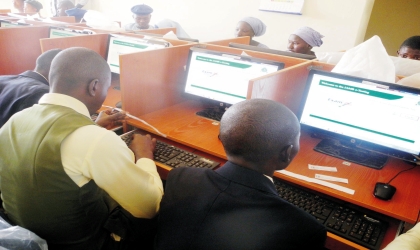
Some of the students during the advocacy campaign on computer-based test organised by the Joint Admissions and Matriculation Board (jamb) ahead of its Unified Tertiary Matriculation Examinations (umte) in Gombe, recently. Photo: NAN