Front Pix
Jonathan Suspends CBN Governor; Sanusi Vows To Challenge Action …Reps Reject Suspension …Naira Falls, Bond Market Falters

President Goodluck Jonathan yesterday suspended Mallam Sanusi Lamido Sanusi as the governor of the Central Bank of Nigeria (CBN).
The suspension order was contained in a statement by the Special Adviser to the President on Media and Publicity, Dr. Reuben Abati.
Abati said Jonathan had found out that Sanusi’s tenure as the CBN governor has been characterised by acts of financial recklessness and misconduct which are inconsistent with his administration’s vision.
He named a Deputy Governor of the CBN, Dr. Sarah Omotunde Alade, as the acting governor.
He said Alade would remain in charge until the conclusion of ongoing investigations into breaches of enabling laws, due process and mandate of the CBN.
The statement read, “Having taken special notice of reports of the Financial Reporting Council of Nigeria and other investigating bodies, which indicate clearly that Mallam Sanusi Lamido Sanusi’s tenure has been characterized by various acts of financial recklessness and misconduct which are inconsistent with the administration’s vision of a central bank propelled by the core values of focused economic management, prudence, transparency and financial discipline.
“Being also deeply concerned about far-reaching irregularities under Mallam Sanusi’s watch which have distracted the Central Bank away from the pursuit and achievement of its statutory mandate; and being determined to urgently re-position the Central Bank of Nigeria for greater efficiency, respect for due process and accountability, President Goodluck Ebele Jonathan has ordered the immediate suspension of Mallam Sanusi Lamido Sanusi from the Office of Governor of the Central Bank of Nigeria.
“President Jonathan has further ordered that Mallam Sanusi should hand over to the most senior Deputy Governor of the CBN, Dr Sarah Omotunde Alade, who will serve as acting governor until the conclusion of on-going investigations into breaches of enabling laws, due process and mandate of the CBN.
“The president expects that as Acting Governor of the Central Bank of Nigeria, Dr. Alade will focus on the core mandate of the bank and conduct its affairs with greater professionalism, prudence and propriety to restore domestic and international confidence in the country’s apex bank.
“The Federal Government of Nigeria reassures all stakeholders in Nigeria’s financial and monetary system that this decision has been taken in absolute good faith, in the overall interest of the Nigerian economy and in accordance with our laws and due process,” Abati said.
However, hours after the suspension from office of Mallam Sanusi Lamido Sanusi as governor of the Central Bank of Nigeria (CBN), Zenith Bank of Nigeria’s Group Managing Director and CEO, Mr. Godwin Emefiele, has been nominated to replace him.
Already, President Goodluck Jonathan yesterday sent Emefiele’s name to the Senate for confirmation.
His tenure will, however, start from June 4, when Sanusi’s six-year tenure will end.
Along with Emefiele, President also sent the name of Adelabu Adekoya, currently an executive director with First Bank of Nigeria, to the Senate for screening and approval as deputy governor to succeed Tunde Lemo who retired late last year.
However,Sanusi, says he intends to challenge the legality of his suspension from office, to establish whether President Goodluck Jonathan has the legal authority to take such decision.
“It has never been my desire to hold on to a job. However, I believe if the CBN governor cannot be removed from office, then he cannot be suspended. He can be queried, but the exercise of the arbitrary decision to remove him must be challenged,” he said.
Mr. Sanusi was speaking to the cable news network, CNBC Africa, from Niamey, the Nigerien capital, shortly after news broke that he had been suspended from office by the Presidency.
The former governor, who was in Niamey to attend the ongoing conference of the West African currency zone with other governors of the Central Banks in West African, said he had to hurriedly leave venue of the meeting shortly after the Nigerian Ambassador to Niger confirmed to him the directive by the Presidency to inform him of the suspension.
Though he said he was not bothered about the suspension as an individual, as he was proud about his achievements and legacies, Mr. Sanusi said his plan to challenge the action bordered on the need to protect the independence of the CBN as an institution.
“As an individual, I was invited to serve my country, and I have always known that at any point the government feels it is time to go, I will go. But, in terms of the institution, it would be helpful to establish the principle by the court, and I think that is the step I intend to take,” Sanusi said.
In spite of his decision to challenge the decision in court “to establish once and for all if the President has the powers to do what he has done,” Sanusi said he has resolved not to return to the job.
“If it (the decision) is not challenged, then from now the next CBN governor cannot be independent. He can be suspended for any reason, and the independence of the CBN would be totally undermined. It is important to establish the point legally whether this can happen. I do plan to ask the court to confirm if, indeed, that authority exists. I will challenge it,” he said.
Expressing surprise that the decision took so long in coming, he pointed out that though one can suspend the individual, he did not believe the truth can be suspended.
“This is all about concerns around oil revenues and corruption in the oil sector. If the suspension is going to bring back the missing $20 billion, then it is fine,” he said.
He said his major concern was for the financial system, particularly the negative impact of the decision on the Nigerian economy and the need to protect the interest of the CBN.
He listed the legacies of his tenure at the CBN to include slow inflation rate, stable exchange rate, well governed banking system, robust reserves, independent central bank and financial inclusion, pointing out that he was satisfied with the service he rendered, which he would not want to see unravelled.
On allegations by the Presidency that his suspension was based on the report received from the Financial Reporting Council of Nigeria (FRCN) and other investigating agencies about various acts of financial misconduct that characterized his tenure, Sanusi said he intends to see what those allegations are when he returns to the country.
Sounding dismissive of the allegations, Sanusi said the only thing he was aware of, which are not new, were the questions asked by FRCN about the published CBN audited account, which he had since sent a response to the President, who did not give any feedback.
He dismissed insinuations that the decision was politically motivated, saying he has opted not to comment on that, pointing out that he believed it was the consequence of the actions he took while in office.
On the capacity of his successor, Sarah Alade, to sustain the momentum of his achievements, Sanusi described her as a very competent person, whom he has every confidence in to run the CBN successfully.
Nevertheless, officials of the State Security Service (SSS) have seized the travelling documents of suspended Governor of the Central Bank of Nigeria, Sanusi Lamido Sanusi, shortly after he arrived Lagos from Niger, where he had gone to attend a meeting of governors of central banks in the West African sub-region.
Shortly after his plane landed at the ExecuJet Terminal of the Murtala Muhammed International Airport in Lagos, he was accosted by plain clothe operatives who detained him briefly and insisted he must surrender his passport.
They also insisted that he would not be allowed to leave the airport until the Lagos state director of the SSS arrives.
But after a while, the operatives had a change of heart after communicating with their superiors. The CBN governor was allowed to leave but only after his passport was confiscated.
The embattled governor had himself been aware of the plan to arrest him, compelling him to change his travel plans. He landed in Lagos instead of Abuja.
In Lagos, Sanusi’s associates and friends, led by a former minister of the Federal Capital Territory, Nasir El-Rufai, were on hand to receive him at the airport.
They drove out of the airport in a convoy heading towards Ikoyi.
Meanwhile, the House of Representatives yesterday rejected President Goodluck Jonathan’s suspension of the Central Bank of Nigeria (CBN) Governor, Sanusi Lamido Sanusi.
The House took the decision yesterday after adopting a motion on the matter moved by Minority Whip, Samson Osagie.
Osagie argued that Sanusi’s suspension was unconstitutional and antithetical to Nigeria’s economy coming at the time the CBN governor raised some concerns about missing funds.
He said the timing was wrong and Sanusi should not be washed away as he was only carrying out his duties as the chief executive officer of the apex bank.
He said the manner in which Sanusi was suspended was bereft of fairness as the man was not given any query, adding that the issues he raised ought to have been diagnosed thoroughly.
However, the motion drew a lot of controversy among the lawmakers as some kicked against it vehemently.
Leading opposition on the motion, Deputy House Leader, Leo Ogor, said the president is constitutionally empowered to appoint any individual into an office and sack him when something is wrong.
The House was thrown into a moment of confusion when some lawmakers booed Ogor, in disagreement with his position.
Some lawmakers wanted to contribute further, but Speaker Aminu Waziri Tambuwal ended the matter by putting it to vote.
Overwhelming majority of the lawmakers present at the plenary voted in favour of the motion.
Meanwhile, President Goodluck Jonathan’s suspension of respected Central Bank of Nigeria (CBN) Governor, Sanusi Lamido Sanusi, yesterday, has triggered significant shock wave across the financial and money markets in Nigeria and elsewhere, causing the Naira to fall more than 1 per cent against the Dollar.
The Naira, quite expectedly, fell sharply yesterday to N169 to a Dollar.
The bond market also remained shut for the day.
Across the world, the shock wave of the president’s action has elicited serious reactions.
For instance, Head of Economic Research, ECOBANK, Angus Downie, said, “Sanusi did a fantastic job as governor and it will be very difficult to find someone that can continue his line of effort in restructuring the banking sector and strengthening monetary policy to the next phase.
“He was due to step down in June but when something unexpected like this happens it does raise concerns about what is happening with the direction of policy in Nigeria.
Economist at Nigerian Stockbroker, CSL, Alan Cameron, “It’s not so much what it does to the CBN (Central Bank of Nigeria), which we believe had a strong institutional foundation and skilled leaders, but what it says about the Presidency itself.
“If the Jonathan administration is willing to discard a safe pair of hands at a time when the currency is being tested anyway, it shows more political motivation than economic awareness.
“Speaking from the perspective of international investors, this is likely to go down badly.”
Economist, NKC Economists in Cape Town, South Africa, Melissa Verreyne, argued that, “This is very worrying for the central bank’s independence, and creates uncertainty about the future monetary policy direction.
“The strange allegations made against Mr Sanusi, and the fact that the government was not content with simply letting his term expire, appear to be aimed at sending a warning to outspoken central bank officials.
“The ability of the central bank to criticise fiscal policy and the remittance of oil revenue is important, as it improves the accountability of the public sector.
Africa Analyst, RENCAP, Yvonne Mhango, said, “Sanusi’s suspension does raise concern among investors about the ability to sustain the naira at present levels. We will see more pressure on the currency between now and June, and more weakness than we had anticipated prior to this news.
Head of Africa Research, Standard Chartered, Razia Khan, said, “The nature of the suspension will come as a significant shock to foreign portfolio investors, whose willingness to invest in Nigeria was very much influenced by the transparency and anti-inflation credibility associated with Sanusi’s policies.
Emerging Markets Strategist, Standard Bank, Samir Gadio, said, “This is a disruptive move which indicates that the CBN has de facto lost much of its independence.
“Clearly it is driven by political motives given Sanusi’s vocal criticism of oil revenue leakages and the opaque fiscal system in Nigeria.
Similarly, a former Minister of Education in the administration of former President Olusegun Obasanjo, Dr. Obi Ezekwesili, has accused President Goodluck Jonathan of being against accountability.
Ezekwesili said this in reaction to the suspension of the Governor of the Central Bank of Nigeria, Mallam Sanusi Lamido Sanusi.
In the reaction on her Twitter handle, Ezekwesili said for Sanusi to be removed while the inquisition into a missing $20 billion from the account of the Nigeria National Petroleum Corporation was ongoing was an indication that Jonathan hated accountability.
She tweeted: “For CBN Governor to be suspended when serious issue of missing $20 billion that he raised remains unresolved shows intolerance for accountability.”
Sanusi had raised the alarm about the missing money from the over $67 billion generated by the NNPC.
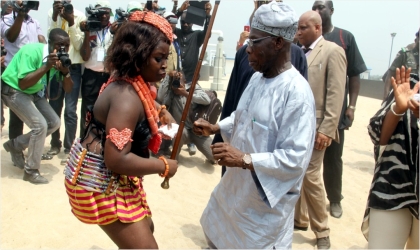
Ex-President Olusegun Obasanjo shows his stuff as he dances with an Iria dancer in Buguma, during his two-day visit to Rivers State