Features
Ensuring Food Security Through Women Farmers

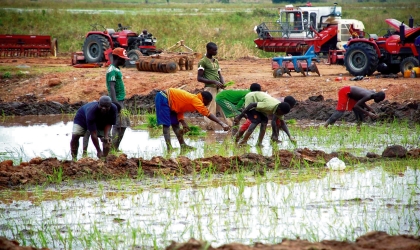
Farmers planting rice in Lokoja, Kogi State.
In recognition of
women’s role in national development, especially in rural communities, the United Nations declared October 15, 2008 as International Day of Rural Women.
The date has since been marked globally to celebrate rural women whose efforts, research had shown, contribute towards enhancing food security and eradicating hunger and rural poverty.
Stakeholders in agriculture say that the day is important because rural women play critical roles in the rural economies of both developed and developing countries.
They agree that with adequate participation of women in food production, especially at the grassroots, abundant food production will be sustained to fight hunger and poverty.
For instance, available statistics in the Federal Ministry of Agriculture and Rural Development indicates that more than 70 per cent of farmers in Nigeria are women who produce 90 per cent of the food consumed in the country.
Principal Advisor, Gender, Equity and Rural Employment Division at Food and Agriculture Organisation (FAO), Ms Eve Crowley, says the population of grassroots women will impact on food production because they constitute between 20 per cent and 30 per cent of agricultural wage workers.
“They often predominate in high-value industries for export such as fresh fruits, vegetables and flowers.
“Although these non-traditional sectors of agriculture can present women with unprecedented income opportunities, we often find that women are hired on temporary or casual contracts to perform labour-intensive, manual tasks.
“They are given limited opportunities to acquire new skills; and overall, higher-level positions continue to be captured by men,’’ Crowley said.
As the world celebrates International Day of Rural Women, she says that recognising the contributions of women and taking account of their needs at all levels were cardinal to food production.
Against this backdrop, Miss Constance Okereke of ActionAid Nigeria, says there is need to carry along more women farmers in budgetary processes.
Speaking at a workshop on empowering small-holder women farmers to influence, challenge and change policies and actions on public finance in the sector, Okereke opined that women farmers should be involved in policy making in agriculture.
According to her, this will help women to relate well with policy makers, and ensure that their issues are well attended to.
“This is the only way that the government can know exactly what they need and how to ensure they gain assistance,’’ she said.
Stating some constraints against women farmers, President, Smallholder Women Farmers’ Association of Nigeria, Hajiya Aishatu Mohammed, notes that the major challenge of women farmers in the FCT was land acquisition.
According to her, women farmers in rural areas are not producing enough food due to inadequate farmlands.
“Most times, these women inherit the land they use from their fathers or husbands, but sometimes, estates developers do not allow them use it for long,’’ she said.
Calling for government’s assistance, a farmer from Bogoro Local Government of Bauchi State, Mrs Nyarim Habila, noted that some women farmers in her community did not benefit from the 2012 Growth Enhancement Support Scheme (GES) of the Federal Government.
According to her, such schemes should target women farmers separately to ensure that they are not marginalised.
“If women farmers receive such inputs in their various commodity associations, it will make more impact than it does now,’’ she noted.
Also commenting, Mrs Rakel Nasiru from Shela local government area of Gombe State said unhindered access to improved seeds through GES would make an impact in women’s effort to achieve food security.
“If the government can add improved seedlings like soya beans, groundnut, maize and rice which they intend to distribute, it will help us to increase production.
“This is because these are some of the crops most of our women farmers around here are familiar with; the seeds should come early with enough fertiliser so that we can utilise the rainy season,’’ she pleaded.
Director of Fertiliser, Federal Ministry of Agriculture and Rural Development, Mr Akinbolawa Osho, observed that there were challenges in the first phase of GES.
He was quick to add that the Federal Government had introduced supply chain managers as part of measures to address the challenges of getting inputs across to farmers.
“This year, we have improved on addressing the challenges of mobile network and Short Message Service (SMS) to farmers; we have addressed those to a large extent,’’ Osho said.
The federal government insists that it has made several efforts to ensure that women farmers enjoy all facilities required to boost food production.
Vice President Namadi Sambo, recently announced approval of N15 billion loan to be routed through the Bank of Agriculture.
Sambo told the Nigerian Economic Summit Group (NESG) in September, in Abuja that the loan would be disbursed to farmers at single-digit interest rate.
In the same vein, the Central Bank of Nigeria (CBN) had in 2009 established a N200 billion Commercial Agriculture Credit -Guarantee Scheme (CACS) to promote commercial agricultural enterprises.
The scheme is being funded through the issuance of federal government bonds by the debt management office in two tranches.
Media reports indicate that N101.38 billion had so far been released to finance 109 privately-owned projects, while 19 state governments received one billion naira each for disbursement to farmers’ cooperatives and unions.
However, observers note that as Nigerians join the rest of the world to mark the International Day of Rural Women, relevant stakeholders should implement policies that will restore the agriculture sector, and empower and encourage rural women.
According to them, empowerment of women farmers will contribute immensely to government’s desire to boost food production and combat hunger and rural poverty.
Onuegbu writes for NAN.
Perpetua Onuegbu