Front Pix
Rogue Oil Marketers In Trouble …Ordered To Refund N220bn

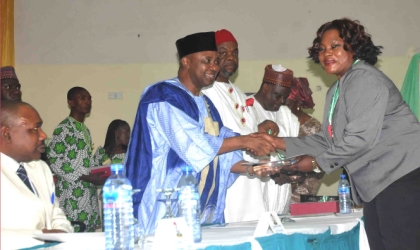
Vice President Namadi Sambo (2nd left), presenting an award to Executive Secretary, Benue State AIDS Control Agency, Mrs Grace Wende (right), at the 13th National Productivity Day celebration and Conferment of National Productivity Order of Merit award in Abuja, yesterday. With them are Chairman, National Productivity Order of Merit Award Committee, Dr Abbas Aidi (left), Minister of Labour and Productivity, Chief Emeka Wogu (3rd left) and Director-General, National Productivity Centre, Dr Paul Bdliya.
The Minister of Finance, Dr Ngozi Okonjo-Iweala, has said that the Federal Government will recover over N232 billion ($1.5 billion) overpayments made to “fraudulent” oil marketers.
Okonjo-Iweala, who is also the Coordinating Minister for the Economy, made the plan known at the National Council of Finance and Economic Development (NACOFED) in Minna, yesterday.
She said that in 2006, the total petroleum subsidies paid to oil marketing firms amounted to N256 billion (about $1.6 billion) and by 2011 the bill for petroleum subsidy payments had risen sharply to nearly N2.10 trillion ($13 billion).
“Even more striking was the increase in the number of oil marketing firms. While most countries have a few well-organised fuel importers, Nigeria had a total of 143 such firms as at 2011.
“The certification process to verify the actual delivery of imported fuel was also very lax, resulting in widespread fraud in the operation of the scheme,’’ she said.
The minister said there were cases where some firms submitted payment invoices for fuel deliveries in Nigeria when their stated cargo ships were actually berthed elsewhere in South America on the same dates,
She said that the subsidised prices for domestic gasoline in Nigeria also created arbitrary opportunities and resulted in widespread smuggling of fuel products to Nigeria’s neighbouring countries.
For this reason, she said, Nigeria embarked on a comprehensive reform of the downstream petroleum sector by appointing the Aig-Imoukhede-led Committee, who discovered lapses in the payment processes.
“Following the discoveries, the Federal Government put in place a number of remedial measures to combat fraud in the subsidy scheme.
“First, a tighter payment regime was introduced with new auditors and stricter guidelines for disbursement of subsidy payments. The increased scrutiny has slowed down the payment process somewhat but also greatly reduced the likelihood of fraudulent payments.
“ Second, we published the names of fraudulent oil marketing companies in the national press and are in the process of prosecuting these fraudulent marketers to reclaim the stolen funds,’’ she said.
To prevent more fraudulent payment claims, she said the government was introducing three electronic payment systems and oversight platforms.
“The new Integrated Personnel and Payroll Information Systems will allow direct payment of government workers based on biometrics data. This has so far saved government over N119 billion through the elimination of ghost workers.
“Also a Government Integrated Financial Management Information System electronically links the treasury to other government departments and enables faster and more transparent movement of funds,’’ she explained.
Okonjo-Iweala said that all these were the government’s way to provide checks and balances in the prudent management of public funds.
Meanwhile the Central Bank of Nigeria (CBN) has launched N220 billion Micro, Small and Medium Enterprise Fund to enhance access to finance for small businesses in the country.
The CBN Governor, Sanusi Lamido Sanusi, made this known at the 7th Annual Conference of Micro Finance and the launch of the fund, in Abuja yesterday.
Sanusi said that 60 per cent of the fund would be devoted to women to enable them access fund to grow their businesses across the country.
“The CBN is presenting to us today, the N220 billion Micro, Small and Medium Enterprise development fund (MSMEs).
“The fund is designed to further enhance access to finance by MSMEs with the objectives bearing in mind that the major constraint to this finance is the ability of the micro finance institutions to access lower interest long term financing,’’ he said.
He assured that the fund would be given at a very lower interest rate and might not be more than 9 per cent for women.
The governor said that the major objective of the fund, include wholesale financing windows for participating financing institutions, improved capacity of Participating Finance Institutions PPIs to meet the credit needs of MSMEs.
Others, he said, was that it would provide funds at reduced cost and longer terms for PPIs, compared to what they take from the commercial banks.
“Enhances access of women entrepreneurs to finance by allocating 60 per cent of the fund to businesses run and managed by women.
“And it is open to non-governmental organisations and micro finance institutions to access,’’ he said.
According to him, the fund should be seen as seamless effort to address the financing gap and strengthen the dynamism in the market system.
He said that the ultimate responsibility to sustainable inter-mediation for the subsector, lied with the financial market.
“This interventions serve to integrate the micro entrepreneurs, low income earners, farmers artisans and active poor, who operate in the informal sector into the financial system to improve the effectiveness of public policy,’’ he said.
Sanusi noted that the apex bank’s various intervention, especially in agriculture had positively impacted on the economy with evidence to lending in agriculture.
He said that lending to agriculture had increased from 1.4 per cent in 2009 to 4 per cent as at June 2013.
“As at June 2013, cash has been disbursed to 292 projects on the agriculture value chain under the credit finance, 48 per cent and 41 per cent were for production and process activities, respectively,’’ he said.