Front Pix
In Sultan’s Defence …That Amnesty Call For Boko Haram

Many saw it coming but very few imagined that it would take the respected person of His Eminence , the Sultan of Sokoto and President-General of the Nigerian Supreme Council for Islamic Affairs (NSCIA), Alhaji Muhammad Sa’ad Abubakar to personally voice the request for amnesty to all combatants in the ranks of Boko Haram.
Covered by the familiar caution often employed by the aged to cow the youth into submission: ‘what an elder sees sitting on a kitchen stool, the young cannot fathom even when well positioned at the summit of the highest mountain’, the sultan last week urged the Federal Government to grant amnesty to a faceless group famed for mass murder of innocent and defenceless men, women and children, at peace time.
Since then, many Nigerians have continued to criticise the Sultan and even accused him of demonstrating crass insensitivity to the countless Christian deaths, bombed by members of the terrorist group. In fact, the Christian Association of Nigeria (CAN) picked holes in the Sultan’s allusion to addressing injustice and questioned what justice there was in a systemic ploy that sought to wipe-out Christians, on daily basis.
The CAN accordingly rejected the Sultan’s request and urged the Federal Government to ignore the appeal on grounds that the group is not only faceless but was merely pursuing an extremist Islamist agenda intended to rubbish the secularity of the Nigerian Constitution.
His Eminence, the Sultan does not require all the criticism to realise how unpopular his request was and is. All the facts concerning the senseless killings, the destruction of parts of the North, the terror attacks on public places including homes of Emirs perceived non-supportive and above all, the growing isolation of the terrorists, are very well known to the royal cum spiritual father.
But he spoke as any worried elder would, particularly since it was part of the communiqué issued at the end of the 1434/2013 Annual Central Council meeting of the Jama’atu Nasril Islam (JNI) held March 5, 2013, at its headquarters in Kawo, Kaduna. He was merely the head, but not alone.
The second of that meeting’s 11-point resolution states: “As a way of curtailing religious insurgency, the meeting called on the Federal Government to as a matter of urgency treat the case of insurgents with all sense of magnanimity by declaring amnesty to all of them, especially combatants that have expressed readiness to tread the path of peace”.
Curiously, that communiqué did not condemn the protracted acts of terror that have claimed more than 1,500 innocent lives, most of them armless Christians in sacred places of worship. It did not also recommend any succour for those who lost loved ones to the wanton destructions, a favour enjoyed by the payment of N100 million to the late Islamist sect leader’s family, by the Borno State government.
Instead, there appears to be greater urgency in calls to compensate killers who, for no just course waged a war against peace, against civilisation, against religious tolerance and, above all, against Christianity. All these facts are known to the Sultan, but he must have spoken as an elder, after appraising secrets, many at mountain-tops can’t see not to talk of comprehending.
In late 2011, this column in an Agony titled, Behind The Smoke- screen… Unravelling The Boko Haram Agenda, made some disclosures concerning the real reasons for the birth and modus operandi of the Boko Haram sect. In that treatise some of the underlisted issues were clearly listed as reasons for the apparent silence of the Northern political elite to the terrorist activities of Boko Haram.
i) A section of the Northern political elite felt and still feel cheated by the resources deployed to the oil producing states of the South in the name of amnesty and needed to posture a murderous insurgency to attract equal, if not more resource allocation.
ii) Since in their estimation, the Vice Presidential slot of the ruling Peoples Democratic Party was ceded to the South-South, during the terminal days of the Obasanjo presidency, as a means of assuaging the neglect suffered by the oil-producing states of the Niger Delta, only a murderous insurgency of the kind unleashed on the Nigerian state by Boko Haram could restore the Presidency back to the North in 2015.
iii) The 13 per cent derivation fund to oil bearing states denies the North better fiscal allocations from the Federation account and unless something drastic was done to attract special Federal Government attention to the North, in whatever guise, the South would progress faster than the North.
To achieve all these, a Northern unity was required, hence, the choice of religion and veiled imposition of sharia in the predominantly Islamic North to silence, and if possible, drive away any, with competiting religion. So, the original propaganda that ‘Western Education is a sin’, clearly offered itself as a brand theme, intended to actualise that unity, albeit by brute force. But not the real reason.
All these facts should be well known to the Sultan, but he spoke only as an elder would, in crises.
Truth is, those hidden goals contained in the political agenda of a section of the Northern political elite, had political power at the nucleus of it all. But with the high rate of human casualties, the growing size of the Boko Haram monster they created, and the level of insecurity even its founders today risk, global condemnation of the group and above all, the recent listing of Boko Haram as a terror group by the United States and other European partners, open identification with the group became less honourable. The call for amnesty therefore becomes not just an after thought but a leeway for their own safety in the hands of the monster they created.
The truth be told, Boko Haram cannot be equated in any way with the civil protest, just struggle and eventual insurgency of the Niger Delta youth. In the case of the latter also, the facts were well known to the Sultan but he merely spoke as would an elder, concerned for his own security.
For the records, in more than 50 years, the oil bearing communities of the Niger Delta lived in squalor, want, disease and total neglect. While they suffered the environmental harm caused by oil prospection and production, destruction of the mangrove swamps and farmlands and above all, denied their basic occupations of fishing and farming, the central government did very little or nothing for their socio-economic survival and infrastructural development.
Curiously, all civil agitations, protests and appeals to redress the injustice yielded no positive results. The situation was made even worse by the area’s minority status and the systemic denial of political space they needed to articulate their grievances. That deprivation continued unabated, the only known assurance then being, “be patient, there is something in the pipeline, very soon, the Niger Delta will smile”.
Plateau State Governor, Jonah Jang, captured the struggle aptly, albeit comically last year in Uyo, when, he told the Nigerian Guild of Editors Conference that, “the search for content of the pipeline repeatedly promised oil bearing communities, without corresponding action, fueled the Niger Delta youth insurgency”.
The ideology thus became, if we can’t benefit from the oil and gas production activities on our land, then, oil companies must stop production. That demand snow-balled into a more profound agitation for resource control, in the words, unless “you carry us along” a term frequently used by the youth, no more oil and gas.
In all these protests, not once did the Niger Delta youth target Mosques, simply because the serving Presidents or Heads of State since independence were predominantly Moslems from the Northern parts of the country. Not once did they bomb any newspaper house and most importantly, the membership and leadership of the insurgent groups were very well known.
That was why it was easy for the Federal Government to dialogue with the Niger Delta agitators and their political leaders, which talks led to cease-fire and eventual granting of amnesty to the repentant militants.
Who are the political and spiritual leaders of Boko Haram on whom government must depend for the group to honour any truce, if eventually reached? Last year, when the group suggested that former Head of State, Gen Mohammadu Buhari (rtd) led its delegation in dialogue with government, Buhari publicly rejected the offer and denied any ties with Boko Haram.
But as soon as Buhari’s Congress for Progressive Change (CPC) along with ACN, APGA and ANPP, merged to form All Progressive Congress (APC) the opposition state governors felt suddenly safe to visit parts of the embattled North, and departed without any incident. Is Boko Haram an opposition army?
My Agony is that His Eminence, the highly revered Sultan is being unfairly criticised for speaking as would an elder, on a kitchen stool, even if the facts were well known to him.
Methinks, the best way to understand the Sultan is to properly appraise and understand the Okrika proverb, “Bu bilema mingi, gborianga ani boke” meaning, ‘From not a single route rages the tide that submerges the mangrove swamp’.
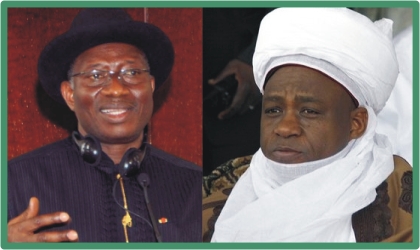
President Jonathan And Sultan of Sokoto