Front Pix
How Saro-Wiwa’s Death Fuelled Arms Struggle – Oronto Douglas

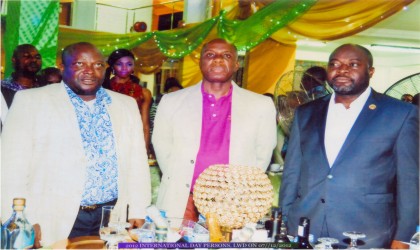
Rivers State Governor, Rt. Hon. Chibuike Amaechi (middle), President Pan African Parliament, Hon. Bethel Amadi (right) and Speaker, Rivers State House of Assembly, Rt. Hon. Otelemaba Amachree, during the Gala Nite to mark the end of the Pan African Regional Parliament, held in Port Harcourt, last week. Photo: Chris Monyanaga
The hanging of Ken Saro-Wiwa by Abacha regime gave birth to armed struggle by the Niger Delta Youths.
The Special Assistant to the President on Research Documentation and Strategy, Mr. Oronto Douglas, who stated this in Yenagoa, Bayelsa State while speaking as a guest lecturer at the 3rd Annual Public Lecture organised by the Federated Correspondents’ Chapel of the Nigeria Union of Journalists (NUJ) said that Jonathan’s administration believes in dialogue in settling conflicts.
Douglas, who spoke on the theme, ‘National Unity: Imperative for Growth and Development in Nigeria stressed that Jonathan and the Federal Government could not dialogue with the members of the Islamic sect because they were faceless.
“You can’t discuss with the people you don’t know. You can’t discuss with the air. You have to talk with human beings. If members of Boko Haram come out today to say ‘we are Boko Haram’, Mr. President will give an audience for a dialogue either directly or through identified committees”, he declared.
On development, Oronto said it must be community based in order to have meaning and long lasting effects, pointing out that for a country to develop, it’s component communities at the periphery must experience it.
According to him, corruption has been so entrenched in the country that it required collective action in reducing the menace and the only way to do this is to build strong institutions.
He said building of strong institutions was the only viable way to fight corruption, adding that the political class must not interfere with the functions of such anti-graft institutions.
“Jonathan never interferes with the EFCC. He even reconstituted the Independent Corrupt Practices and other Related Offences Commission with persons of integrity,” he said, adding that the agencies were expected to do their jobs.
In his keynote address, a University Don, Dr Samuel Ibaba of Department of Political Science, Niger Delta University, blamed the disunity in the country on the entrenched poverty and lack of development.
He said despite having abundant natural resources and selling oil since independence, Nigeria had consistently been classified as a poor country.
“Nigeria since 2005 has been classified as a country vulnerable to fail. We have a responsibility to rescue it from failing,” he said.
According to him, there is a lot of bottleneck to national unity which he identifies as ethnic politics, tribalism, lack of trust, corruption, mobility of labour which needs to be fought with political will power to make progress.
In his welcome address, the chairman of FCC, Mr Kola Oredipe said the lecture which is the third edition was to create awareness on issues affecting the unity of the country.