Front Pix
That St. Theresa Attack …Of JTF Alerts, What Was Not Done

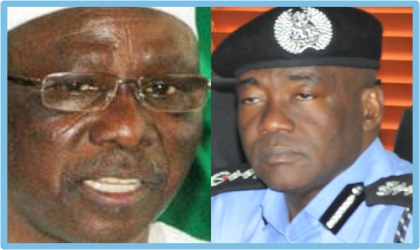
Gov Yakowa And IGP Abubakar
Since the Islamist extremist group, commonly known as Boko Haram started its terror attacks on both public and private property in parts of Northern Nigeria, a lot of guesses have been made as to the group’s real targets. Some say, members are merely misguided young Moslems trying in futility to rewrite the Koran in bloody letters, with education and the educated as enemies.
Others believe, the group’s main agenda is mainly political, with rubbishing the Jonathan Presidency as a target, hence its tactical drive focused on making parts of the North utterly ungovernable.
In this school also, are those who feel that the Boko Haram terror group is being groomed as a negotiating template to drag political power back to the North.
Yet others simply see the Boko Haram as an Islamist insurgency bent on imposing Islam in parts of the North and if possible in the whole of Nigeria. This third school of thought points to the countless number of Christian deaths through attacks on Christian places of worship. It argues that the terror attacks are clearly directed at Christians, that other victims are merely secondary or accidental victims either because of their vocal condemnations, like in the case of mass media houses and some top government officials, that the terrorists reckon, had been impediments to their terrorist activities, when they should be supportive.
Those who share this line of thought very easily point to the fact that not a single mosque had been attacked, since the madness began more than two years ago, and that all Moslem deaths were purely accidental.
All three schools of thought do have their reasons for their conclusions but not once has any been explicit enough to engineer government’s support to its course. That perhaps accounts for why government has repeatedly labelled the Boko Haram as terrorists merely driven by moral depravity and lust for human blood. They are neither true Moslems nor enemies of Christians but enemies of civilised Nigeria, good conscience, communal living and indeed peace.
With this conviction, government has not considered deeply, those that form the weakest link of the vulnerable chain, those high-risk targets and hence the need to protect such areas. Otherwise, there is no justification for the terror attacks, yesterday, on St Theresa’s Catholic Church, Kaduna in which, a yet-to-be ascertained number of Christian-worshippers were killed.
Curiously, in what many Nigerians called a timely alert, the military had last week Tuesday warned of likely terror attacks by the Boko Haram sect. The Joint Task Force (JTF) said it had uncovered a plot by Boko Haram Islamists to carry out “massive attacks” during the last Moslem holidays, with the help of foreign mercenaries.
“Information available to the Joint Task Force indicates that the Boko Haram terrorists are planning to launch massive attacks on military and civilian targets in Borno State, before, during and after the forthcoming salah celebrations,” Lieutenant Colonel Sagir Musa was quoted as saying.
“The terrorists have invited foreign mercenaries to assist them in the anticipated attacks”, Sagir said, adding, “we know where they are coming from but we don’t want to disclose that because we don’t want to pre-empt our security arrangements to tackle them”.
That warning would be one of very few that JTF had dished-out in recent times and with such confidence and certainty, and, if you like, welcome assurance that the security institutions were indeed on top of the situation. It was unlike the assurances frequently given by them since 2009, after each of the sustained terror attacks by Boko Haram, believed to have left more than 2,800 people dead and counting.
Yes, Nigerian security forces had frequently exaggerated their success in cracking down on Boko Haram insurgents, but they sounded more convincing in their terror alert of last Tuesday, afterall, a military that is pre-informed of enemy attack must be counted upon to rise-up to their constitutional duties of protesting the nation and her peoples.
This is indeed why it came to many as a huge disappointment that in the midst of such alert and preparedness of the security forces to prevent such attacks, St Theresa Catholic Church in Kaduna could suffer such killings. What went wrong?
That no single attack was recorded all through the salah holidays when Moslems went about their usual prayers in public places gave me some sigh of relief and nearly destroyed my skepticism of such security-based assurance, when it mattered the most. So, why should a church again be a victim.
This attempt is not to impute lack of government protection for Christian places of worship, although the temptation to do so is very strong, it is instead to question of how well the security structure understands the most vulnerable of targets in this senseless Boko Haram siege.
Is anyone pretending not to know that Christian places of worship have been targeted repeatedly? Is any one feigning ignorance of the fact that not a single worship-day passes without a story of one bomb attack or another on a church in the North? How many mosques suffer such insecurity? Shouldn’t that be enough reason for the security agencies to see the protection of churches in the North as a major concern? These are the questions which answers tend to give credence to the sentiments expressed by the third school of thought earlier addressed. These are Nigerians who cannot be easily convinced that annihilation of Christians in the predominantly moslem North is not part of Boko Haram’s agenda.
This is why none ought to undermine the likely consequences of silence in all these because of the unpleasant results of reprisals by groups, families and indeed churches of victims in all such attacks. Besides, a religious war is not one that Nigerian can manage, for many obvious reasons.
That is why I consider it unacceptable that Christian places of worship are frequently being targeted, with countless deaths but without any sure end to such hostilities.
The security institutions need to give Christians in the North enough reasons to believe that they too are covered by their arrangements, and not be made to believe that they are on their own.
For sure, there is no telling if the St. Theresa attack will be the last of such desecration of Christian places of worship in parts of the North, hence, the need for improved security of such facilities.
No doubt, an attack on any human being by another is condemnable but one on a faithful, in the presence of the Maker is most insane. Government must begin to see the Boko Haram for what it truly is and device appropriate safeguards against further attacks on churches.
My Agony is that among victims of the St. Theresa Catholic Church, Kaduna attacks, were defenseless men, women and children whose deaths may never be avenged through a legal process of bringing to justice their killers. This is because, after more than two years, such killings, are merely dismissed as Boko Haram job, a name that means invincible and untouchable. For now.