Front Pix
Gas Supply To NLNG Threatened …Total Stops Supply, Shell Yet To Lift Force Majeure

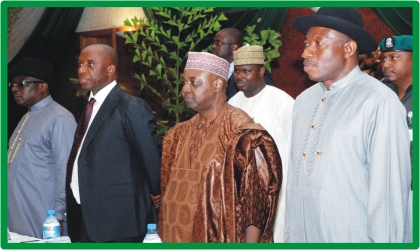
L-R: Chief of Staff to the President, Chief Mike Ogiadohme; Governor Chibuike Amaechi of Rivers State, Vice-President NamaAdi Sambo and President Goodluck Jonathan at the Presidential Sports Sector Retreat in Abuja, on Monday
Total Exploration and Production Company yesterday confirmed the declaration of force majeure on gas supplies to Nigeria Liquefied Natural Gas Limited (NLNG) plant located on Bonny Island, Rivers State.
In a statement in Port Harcourt, the company said that it took the decision after losing oil and gas production from an onshore OML block equivalent to 90,000 bpd of oil, related to the flooding 10 days ago.
The company, which operates in the Egi area of the state, holds around 40 per cent stake in the block.
In a similar development, the Shell Petroleum Development Company (SPDC) has said it does not know when a force majeure on exports from Bonny and Forcados terminals would be lifted.
The development had forced the cut of about 20 per cent of its exports, after a stoppage caused by crude theft and flooding in the Niger Delta, the company said.
Shell had announced the latest suspension of pumping of the crude grades to Forcados on Friday afternoon following flooding affected a third party supply line it did not identify.
Shell had suspended pumping of 150,000 barrels per day to Bonny Terminal in Rivers State on September 30, 2012 following a fire from a crude theft vessel atop its Trans Niger Pipeline.
The action means that the Federal Government has lost about 3.6million barrels of crude for export from Bonny Terminal since the last 24 days, which represents some N7.1trillion in revenue loss to government.
Last Friday, the company also announced suspension of crude lifting from Forcados Terminal, near Warri, Delta State, following severe flooding that has affected its facilities in the state.
In October, both grades accounted for 427,000 barrels per day, about a fifth of Nigeria’s total exports of 2.048 million bpd.
A force majeure allows a company to suspend contractual obligations in the face of unexpected events.
The outages underscore the scale of the problem of oil theft to which officials say up to 20 per cent of its oil is lost.
It would also be the first confirmed evidence of an impact on oil output by the worst flooding Nigeria has experienced in five decades.
The River Niger burst its banks last month, submerging stretches of the oil-rich region in flood waters.
“Shell cannot yet say at this time when the force majeure will be lifted,” Shell spokesman, Precious Okolobo said by telephone, declining to give further details.
Traders said Shell’s Forcados exports had been delayed by about five days.
A spokesman for ExxonMobil said its Quo Iboe Terminal in Akwa Ibom State and other operations had not been affected by flood waters, but fresh warning that imminent flood may hit the state soon means that the terminal faces a threat of shutdown.
Chevron which operates the Escravos field did not immediately comment.
On Monday, SPDC said loadings of Forcados were affected by damage caused by thieves tapping into the Trans Forcados Pipeline and the Brass Creek trunk-line, while the Bonny loadings were hit by a fire on a ship suspected of stealing oil on September 30, and flooding affecting a third party producer.
Shell has since September 30 shut its major TNP oil pipeline and deferred 150,000 bpd of production after oil thieves sparked off an explosion and severe fire on the ship.
Bonny Light is Nigeria’s benchmark crude, used to price other grades of oil, and makes up around 10 per cent of the total oil exported out of Africa’s biggest producer.
A senior politician from Nigeria’s oil-rich Niger Delta, Dele Cole, has, however, launched a campaign against bunkering on Monday, highlighting the international criminal networks involved in the trade, including Balkan criminal groups.
Bunkering causes huge environmental damage in Nigeria, as burst pipelines are often left spewing oil into the Niger Delta’s fragile wetlands.