Front Pix
Those Needless Quarrels …Of IBB,Clark Public Outbursts

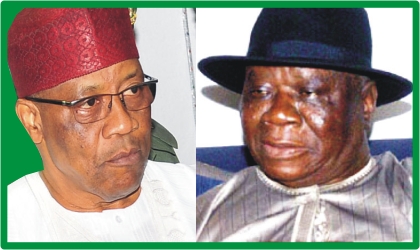
Gen Babangida And Edwin Clark
After reading a joint-statement issued by two former
Presidents, Olusegun Obasanjo and Ibrahim Badamosi Babangida (IBB) on Monday,
July 30, 2012, which among others prescribed the use of clerics as
inter-mediaries in the face-off between Boko Haram and the Federal Government,
I was minded to ask why Now? But both are statesmen and former
Commanders-in-Chief of the Armed Forces of Nigeria and should know better, when
to attack and when to retreat in battle.
Also, by their pedigrees in National politics and leadership
of the army, they are in a better standing than most to analyse government’s
approach to tackling the menace of the Islamist extremist group and proffer
timely advise on form of engagement. More importantly, as influential members
of the Council of State, they enjoy unimpeded access to government and should
wield unimaginable influence in the running of the Nigerian state.
This means, they could, from time to time, advise the
serving President and Commander-in-Chief on alternative ways of addressing the
Iingering insecurity in parts of the North and also help reach out to key
figures, including Islamic clerics and the Christian clergy and preach the need
for tolerance, peaceful co-existence and national unity.
Both Obasanjo and IBB had risked their lives in battle to
defend the Unity of Nigeria so, it would be foolhardy on their part to sit idly
by and watch the systemic destruction of the same values that highlight the
beauty of the country’s diversity: Mutual respect, right to religion, national
Unity, Peace, Justice and indeed an egalitarian society where every citizen or
group enjoys the right of protest in a non-violent manner.
Instead, it should remain a lifelong duty to forge
dependable, potent and enduring common grounds that momentarily remind the
citizenry of the true value of our Unity,
as other former Heads of government do, in other lands. This is why the
content of their well-worded statement on the state of insecurity in the land
came across to me as a viable project of
the patriots, that should not be delegated.
The fulcum of the leaders’ treatise was the need for
dialogue, using clerics as intermediaries to properly engage “all armed
belligerents,” as a means of checking the spate of insecurity in the land, with
the suggestion that a grassroots approach be adopted, if the nation was to make
any headway.
Both leaders decried the increasing loss of human lives, on
account of the terror attacks by the Boko Haram and other criminals and called
on all tiers of government beginning with the 774 local government councils, to
comprehensively engage their communities at the various levels including;
elders, youth organisations, trade unions and associations, women bodies, the
clergy and other community stakeholders.
By its nature, the joint statement is effective but it would
have been more proactively so, if its content had been encapsulated into a
joint-project by the two former Heads of government to complement efforts of
the Federal Government. It would have been most appropriate if that effort had
taken off far far earlier than now, a reason that whittles down its essence as
a face-saving measure or after-thought.
It is true that when the disturbances got to a disturbing
pedestal in Maiduguri, Borno State, former President Olusegun Obasanjo visited
the terror-torn areas and pledged to intervene and did. He visited bereaved
families, empathised with the aggrieved and later called for peace which was
required to properly address the issues. Perhaps, only perhaps, all the
killings would have abated if IBB, considering his influence, had joined
Obasanjo or ventured an independent trip.
Capitalising on that seeming negligence, one-time Minister
of Information and prominent Ijaw-Leader, Chief Edwin Clark threw what IBB
considered a fatal jab on his person and integrity. Clark who was guest
lecturer at a symposium organised by the
Nigerian Institute of Advanced Legal Studies in Abuja, August 1, 2012 had said
that the silence of IBB and former Military Head of State, Major-General
Mohammadu Buhari’s silence on the Boko Haram crisis was not golden and amounted
to tacit support for the group.
“IBB should have spoken on the Boko Haram issue long before
now, why has he been silent all this while? Former President Obasanjo had
visited Maiduguri, why have IBB and
General Buhari not visited the place? “He asked.
Unfortunately, Clark’s opinion was voiced barely a day after
the joint statement by IBB and Obasanjo which inadvertently questioned the
former’s real intent in co-releasing that joint public document. And did an
angry IBB pour his venom on good old Clark.
Babangida in a statement released on his behalf by his media
aide, Kassim Afegbua, described Clark as a loose cannon in public discourse,
who deserves pity, and his views, as not only misguided but senseless. With no
urgent intent to touch the accusation of ‘long silence,’ IBB’s response veered
into self-praise and proper dusting of his military pedigree and love for
Nigeria’s unity.
“The Former President and Commander-in-Chief of the Armed
Forces and civil war hero does not and will not have a hand in anything
untoward against the unity and stability of the Nigerian state.
“Having seen it all in life, and now enjoying his retirement
in Minna, Niger State, General Ibrahim Babangida has paid his dues by serving
fatherland to the best of his ability at various times in the history of the
Nigerian state.
“Having invested so much in the unity and stability of the
country, to the extent of fighting in the civil war to keep the country
together, it is out of place for anyone, least of all an old man of Edwin
Clark’s nomenclature, to input directly or indirectly that the great IBB should
prove his innocence on the Boko Haram menace,” the statement further said,
adding, rather than crucify him (IBB) Clark should advise President Goodluck
Jonathan (his Ijaw kinsman) to undertake more consultations with former
presidents, opinion moulders and leaders of thoughts nationwide to find lasting
and integrated solutions to the nation’s problems. That’s it.
Should it take Clark’s seemingly unsavoury comments on his
person, for IBB to advise Jonathan on the essence of wide consultations? Was
IBB’s silence, as pointed out by Clark, informed by the absence of such
consultation by Jonathan?
As former Head of State doesn’t IBB attend meetings of the Council of State?
Has the security situation never been discussed or such discussions were never
addressed while the patriotic general from Minna was in attendance? If
consultation was an issue, who consulted IBB
and Obasanjo to issue that wonderful joint statement? And more
importantly, had his comfortable Minna-home been touched by the lingering Boko
Haram menace as did other public places and homes of other top government
officials, would IBB require presidential consultation before searching for
solutions?
It is a popular Igbo saying, that one whose house is on fire
does not go chasing rats, which is why I consider it unstatesmanly for
accomplished national leaders like IBB and Clark to be busy chasing rats when
the Nation they claim to love is on fire.
Clark on the one hand did not need the podium of an
anniversary lecture, even if it offers literary privilege, to be as honest as
he could, to challenge IBB to put his vast military experience, high level
patriotism as demonstrated during the civil war and indeed his limitless
knowledge in handling security matters to bear on the Boko Haram menace. On the
other hand, IBB need not see Clark’s position as the right opportunity to
identify lack of adequate consultation with former Heads of State or Presidents
to tinker a way forward as reason for the Iingering insecurity.
Afterall, was it not said that an aged woman does not look
the other way when a pregnant goat delivers in its tethers.
Rather than use the pages of newspapers to chronicle past
heroic exploits or blame one another for the poor state of security in the
land, couldn’t these elder statesmen forge a non-ethnic, non-religious but
purely national front and pursue the engagement of all stake-holders in support
of the Federal Government? Or is it now Jonathan’s government?
It is never too late but late, only when some issues are over-looked much longer
than necessary they risk being late. Such indeed was the time-frame of silence
between when Boko Haram’s senseless killings started nearly two years ago and
when, IBB and Obasanjo finally made a joint statement. On the other hand, if
Clark appreciated both Buhari and IBB’s pedigree and influence in taming the
Boko Haram, why did he not approach both leaders for such intervention, for
love of the country?
My Agony is that the insecurity in the land is being reduced
to a Jonathan’s personal problem that
must be tackled as such. It has, accordingly divided the leadership into those
who like or dislike the serving President.
The sad irony is that what is being ignored based on
considerations founded along pro and anti Jonathan divides will some day,
consume all concerned, hence, the need for all to proffer honest solutions and
not waste ample time on ego trips and name calling. That will not do.
Soye Wilson Jamabo