Front Pix
Another Frogs Debate …Those Calls For, Against State Police

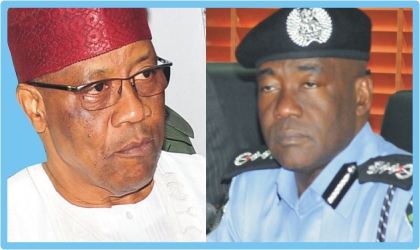
Gen Babangida And IGP,Abubakar
At a time when
well-meaning Nigerians should be worried about the state of insecurity in the
land, no account of the orgy of senseless bloodletting unleashed on the
Nigerian state by the Islamist terrorist group, commonly called Boko Haram, it
is unfortunate that the country’s political class is busy with another round of
debate, one that is not too different from the time-long shouts by frogs and
toads.
A popular Okrika legend has it that all the noise often
heard of frogs and toads in virtually every stagnant pool is over a piece of
yam, thrown at the amphibious creatures by an aged woman, ages ago. The debate
among the beneficiaries thus became either to have the piece of yam roasted
(Foi) or have it cooked (Cho), hence the familiar noise, foi,cho,foi,cho, with
none ready to listen to the other, and with the subject of the debate, left to
decay.
Never tired of debates, which by the way, is a healthy
component of a potent democracy, it is not yet clear if the raging debate over
a State Police or not serves the priority needs of a nation in dire need for
answers to her security questions. None is yet to state clearly, if the absence
of State Police accounts for the known security breaches Nigerians have had to
live with, neither has any convinced us, Nigerians, what wonderful job,
Nigerians will see with the re-introduction of State Police.
In the first and second republics of our political voyage,
when regional police experience was on trial, it left a lot to be desired.
Rather than encourage efficiency and indeed nationalism,
regional police became one of the biggest threats to the nation’s own democracy
and indeed her unity, as each region constituted its Police as a
pseudo-protectionist army against political opponents. Those were days when
Nnamdi Azikiwe could not extend his Presidential campaigns to say, Katsina or
Maiduguri, when Ahmadu Bello could not campaign in Enugu and Obafemi Awolowo
could not go to other parts of the country.
The only known achievement recorded by that experience was
the regionalisation of political parties, which by their nature became a threat
to a united Nigeria. The reason was that the Police became a tool in the hands
of politicians who used them against opponents and perceived threats to the
security of their seats.
However, proponents of the State Police concept, argued that
it was a major component of a Federal system to have both Federal and State
Police side by side, as obtains in other civilised democracies. They argue that
a well-grounded regional police would be better equipped to confront crime as
such criminals would have been well known by their kith and kin.
In practice however, the opposite became true as such
regional police forces became part of the apron strings of the ruling political
class who themselves became untouchables hence, above the law. In same vein,
associates and relations of the power-that-be became the law in themselves, a
trend that threatened, in very profound ways; the rule of law.
Those were days when punishment for a given crime depended
largely on the suspect’s political following while those who challenged the
status quo became regular visitors to the few penitentiaries. Right to public
opinion suffered greatly and opposition to government views and actions, a
crime. The law courts became mere circuit shows and chambers for shameful
hollow rituals designed to protect the mighty and politically well-connected
few against the helpless many.
These experiences informed the preference for a national
police force with state Commissioners of Police operating in synergy with state
security organisations, all under the superintendence of the state governor who
is also the state’s chief security officer. Infact, some states’ governors are
known to have invested handsomely in the Police under that working arrangement
without any known breaches. Where the concerns are of national security
colouration, zonal or federal troops are assigned to complement efforts against
existing challenges.
The beauty of that arrangement was best seen during the
elections in Edo State early this year, when, federal troops and the army
complemented policing in the state. Were the arrangement that in the first and
second republics, the ruling Action Congress of Nigeria (ACN) would not have
even campaigned and simply won the elections, using its own police for the
purpose.
Also, the Peoples Democratic Party (PDP), today governs more
states than any other party. With a State Police, can any political party ever
dream of winning elections as it is today?
Happily, there is a Police
Council in place with the President and Commander-in-Chief as chairman,
the chairman of Police Service Commission as member, and all state governors,
members, so also is the Inspector-General of Police. With such membership
spread, the Council should be able to influence better and more proactive
policing and also take into account the hopes and fears of various states.
Besides, police commissioners are also part of the security councils of the various
states with the governor as chairman and chief security officer.
So, what is the real need for State Police? How many states
can fund a Police in these times of unstable, even, inadequate federal
allocations? Considering the lingering question of new minimum wage
implementation by states of the federation, will an additional, even well
improved wage bill for the Police in such states be realistic? Or are there hidden advantages not easily
discernable by the ordinary Nigerian?
If that is so with the ordinary masses, shouldn’t those who
at various times headed the Police be knowledgeable enough to define the
difference? The Presidential Committee on the Re-organisation of the Nigeria
Police and indeed the forum of former Inspectors-General of Police, only recently
voiced their disapproval for State Police, in addition to identifying
institutional hurdles against effective policing.
In unambiguous terms, both groups of eminent citizens
sounded a big ‘No’ to calls for State Police. The attempt, they warned would be
an invitation to anarchy, a near recall of the sad experiences of the past.
Instead of State Police, the Presidential Committee called
for autonomy for the Nigeria Police and scrapping of the Ministry of Police
Affairs, another avoidable political creation, and instead allow the Police
hierarchy to prioritise its needs and maximise available resources, often
allocated to it by the Federal Government. Presenting its report to President
Goodluck Jonathan last Tuesday, in Aso Rock, Abuja, the Panel’s chairman, Deputy Inspector-General of Police Parry
Osayande (rtd) same day as the former IGP’s meeting with the Presidency, also
kicked against State Police.
Holding that the calls for State Police were not in the
interest of the nation, the former Police chiefs, argued that the most
unreasonable thing for any administration to do at this time was to allow State
Police to exist, stressing that with the current, “political climate in our
country, a State Police would only be a tool in the hands of political leaders
at state levels.”
In its opposition to the calls for State Police, the
Presidential panel on its part feared that the states in their known financial
states cannot fund a full-blown Police, and suggested that the nation’s Police
Council be allowed to function, with a warning that institutionalisation of the
State Police in Nigeria would be a prelude to the disintegration of the
country.
Apart from the legitimisation of small arms proliferation,
such States Police risk transforming into state armies and at each slight
provocation engage in warfare that can spell greater doom to the citizenry.
With each State Police empowered to fight crime, it could spill-over to
cross-border Police and the consequences in times of conflicts can better be
imagined than seen.
These are perhaps why former Military President, Ibrahim
Badamosi Babangida (IBB) roundly condemned the calls for State Police and
instead insisted on proper funding of the Police to discharge its
constitutional duties to the Nigerian state.
That indeed is the point. That the Police has performed
below expectation is a given but reasons for such lacklustre record are varied.
But going by the Presidential Panel’s findings, poor remuneration, inadequate
funding and conflicting loyalties seem the most crucial. For instance, all
extra-Police institutions created out of the Police for specific duties enjoy
better public respect than the regular police. They also earn more in wages.
For example, while the Inspector-General of Police (IGP)
earns a monthly salary of N711,498, his counterpart in the State Security
Service (SSS), the Director-General, earns N1.336 million, a nearly 100 per
cent difference. On the other hand, the chairman of the Economic and Financial
Crimes Commission (EFCC), by far, a junior officer to the IGP earns N1.5
million. How can such officers be expected to bow to the Police high command?
If the Inspector-General can be so ill-treated, what is
expected of other officers and ranks? Where would they source the extra spirit
of statesmanship to go after well-armed criminals, when, even their severance
benefits are not too different from the wages? Or was the Nigeria Police
created to fail? Why are other institutions, created out of the main Police
fairing better in operations and public approval?
These are the questions that ought to engage Nigerians at
these times of serious security challenges. It should not be clamour for State
Police which benefits are subsumed by the milieu of disadvantages it parades.
The argument should be, how better to equip the Police for better policing, and
improved support by states, to the
force.
The states should think more about how to complement regular
policing than owning their own police. Apart from the funding implications,
their poor earnings have hardly provided meaningful dividends of democracy to
their peoples not to mention their inability to implement the New National
Minimum Wage for their various work-forces.
Why are these too difficult to appreciate. What better work
would ill-funded States Police do better than the Nigeria Police? Where do the
states hope to source the extra funds to equip such State Police in these times
of near-total dependence on the ever dwindling federally allocated monthly meal
tickets?
Answers to these questions will reveal how unnecessary calls
for State Police are. And by extension, the rigorous debate on the issue.
My Agony is that many Nigerians forget easily and which is
often why they are forced to witness same historical misadventures in even more
perilous degrees. The horrific thoughts of the early republics do not deserve
such amnesia.
Methinks, the debate for or against State Police, without
necessary facts, needed to help form national opinion, amounts to the shouts of
Foi Cho, Foi Cho understood only by the frogs and toads, and should be
forgotten.
Truth is , there is yet, no better reason for State Police
than the horror it created in first and second republics, and deserve no
recall. Not now.
Soye Wilson Jamabo